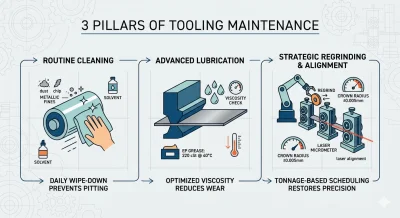
In modern film production, tooling precision directly affects product quality, machine stability, and production efficiency. Whether operating a 2-layer medium-speed bubble film machine, a 5-layer stretch film machine, or a 7-layer high-speed bubble film line, proper roll forming tooling maintenance is essential for maintaining stable output and extending equipment lifespan.
Poor tooling care can lead to profile deformation, unstable film thickness, excessive edge trim waste, increased downtime, and premature component failure. Common causes include abrasive wear, improper lubrication, contamination buildup, and roll stand misalignment. A structured maintenance program helps prevent these issues and improves overall machine performance.
Importance of Roll Forming Tooling Maintenance
Roll forming tooling works continuously under high pressure and high-speed operating conditions. During production, metallic particles, polymer residue, and dust gradually accumulate on tool surfaces. Without regular maintenance, these contaminants accelerate wear and damage tooling accuracy.
Effective tooling maintenance provides several advantages:
- improves film thickness consistency
- reduces surface defects and edge waste
- extends tooling service life
- minimizes unexpected downtime
- maintains forming precision at high production speeds
- supports stable operation for multi-layer film extrusion lines
For high-speed bubble film machines and stretch film production systems, even small tooling deviations can affect final product quality.
Daily Cleaning Procedures
Routine cleaning is the foundation of tooling care. During continuous production, micro-debris from raw materials and processing friction can accumulate on hardened roll surfaces.
Daily cleaning should include:
- wiping tooling surfaces with non-abrasive industrial solvents
- removing polymer residue and metallic fines
- inspecting forming rolls for scratches or surface pitting
- cleaning lubrication channels and cooling areas
Regular cleaning prevents abrasive particles from acting like grinding compounds on tooling surfaces. This helps maintain accurate roll geometry and improves long-term forming stability.
Proper Lubrication for Roll Forming Tooling
Lubrication reduces friction, controls operating temperature, and protects tooling surfaces from premature wear. Selecting the correct lubricant depends on machine speed, production load, and operating temperature.
For medium-speed and high-speed bubble film machines, synthetic extreme-pressure grease is commonly recommended because it provides:
- stable viscosity under continuous operation
- improved load resistance
- lower friction between forming rolls
- reduced bearing wear
- better protection against lubrication breakdown
Lubricants with poor thermal stability can migrate away from contact surfaces, increasing friction and accelerating tooling damage.
Strategic Regrinding and Surface Restoration
Tooling gradually loses dimensional accuracy after long production cycles. Regrinding restores the original crown radius and surface precision of forming rolls.
Instead of following fixed calendar schedules, regrinding intervals should be based on actual production tonnage or linear output.
Benefits of scheduled regrinding include:
- restored roll forming accuracy
- improved bubble thickness consistency
- reduced edge trim waste
- smoother film surface quality
- extended tooling lifespan
For high-speed multi-layer film production lines, maintaining precise tooling tolerances is critical for stable extrusion performance.
Roll Stand Alignment and Precision Control
Misaligned roll stands create uneven forming pressure and dimensional variation. Over time, this can cause unstable film width, inconsistent bubble structure, and excessive tooling stress.
Precision alignment inspections should include:
- laser micrometer measurements
- roll parallelism checks
- bearing condition inspection
- vibration analysis
- torque monitoring
Accurate alignment improves production consistency and reduces mechanical stress across the entire forming system.
Predictive Maintenance for Modern Film Production Lines
Advanced roll forming systems now integrate Industry 4.0 monitoring technologies for predictive maintenance. Sensors installed on roll stands continuously monitor:
- vibration patterns
- bearing temperature
- torque fluctuations
- lubrication performance
- operating load conditions
Real-time monitoring allows operators to identify abnormal conditions before major failures occur. Predictive maintenance reduces downtime, improves equipment reliability, and supports stable long-term operation for high-speed bubble film machines and stretch film production lines.
Benefits of a Structured Tooling Maintenance Program
A professional tooling care program delivers measurable operational improvements across all film extrusion systems.
Key benefits include:
- longer tooling service life
- lower maintenance costs
- reduced machine downtime
- higher first-pass production quality
- improved dimensional stability
- consistent multi-layer film performance
- increased production efficiency
For manufacturers operating 2-layer, 3-layer, 5-layer, 7-layer, or 9-layer film machines, tooling maintenance remains one of the most important factors in achieving stable and efficient production.
Conclusion
Roll forming tooling maintenance is essential for maintaining precision, efficiency, and long-term equipment reliability in modern film manufacturing. Through regular cleaning, proper lubrication, accurate alignment, and scheduled regrinding, manufacturers can significantly improve tooling performance and production stability.
As demand for high-quality multi-layer films continues to grow, advanced tooling care and predictive maintenance technologies will play a critical role in improving production efficiency and maintaining consistent film quality.