Methods to Prevent Wrinkles During Stretch Film Extrusion Machine Production
2026-08-18
In high-speed stretch film manufacturing, preventing wrinkles is one of the most important challenges for achieving consistent film quality, excellent transparency, and superior surface flatness. During the extrusion and winding process, even small variations in tension, temperature distribution, or mechanical alignment can create visible surface defects that affect the final packaging performance. For modern packaging manufacturers, wrinkle-free stretch film production is not only related to appearance but also directly influences material efficiency, machine stability, and customer satisfaction.
Traditional film production systems often face problems caused by unstable tension control, uneven cooling, and inaccurate roller alignment. These issues may result in diagonal wrinkles, edge deformation, film tracking problems, and inconsistent roll quality. As market demand continues to increase for high-performance packaging materials, advanced stretch film extrusion machine technology has become essential for solving these physical and engineering challenges through precise control systems and optimized mechanical designs.
The Importance of Flat and Stable Stretch Film in Modern Packaging Applications
Stretch film plays a critical role in logistics, warehousing, manufacturing, agriculture, and export packaging. High-quality stretch film must provide excellent puncture resistance, stable cling performance, reliable load holding force, and a smooth surface appearance. These properties allow products to be protected during transportation while reducing packaging waste and improving operational efficiency.
For industrial users, film surface quality directly affects packaging performance. Wrinkles or uneven areas can reduce the contact between the film and packaged goods, causing unstable wrapping results and increasing the risk of load movement during transportation. In automatic packaging systems, poor film flatness may also interrupt machine operation and reduce production efficiency.
Because of these requirements, producing premium stretch film requires more than accurate extrusion. The entire production process, including melt distribution, cooling, film stretching, tension control, and winding, must work together as an integrated system. A modern stretch film extrusion machine is designed to maintain stable processing conditions throughout the complete web handling process, helping manufacturers achieve consistent film quality at high production speeds.
Advanced Tension Control System for Wrinkle-Free Film Winding
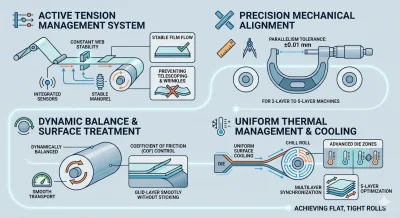
One of the main causes of stretch film wrinkles is unstable tension during the winding process. When film tension changes continuously between the cooling section and the winding shaft, the film web may experience uneven stretching forces, creating surface folds or telescoping problems inside the finished roll.
Advanced stretch film extrusion machine systems use automatic tension management technology to maintain stable web tension from film formation to final winding. Sensors continuously monitor film movement and transmit real-time information to the control system, allowing the winding unit to automatically adjust operating parameters according to production conditions.
Compared with traditional mechanical adjustment methods, automatic tension control provides more accurate control during high-speed operation. It reduces speed fluctuations, prevents uneven film accumulation, and minimizes common winding defects such as telescoping and horizontal wrinkles.
The integration of servo-driven winding systems and intelligent control technology allows manufacturers to produce larger and more stable film rolls while maintaining smooth surface quality. This is especially important for high-speed production lines where even minor tension variations can become more noticeable at higher operating speeds.
Precision Roller Alignment to Eliminate Diagonal Wrinkles
Mechanical alignment is another key factor affecting stretch film flatness. During continuous production, the film passes through multiple rollers, including cooling rollers, guide rollers, and winding rollers. If these rollers are not accurately aligned, uneven forces may appear across the film width, causing diagonal wrinkles and film deviation.
High-quality stretch film extrusion machine designs use precision-machined rollers with strict parallelism control. Proper roller installation and accurate surface processing help maintain consistent film movement throughout the production line. In advanced equipment, roller parallelism can be controlled within very small tolerances to reduce alignment-related defects.
Incorrect roller positioning can also create the so-called banana effect, where the film gradually shifts sideways during production. This not only affects roll appearance but may also reduce material utilization. Through optimized mechanical structures and precise adjustment systems, modern extrusion equipment ensures stable film tracking and smoother web handling.
Dynamic Balance and Surface Friction Control for Stable Film Movement
At high production speeds, even small mechanical vibrations can influence film quality. Unbalanced rollers may create periodic tension changes, resulting in surface marks or wrinkles on the finished stretch film. Therefore, dynamic balancing of rotating components is essential for maintaining stable operation.
A reliable stretch film extrusion machine uses carefully balanced rollers and optimized rotating structures to reduce vibration during continuous running. Stable mechanical movement allows the film to pass through the production line smoothly without unnecessary tension fluctuations.
Surface friction control is equally important. The interaction between film and roller surfaces must be carefully managed to prevent excessive dragging, sticking, or slipping. Proper roller surface treatment helps achieve controlled contact between the film and machine components, ensuring smooth transportation while maintaining excellent film appearance.
By optimizing the coefficient of friction (COF) between the film and rollers, manufacturers can reduce surface damage and improve winding consistency. This technology is particularly valuable for producing thin stretch films where minor surface defects are easier to detect.
Precise Temperature Management and Uniform Cooling Technology
Temperature stability is one of the fundamental requirements for producing high-quality stretch film. During extrusion, uneven melt temperature distribution can cause differences in film thickness, internal stress, and shrinkage behavior. These variations often contribute to wrinkle formation during later stretching and winding processes.
Advanced stretch film extrusion machine systems apply precise temperature control technology throughout the extrusion process. Multi-zone barrel heating, accurate die temperature regulation, and optimized cooling systems help maintain uniform melt conditions from extrusion to film formation.
The T-die plays an important role in achieving consistent film thickness. A well-designed die with precise temperature control ensures even melt flow across the entire film width. This reduces thickness variations and improves overall film stability.
The cooling roller system is also critical for wrinkle prevention. Optimized internal water circulation channels provide uniform cooling across the roller surface, helping the film achieve stable crystallization and consistent mechanical properties. When multiple layers are produced, synchronized cooling and layer distribution further improve film flatness and performance.
Achieving High-Speed Production with Consistent Film Quality
Modern stretch film manufacturers require equipment that can combine productivity with reliability. Advanced stretch film extrusion machine solutions are designed to support high-speed production while maintaining strict quality standards.
Depending on machine configuration, high-performance production lines can achieve line speeds exceeding 200 meters per minute while maintaining stable film thickness and surface quality. With accurate tension control, precision mechanical design, and intelligent temperature management, wrinkle-related defects can be significantly reduced during continuous operation.
For professional film producers, quality control is not only about reducing visible defects. It also involves improving material utilization, reducing production waste, and ensuring that every finished roll meets customer requirements. Stable production technology allows manufacturers to achieve better cost control while delivering premium stretch film products.
Reliable Stretch Film Manufacturing Starts with Advanced Extrusion Machine Technology
Preventing wrinkles in stretch film production requires a complete engineering approach rather than a single improvement. From automatic tension control and precision roller alignment to dynamic balancing and advanced cooling technology, every part of the production system influences final film quality.
Our stretch film extrusion machine solutions integrate these key technologies into complete production systems designed for different market requirements. Whether for standard two-layer stretch film production or advanced multi-layer applications, our equipment focuses on improving stability, efficiency, and long-term production reliability.
By solving the challenges of web handling and film quality control, we help customers achieve smoother operation, lower waste, and more competitive packaging material production. Contact our technical team to explore customized stretch film manufacturing solutions and build a more efficient, reliable, and high-quality film production line for your business.