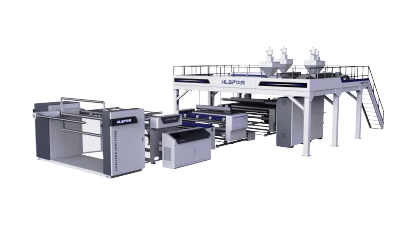
Operating Precautions for 3–5 Layer Medium-Speed Bubble Film Machines in Industrial Production
2026-09-07
Stable, repeatable output is the whole point of investing in a multi-layer bubble film extrusion machine, yet it's also the thing that's hardest to hold onto once a line has been running for a while. A 3–5 layer medium-speed system is a co-extrusion process by nature, which means it only stays consistent when process parameters, mechanical synchronization, and thermal stability are all managed together rather than individually. Skip any one of those three, and the film that comes off the line starts telling on the operator — uneven bubble structure, thickness drift, or bonding that doesn't hold up once the roll leaves the plant.
Why Multi-Layer Bubble Film Production Goes Wrong on Older Lines
Most of the instability traced back to production problems on older equipment comes down to a handful of recurring issues. Process parameter control is often too coarse to catch small drifts before they show up as visible defects, so bubble structure ends up uneven and film thickness fluctuates from one section of a roll to the next. In a multi-layer co-extrusion system specifically, feeding between layers has to stay synchronized — when melt flow rates between layers aren't matched, bonding between layers becomes unreliable and the overall structural integrity of the film suffers. Uneven temperature distribution across the extrusion and die head heating zones compounds this further, since melt flow needs to stay stable for bubble formation to stay consistent. On top of the process side, tension and alignment issues at winding frequently go unmanaged until they show up as wrinkling, edge deviation, or uneven roll formation, and mechanical transmission components like gearboxes wear down faster without a scheduled lubrication and inspection routine — all of which adds up to more downtime and less predictable output.
Where Inconsistent Bubble Film Actually Costs Money
These issues don't affect every application equally — they hit hardest in packaging jobs where the film's job is to protect something delicate, oddly shaped, or highly visible.
In cosmetics and beauty gift box packaging, presentation matters almost as much as protection, and buyers notice inconsistency immediately. Uneven bubble structure from an unstable process shows up as visible defects in the wrap and increases the rate of transit damage on products that are already sold on their finished appearance.
In lighting fixture packaging, precision components and fragile glass or acrylic parts need a bubble layer that holds its cushioning uniformly across the whole surface. Film with inconsistent interlayer bonding is prone to localized collapse under stacking pressure, which leaves exactly the wrong spot on a fixture unprotected.
In outdoor sports equipment packaging, products are often irregular in shape and heavier than standard retail goods. Bubble film with uneven thickness distribution from an inconsistent process leaves thin spots that can't absorb impact the way the rest of the roll can, so protection ends up concentrated where it's needed least and thin where it's needed most.

Standard Operating Precautions for a 3–5 Layer Medium-Speed Bubble Film Extrusion Machine
Consistent output on a 3–5 layer medium-speed bubble film extrusion machine starts before the line ever runs. A full system inspection should be completed prior to startup, covering the stability of mechanical and pneumatic systems, air supply consistency, and confirmation that every heating zone across the extrusion system and die head is holding within its specified temperature range. Extrusion temperature settings vary depending on resin formulation and layer structure, so this isn't a single fixed number to check off — it's a range that needs to be verified for the specific structure running that day, since uniform temperature distribution is what keeps melt flow and bubble formation stable from the first meter of film to the last. This step alone addresses much of the appearance-consistency issue that shows up in cosmetics and beauty packaging, where any visible defect in the wrap is unacceptable.
Material preparation deserves equally close attention. Polyethylene resins need to be properly dried to control moisture content before processing, since moisture-related instability shows up downstream as processing inconsistency that's hard to trace back to its source. In a multi-layer co-extrusion system, feeding between layers has to be balanced and synchronized so that melt flow rates match across layers — inconsistency here is exactly what leads to unstable bonding performance and the localized collapse risk that lighting fixture packaging can't tolerate.
Once production is underway, continuous monitoring of the key process variables keeps the system inside its stable operating window. Melt temperature, extrusion output stability, line speed, bubble inflation pressure, and winding tension all interact with each other, and coordination between them is what actually determines film thickness uniformity and overall product consistency. Real-time parameter tracking throughout the operation cycle is the most reliable way to catch drift before it turns into scrap — this is the layer of control that keeps outdoor sports equipment packaging protected evenly across an irregular surface rather than thin in the spots that matter most.
The bubble forming and air distribution system needs regular inspection to confirm airflow stays uniform and bubble geometry stays stable, since drift here is often the earliest sign of a developing thickness problem. On the winding side, tension and alignment need active control to prevent wrinkling, edge deviation, or uneven roll formation, all of which turn a good run of film into an unusable roll at the very last step of production. Mechanical transmission components, including gearboxes and drive systems, should follow a scheduled lubrication and inspection routine rather than a reactive one, since these are the components most likely to introduce mechanical inconsistency as they wear.
Shutdown deserves the same discipline as startup. The extrusion system and die head should go through a controlled cooling process to avoid thermal stress and material degradation, followed by system purging with appropriate cleaning compounds to prevent residual polymer buildup before the next run begins. Preventive maintenance during this window should include inspection of air distribution components, calibration of sensors, and replacement of wear-prone parts based on accumulated operating hours rather than waiting for a visible failure.
Precision Process Control Built Into the Machine
These precautions work because our 3–5 layer medium-speed bubble film extrusion machines are built to make each one easier to maintain consistently, not harder. Precise heating zone control, synchronized multi-layer feeding, and stable bubble forming and winding systems are engineered into the platform so that operators are managing a process within tight tolerances rather than compensating for a machine that drifts on its own. For cosmetics brands that can't afford visible defects, lighting manufacturers protecting fragile precision parts, or outdoor equipment producers packaging irregular and heavier products, this level of controlled, repeatable production is what turns a bubble film machine from a source of variability into a dependable part of the packaging line. If your current equipment is struggling to hold these parameters consistently, our 3–5 layer medium-speed bubble film extrusion machines are built specifically to close that gap.