High-Permeability Breathable Stretch Film Extrusion Process & Technology
2026-08-14
The growing demand for efficient and reliable packaging solutions has created higher requirements for breathable stretch film production in industries such as fresh food logistics, cold chain transportation, agricultural products, and industrial packaging. During long-distance transportation and storage, moisture accumulation and condensation inside wrapped pallets can affect product quality and packaging stability. Our advanced stretch film extrusion machine is designed to address these challenges by providing precise extrusion control, stable material processing, and accurate film structure management for high-permeability breathable stretch film production.
Equipped with advanced cast extrusion technology, multi-layer co-extrusion capabilities, and intelligent control systems, our machine helps produce breathable stretch film with consistent thickness, excellent stretching performance, and reliable load retention. By optimizing layer distribution, temperature control, and film processing stability, our equipment enables customers to manufacture high-quality breathable stretch film that improves moisture management while maintaining strong pallet protection performance.
Challenges of Traditional Stretch Film Packaging
Traditional stretch film is widely used for pallet wrapping because of its excellent transparency, stretchability, and load retention properties. However, conventional packaging structures may have limitations when used in applications where moisture management and ventilation are important.
In cold chain logistics, temperature differences between storage facilities, transportation vehicles, and outdoor environments can create condensation inside wrapped pallets. When moisture cannot escape effectively, it may accumulate around the packaged products and negatively affect product appearance, storage conditions, and overall packaging performance.
Another challenge is maintaining pallet stability while improving ventilation. Simply increasing airflow through packaging materials can reduce mechanical strength if the film structure is not properly designed. Manufacturers need a solution that balances permeability, tensile strength, puncture resistance, and load-holding capability.
At the same time, industries are looking for ways to reduce secondary packaging materials. Additional moisture-absorbing layers, protective covers, or complex packaging procedures can increase labor costs and material consumption. High-performance breathable stretch film provides an opportunity to simplify packaging operations while maintaining reliable protection.
The Importance of Breathable Stretch Film in Modern Packaging
Breathable stretch film has become an important solution for applications that require controlled air exchange and stable pallet protection. Unlike conventional wrapping materials, breathable film is designed to improve moisture management while maintaining the advantages of stretch packaging.
Through optimized material formulations, functional layer structures, and controlled film processing technology, breathable stretch film can provide better ventilation performance. This helps reduce moisture accumulation inside wrapped loads and supports more stable packaging conditions during transportation and storage.
In industries such as fresh produce, flowers, beverages, and temperature-sensitive goods, effective air circulation can help maintain product quality throughout the supply chain. In industrial applications, breathable stretch film can also provide a practical packaging solution where humidity control and load stability are both important.
Another key advantage is packaging efficiency. By using advanced multi-layer film structures, manufacturers can improve film performance without significantly increasing material consumption. Functional layers can be designed to provide specific properties, such as enhanced stretchability, puncture resistance, and controlled permeability.
How Stretch Film Extrusion Machine Enables High-Performance Breathable Film Production
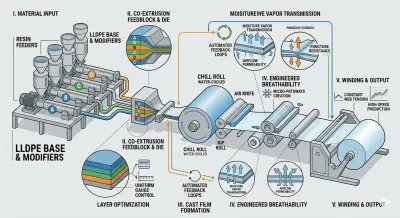
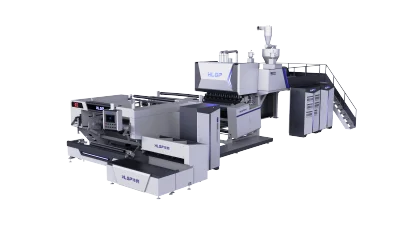
The production of breathable stretch film requires advanced extrusion technology capable of maintaining precise control over polymer processing, layer distribution, and film quality. A modern stretch film extrusion machine is designed with optimized mechanical structures and intelligent control systems to support stable continuous production.
Advanced Multi-Layer Cast Extrusion Technology
High-quality breathable stretch film is mainly produced through cast extrusion technology, which provides excellent thickness uniformity, transparency, and stretching performance. Compared with traditional film production methods, cast extrusion offers precise control over melt distribution and cooling conditions, making it suitable for high-performance stretch film manufacturing.
Modern multi-layer configurations allow manufacturers to combine different resin materials and functional layers according to specific application requirements. Two-layer, three-layer, and five-layer stretch film extrusion systems provide flexible production options for different markets.
Two-layer systems are suitable for standard breathable stretch film production where cost efficiency and stable performance are important. Three-layer configurations provide additional flexibility by separating functional layers, allowing manufacturers to optimize surface performance and core strength. Five-layer co-extrusion systems are designed for more demanding applications that require improved mechanical properties, better material utilization, and advanced film structures.
By combining LLDPE, mLLDPE, and other suitable polymer materials, manufacturers can produce stretch film with excellent elasticity, puncture resistance, and load retention performance.
Precise Temperature Control for Stable Film Quality
Temperature management is one of the most important factors affecting stretch film quality. During extrusion, unstable temperature conditions can influence melt flow, layer distribution, and final film performance.
An advanced stretch film extrusion machine uses precise heating and cooling control systems to maintain stable processing conditions throughout the extrusion process. Closed-loop temperature control technology helps reduce temperature fluctuations and improves melt consistency.
Stable temperature management also supports uniform film thickness and reduces material waste caused by production variation. For breathable stretch film applications, consistent processing conditions are especially important because permeability performance depends on stable film structure and reliable layer distribution.
Intelligent Thickness and Tension Control System
Breathable stretch film requires consistent thickness control to ensure stable mechanical performance and reliable packaging results. Uneven thickness can affect stretching behavior, puncture resistance, and load retention during pallet wrapping.
Modern extrusion lines integrate online thickness monitoring and automatic feedback adjustment systems to improve film uniformity. Advanced control technology helps maintain stable thickness performance, commonly achieving industrial-level thickness consistency within approximately ±3% depending on material formulation and production conditions.
The tension control and winding system also play an important role in final film quality. Precise tension adjustment prevents uneven stretching during winding and ensures smooth, high-quality finished rolls. This improves storage stability and reduces problems during transportation and customer usage.
Benefits of Producing Breathable Stretch Film with Advanced Extrusion Technology
Investing in an advanced stretch film extrusion machine provides manufacturers with multiple production advantages. The combination of precise extrusion control, multi-layer technology, and intelligent automation helps improve product consistency while reducing unnecessary production losses.
Energy efficiency is another important benefit. Optimized screw design, efficient heating systems, and stable process control reduce unnecessary energy consumption during continuous operation. Lower energy usage helps manufacturers control operating costs and improve production sustainability.
Advanced extrusion technology also provides greater product flexibility. Manufacturers can adjust layer structures, resin combinations, and film specifications according to different customer requirements. This allows companies to serve a wider range of applications, including food packaging, cold chain logistics, agricultural packaging, and industrial pallet wrapping.
In addition, stable film quality improves customer satisfaction. Consistent stretch performance, reliable load retention, and controlled permeability help end users achieve better packaging results with fewer material adjustments.
Future Development Trends of Breathable Stretch Film Production
As global packaging industries continue to focus on sustainability and efficiency, breathable stretch film technology will continue to develop. Manufacturers are increasingly adopting lightweight film structures, recycled material solutions, and energy-efficient production processes.
Future stretch film production will require equipment with higher automation levels, better process monitoring, and greater flexibility. Intelligent extrusion systems will help manufacturers optimize production parameters, reduce waste, and maintain consistent quality during long-term operation.
For companies entering high-value packaging markets, choosing the right production equipment is essential. A reliable extrusion system not only determines film quality but also directly influences production efficiency and long-term competitiveness.
Advanced Stretch Film Extrusion Machine for High-Performance Breathable Film Production
The development of high-permeability breathable stretch film represents an important direction in modern packaging technology. By balancing air exchange capability with mechanical strength, breathable film provides an effective solution for industries requiring moisture control, transportation protection, and efficient packaging operations.
Our stretch film extrusion machine is designed with advanced cast extrusion technology, multi-layer co-extrusion capabilities, precise temperature control, and intelligent automation systems to support the production of high-quality breathable stretch film. With flexible two-layer, three-layer, and five-layer configurations, our equipment helps manufacturers achieve stable production, optimized material utilization, and consistent film performance. By providing reliable and efficient extrusion solutions, we help customers improve packaging quality, reduce production challenges, and develop competitive breathable stretch film products for growing global markets.