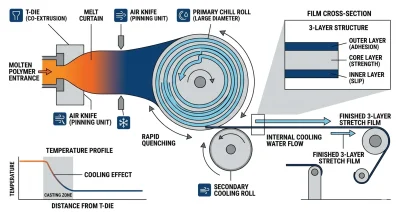
In the technical architecture of a stretch film making machine, the casting and cooling process is the critical juncture where molten polymer transforms into a high-performance packaging substrate. This stage dictates the film's crystallinity, optical properties, and mechanical integrity.
Precision Casting: The Foundation of Film Morphology
The process begins as the co-extruded melt exits the T-die. In a high-end stretch film making machine, the "melt bank" is precision-cast onto a large-diameter, chrome-plated cooling roller.
- Rapid Thermal Transfer: The use of large-diameter rollers increases the contact surface area, enabling instantaneous heat extraction from the molten web.
- Molecular Orientation: This rapid quenching "freezes" the polymer chains before they can form large spherulites, ensuring the film remains amorphous and highly transparent.
- Internal Stress Management: Controlled casting prevents the formation of internal stress points, creating a balanced 3-layer structure ready for high-ratio stretching.
- Critical Cooling Dynamics for Gauge Control
The efficiency of the casting and cooling process is the primary factor in achieving a thickness uniformity of ±1.5μm. - Homogeneous Temperature Distribution: Advanced internal spiral flow designs within the cooling rollers ensure the surface temperature remains uniform across the entire width.
- Eliminating Thermal Fluctuations: By preventing "hot spots" on the roller surface, the system eliminates gauge variations, ensuring the stretch film making machine produces a consistent, flat profile.
- Stabilized Pinning: Whether using air knives or electrostatic pinning, the cooling process is synchronized to ensure the film adheres perfectly to the roller, preventing air entrapment and surface defects.
- Impact on Final Mechanical Specifications
A technically superior casting and cooling process directly translates into measurable film performance: - Enhanced Tensile Memory: Precise thermal setting allows the film to achieve up to 300% pre-stretch while maintaining powerful elastic recovery.
- Optimized Puncture Resistance: Uniform cooling creates a consistent molecular density, removing the "weak links" that lead to film breakage during high-speed wrapping.
- Optical Excellence: By mastering the crystallization phase, the process eliminates haze, providing the high-gloss finish essential for professional packaging.
- Technical Adaptation for Next-Gen Materials
The stretch film making machine must be capable of processing diverse resins. Our cooling technology is engineered for: - LLDPE/LDPE Blends: Specialized cooling curves for metallocene-based resins.
- Sustainable Feedstocks: Maintaining process stability when using recycled or bio-based resins, which often have sensitive thermal windows.
- High-Speed Stability: Maintaining cooling efficiency even as line speeds increase, ensuring consistent output without quality degradation.
- Summary
The casting and cooling process is not merely a stage of production; it is the definitive factor in film quality. By integrating precision thermal management into every stretch film making machine, we ensure the production of stretch films that meet the most rigorous industrial standards for clarity, strength, and uniformity.