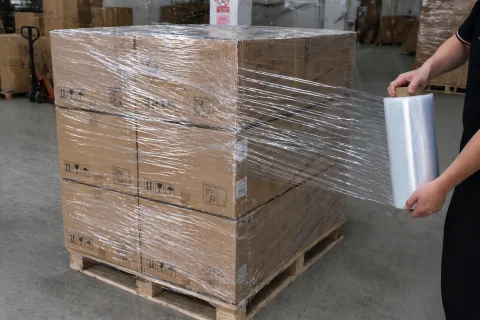
In modern logistics and industrial packaging, carton products require reliable protection throughout storage, handling, and long-distance transportation. Corrugated cartons are widely used for food, electronics, household products, and industrial goods because of their lightweight structure and excellent stacking performance. However, when multiple cartons are combined into palletized loads, additional reinforcement is required to prevent shifting, damage, and instability during transportation.
Stretch film plays an essential role in maintaining pallet integrity by providing load containment, surface protection, and improved handling efficiency. For packaging manufacturers and film producers, producing stable and high-performance stretch film requires advanced extrusion technology. A 2-layer stretch film manufacturing machine provides an efficient solution by producing co-extruded LLDPE stretch film with different functional layers designed for improved cling performance, tensile strength, and processing flexibility.
Packaging Challenges in Carton-Based Logistics Applications
During transportation, palletized carton loads experience various external forces, including vibration, acceleration, braking, stacking pressure, and changes in temperature and humidity. These conditions can gradually reduce load stability if the stretch film does not provide sufficient holding force and elasticity.
One common challenge is load movement caused by insufficient containment force. When cartons shift during transportation, the wrapping film must maintain continuous tension and recover from deformation. Low-quality films with poor elastic memory may gradually lose their holding force, increasing the risk of unstable pallets and damaged cartons.
Another important consideration is the balance between wrapping force and carton protection. Excessive tension applied during wrapping can create concentrated pressure points, especially around sharp carton edges. If the film has poor puncture resistance or excessive neck-down during stretching, it may damage carton corners or reduce the overall protection effect.
Environmental conditions also influence carton performance. Corrugated cardboard can absorb moisture from humid environments, which may reduce its compression strength over time. Properly applied stretch film creates a protective outer layer that helps reduce exposure to moisture, dust, and external contamination during storage and transportation.
Advantages of 2-Layer Co-Extruded Stretch Film for Carton Packaging
A 2-layer co-extruded stretch film is designed by combining different material properties into separate functional layers. Compared with single-layer films, this structure allows manufacturers to optimize cling performance, mechanical strength, and surface characteristics according to specific packaging requirements.
The inner layer is mainly responsible for adhesion and load fixation. By using suitable LLDPE formulations and tackifier components, the inner surface provides reliable cling performance when contacting carton surfaces. This helps reduce movement between cartons and improves pallet stability during transportation.
The outer layer focuses on strength, durability, and smooth handling performance. A properly designed outer layer provides better resistance against punctures caused by carton edges or pallet surfaces while maintaining a low-cling surface that prevents wrapped pallets from sticking together during storage and handling.
The combination of these two functional layers improves overall film performance. The film can maintain stable tensile properties while providing sufficient elasticity for automatic wrapping applications. With proper production control, 2-layer stretch film can achieve consistent thickness distribution, reliable stretching performance, and reduced material waste.
Improving Material Efficiency with Advanced Stretch Film Production
For large-scale packaging operations, material efficiency has become an important factor in reducing operating costs and meeting sustainability targets. High-quality stretch film allows manufacturers to achieve required load stability with optimized film thickness and controlled stretching performance.
A well-designed stretch film manufacturing machine enables precise control of film thickness, layer ratio, and melt distribution. Stable extrusion conditions help ensure that each roll maintains consistent mechanical properties, reducing film breaks and production variations during packaging operations.
Modern automatic wrapping systems require film with reliable tensile strength and uniform elongation characteristics. When the film quality is consistent, packaging lines can operate more efficiently with fewer interruptions caused by tearing, unstable stretching, or inconsistent roll performance.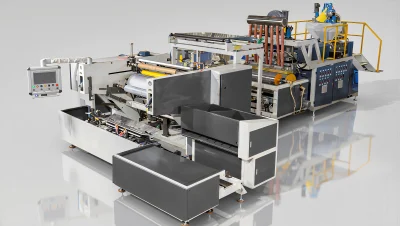
Key Production Technologies of 2-Layer Stretch Film Manufacturing Machine
The performance of 2-layer stretch film depends not only on resin selection but also on the precision of the extrusion equipment. A professional stretch film manufacturing machine integrates advanced extrusion technology to achieve stable and efficient film production.
The dual-extruder configuration allows different LLDPE materials to be processed separately according to their specific functions. Through precise melt flow control and layer distribution technology, the machine ensures that each layer maintains the designed thickness ratio and performance characteristics.
The T-die system is another critical component affecting film quality. A precision-designed die head provides uniform melt distribution across the film width, helping manufacturers achieve consistent thickness and stable mechanical properties. Accurate temperature control throughout the extrusion process also reduces material fluctuations and improves production reliability.
Cooling performance directly affects film clarity, strength, and surface quality. The machine uses a high-efficiency cooling system with a precision chill roll to quickly stabilize the molten polymer after extrusion. Effective cooling control improves dimensional stability and supports continuous high-speed production.
The winding system also plays an important role in finished roll quality. Advanced tension control technology ensures that film rolls are wound evenly without excessive tightness or loose edges. This improves storage stability and ensures smooth operation when the film is used on automatic pallet wrapping equipment.
Supporting Different Carton Packaging Requirements
Different industries have different requirements for stretch film performance. Food packaging suppliers may require stable wrapping performance and clean film appearance. Electronics manufacturers often focus on dust protection and secure transportation. Industrial goods suppliers may need stronger puncture resistance for heavier carton loads.
A flexible 2-layer stretch film manufacturing machine allows manufacturers to adjust production parameters according to application requirements. By optimizing resin combinations, layer ratios, thickness settings, and production speed, producers can develop films suitable for various carton packaging environments.
This flexibility helps film manufacturers respond to changing market demands while improving production efficiency and product consistency.
Reliable Stretch Film Manufacturing Machine for Industrial Film Production
Producing high-quality 2-layer stretch film requires the combination of suitable raw materials, precise process control, and reliable extrusion equipment. A well-engineered stretch film manufacturing machine provides manufacturers with stable production performance, accurate layer control, and efficient operation for large-scale film production.
Our stretch film manufacturing machine is designed with advanced co-extrusion technology, precision T-die systems, efficient cooling units, and automated winding solutions to support the production of high-quality LLDPE stretch film. The equipment is developed to help customers improve film consistency, reduce production waste, and meet the requirements of modern carton packaging applications.
By investing in professional stretch film production equipment, manufacturers can enhance their product competitiveness, expand application possibilities, and provide reliable packaging solutions for global logistics and industrial markets. Contact our engineering team to discuss suitable machine configurations and develop a stretch film production solution based on your specific requirements.