How to Solve Static Electricity Problems in Stretch Film Production
2026-08-12
Static electricity is one of the most persistent technical issues in stretch film production, and it tends to get worse rather than better as production speeds increase. On high-speed multi-layer extrusion lines and automatic winding systems, static buildup shows up as film sticking, uneven rewinding, edge tearing, dust attraction, and in dry environments, even spark discharge. These are not cosmetic problems — they directly undermine production stability and finished film quality, which is why a properly engineered stretch film extrusion machine needs a genuine anti-static system built into its design rather than treated as an afterthought.
Why Static Buildup Is a Serious Production Problem
The first place static charge causes damage is at the point of film formation and winding itself. As film passes through high-speed extrusion, stretching, and rewinding stages, friction between the film surface and rollers generates electrostatic charge that has nowhere to dissipate on an ungrounded or poorly designed line. That charge causes adjacent film layers to cling to each other unpredictably, making clean film release difficult and disrupting the smooth unwind that automatic wrapping and packaging equipment depends on. The winding process itself suffers as a direct consequence: charged film tends to wind unevenly, producing loose or telescoping rolls that are harder to handle downstream and that can shift or collapse during transport and storage. Static charge also affects the finished product's surface quality in a very visible way — charged film acts like a magnet for airborne dust and particulate, and any contamination trapped against the film surface during winding becomes a visible defect that reduces the roll's commercial value, particularly for buyers who require a clean, transparent finish. Beyond quality and handling issues, there is a genuine safety dimension: in low-humidity production environments, especially during winter months or in climates with naturally dry air, accumulated static charge can reach levels sufficient to produce a visible spark discharge, which is a real ignition risk in a facility handling polymer film and packaging materials. Taken together, these effects compound over a production run — static-related defects that start as a minor winding irregularity early in a shift often escalate into line stoppages, film breaks, and rejected rolls by the end of it, so what looks like a small technical nuisance actually erodes both output volume and product consistency across a full production cycle.
The Role of Static Control in Reliable Stretch Film Production
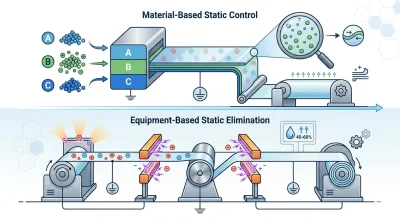
Solving this problem effectively requires attacking static generation from multiple directions rather than relying on a single fix, because charge builds up at several different points in the production process for different physical reasons. On the material side, antistatic masterbatch added during extrusion works by modifying the film's surface resistivity, typically bringing it down into a range where surface charge can dissipate naturally rather than accumulate — well-formulated antistatic masterbatches can reduce surface resistivity to roughly 10⁹ to 10¹¹ ohms per square, compared to the 10¹³ ohm-per-square range typical of untreated polyolefin film, which is enough to meaningfully improve film release and winding behavior across both semi-automatic and fully automatic systems. On the equipment side, ionizing bars address the charge that still forms mechanically at friction points regardless of resin formulation. Installed at key locations such as the unwind station, dancer rollers, and the winding station itself, ionizing bars generate a balanced field of positive and negative ions that neutralize static charge on contact with the film surface, and because they act directly at the point of charge generation rather than relying on the film's own conductivity, they remain effective even at the highest line speeds where friction-generated static is most intense. Grounding and mechanical design form the third layer of control: every conductive component in the film path — rollers, shafts, and winding units — needs to be properly and continuously grounded, because even a well-neutralized charge can re-accumulate if it has no path to safely discharge, and a machine frame with gaps in its grounding continuity effectively creates isolated static traps. Environmental humidity control rounds out the system: maintaining workshop humidity above roughly 40% relative humidity improves the conductivity of the surrounding air itself, giving static charge a natural path to dissipate before it builds to a problematic level, which is why converters running production in dry climates or during winter heating season often see static-related defects spike unless humidity is actively managed.
How a Well-Engineered Stretch Film Extrusion Machine Integrates Static Control
| Technology | Function | Production Benefits |
|---|---|---|
| Masterbatch Dosing | Adds antistatic additives accurately into film layers | Stable surface resistivity |
| Ionizing Bar | Neutralizes static charges during film movement | Reduces dust and film sticking |
| Grounding System | Provides a continuous discharge path | Prevents charge accumulation |
| Humidity Control | Reduces static caused by dry conditions | Improves film handling stability |
| Integrated Design | Combines multiple static control methods | Fewer film breaks and rejected rolls |
None of these four measures — masterbatch dosing, ionization, grounding, and humidity management — fully solves the static problem on its own, which is why the equipment itself needs to be designed to support all of them working together. A properly engineered stretch film extrusion machine includes a precision dosing system that allows antistatic additives to be metered consistently into each layer during multi-layer co-extrusion, so the resulting film carries stable, predictable surface resistivity from the first meter of a run to the last rather than drifting as additive concentration varies. Ionizing bar systems are increasingly built as optional or fully integrated components across 2-layer, 3-layer, and 5-layer stretch film production lines, positioned at the friction points where static generation is most concentrated so that charge is neutralized continuously during high-speed operation rather than only addressed after the fact. Grounding is engineered into the machine's mechanical structure from the outset — rollers, shaft assemblies, and winding units are connected through a continuous, low-resistance grounding path, closing off the discharge pathways that would otherwise allow charge to accumulate on isolated metal components. When these elements are combined into a single integrated architecture, the practical result is a production line that holds stable extrusion behavior, consistent film release, and precise winding tension even during extended high-speed runs, with a measurable drop in static-related film breaks, contamination, and rejected rolls compared to lines relying on only one or two of these measures.
What Integrated Static Control Delivers for Producers
For a converter running a modern production line, the value of integrated static control shows up directly on the production floor rather than as an abstract technical improvement. Fewer static-related film breaks mean less unplanned downtime and less operator intervention during a shift, which translates into higher effective output from the same equipment and labor hours. More consistent winding quality reduces the rate of rejected or downgraded rolls, protecting margin on every batch rather than only the ones produced under ideal humidity conditions. And because static-related defects tend to worsen as line speed increases, a machine engineered with genuine static control from the design stage is what allows a producer to actually run at its rated high-speed capacity year-round, rather than being forced to slow down production during dry winter months just to hold film quality steady.
Choosing a Stretch Film Extrusion Machine Built for Static Reliability
Static electricity may look like a minor operational detail, but in high-speed stretch film production it is directly tied to line uptime, film quality, and workplace safety, which makes it a factor that belongs in the equipment specification stage rather than something addressed after problems appear on the floor. Our stretch film extrusion machines are engineered with this in mind, combining precision antistatic masterbatch dosing, integrated ionizing bar systems, comprehensive machine grounding, and design support for humidity-stable operation across our 2-layer, 3-layer, and 5-layer production lines. If your current line is losing output to static-related defects, or you are specifying a new stretch film extrusion machine and want static control built in from the start, contact our engineering team to discuss configuration options, request technical specifications, or arrange a production line consultation tailored to your facility's environment and output requirements.