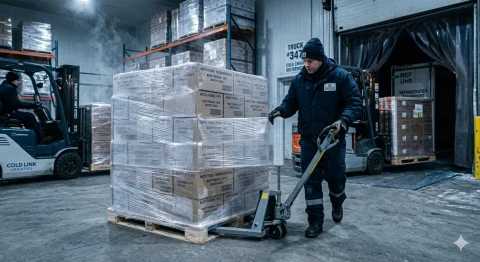
Cold chain logistics places a demand on packaging that most other supply chains never encounter: the film itself has to keep working while the product it protects is frozen solid. Frozen seafood, poultry, and meat are typically stored and shipped at -18°C or below, and at that temperature standard stretch film starts to fail in ways that room-temperature packaging never reveals. Pallets that were tightly wrapped at the loading dock arrive at the cold store with loose corners, torn film, and shifted cartons — not because the wrapping was done poorly, but because the film itself was never engineered for sustained sub-zero performance. This is the gap that a purpose-built stretch film manufacturing machine is designed to close.
Why Standard Stretch Film Fails in Cold Chain Conditions
The first and most immediate problem is cold-induced brittleness. General-purpose mono-layer or basic multi-layer film relies on resin systems optimized for ambient handling, and when that same film is exposed to freezer temperatures its flexibility drops sharply — a condition known in the industry as cold cracking. On an automated wrapping line, a film that has lost its flexibility tends to snap under tension rather than stretch, which not only stops production but also means the film can no longer deliver the containment force the pallet needs. A second problem is tack loss: the adhesive cling that holds each wrap layer against the one beneath it weakens as temperature drops, so even film that survives the wrapping process without tearing may fail to stay bonded to itself, leaving pallets that loosen progressively as they move through cold storage and long-distance transport. On top of the temperature issue, frozen and chilled goods are frequently heavy, dense, and irregularly shaped — cartons of frozen fish, poultry crates, boxed meat — which demands higher tensile strength and stronger holding force than lighter ambient-temperature goods, while the constant vibration and handling shocks of long-haul transport put additional strain on already-compromised film. Frost and condensation inside cold storage further weaken corrugated secondary packaging over time, meaning the stretch film has to compensate by forming a tighter, more moisture-resistant barrier than it would need to in a dry warehouse. Faced with all of this, many cold chain operators have historically tried to solve the problem by simply using thicker film, but added gauge increases material cost and film consumption without actually solving the underlying resin performance problem — what the industry needs instead is a genuinely engineered multi-layer film, not just more of an inadequate one.
The Role of Stretch Film in Protecting Cold Chain Cargo
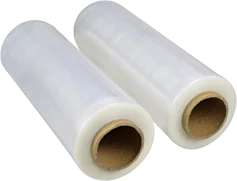
Properly engineered stretch film performs three distinct jobs simultaneously in a cold chain application, and each one matters for a different reason. First, it has to remain flexible and workable through the full temperature range the product will experience, from ambient wrapping conditions down to deep-freeze storage, so that the film's elastic recovery and adhesive cling stay functional rather than degrading the moment the pallet enters the cold store. Second, it has to hold the load together mechanically — sustained clamping force keeps stacked cartons of frozen seafood, poultry, or boxed meat from tilting, collapsing, or shifting relative to one another as the pallet is handled and transported, and this holding force needs to accommodate the irregular shapes and uneven stacking that frozen product cartons often present. Third, it functions as a moisture barrier: a tightly sealed multi-layer wrap limits how much ambient humidity reaches the load, which reduces the frost buildup that otherwise accumulates on cartons in freezer storage and weakens the corrugated packaging underneath over time. Together, these three functions extend how long a palletized load stays structurally intact and properly sealed across storage, cross-dock handling, and final-mile cold transport.
How a 5-Layer Stretch Film Manufacturing Machine Solves the Cold Chain Problem
Delivering low-temperature flexibility, high tensile strength, strong cling, and puncture resistance all in a single film is not realistically achievable with a mono-layer or basic three-layer structure — it requires true five-layer co-extrusion. On a 5-layer stretch film manufacturing machine, production typically runs on an A-B-C-B-A structure, in which each layer group is extruded through independently controlled dies and fused into a single web. The outer skin layers are formulated for abrasion and puncture resistance, protecting the film against carton edges and rough handling during cold storage cycling; the inner layer carries a high-tack resin blend so the wrap self-adheres securely even as temperatures drop; and the core layers are built around cold-flexible resin systems such as mLLDPE and LLDPE blends, chosen specifically for the low-temperature toughness and elastic recovery that keep the film from cracking or losing its grip in freezer conditions. Because each extruder feeds its layer independently, producers can fine-tune the ratio and resin selection in every layer to hit a target performance profile — commonly a finished gauge in the 17 to 23 micron range with prestretch capability in the 150 to 300% range — rather than compensating for weak resin performance with unnecessary added thickness. Precision T-die tooling and automatic thickness gauging keep gauge variation tight across the width of the roll, while stable melt temperature and chill-roll cooling control ensure that the film's low-temperature performance is consistent from batch to batch, which matters enormously to buyers who need every roll to perform the same way at -18°C, not just the sample that was tested in the lab.
Commercial Value for Cold Chain Packaging Producers
For film converters and packaging suppliers serving frozen food, seafood, and pharmaceutical cold chain customers, the ability to produce genuinely cold-resistant film on a well-controlled five-layer line is a direct competitive advantage. Because the core layer's cold-flexible resin system reduces gauge requirements without sacrificing strength, producers can offer customers a thinner, more material-efficient film that still holds up through the full freezer-to-transport cycle, lowering the customer's per-pallet packaging cost. Consistent low-temperature cling and puncture resistance also reduce the film breaks and re-wraps that plague cold storage operations running high-volume automatic wrapping equipment, which translates into fewer line stoppages and steadier throughput for the end customer. As global cold chain volumes continue to grow across frozen food export, seafood processing, and pharmaceutical logistics, packaging buyers are increasingly specifying film by its actual low-temperature and tensile performance data rather than by gauge alone — and producers running the right co-extrusion equipment are the ones positioned to win that business.
Building the Right Cold Chain Film Production Line
If your production line needs to move beyond general-purpose stretch film into genuine cold-chain-grade packaging, the starting point is the co-extrusion equipment itself. Our five-layer stretch film manufacturing machine is engineered with precise A-B-C-B-A layer control, stable multi-stream extrusion, and cold-flexible resin compatibility, giving producers the tools to manufacture film that holds its strength, cling, and clarity from ambient loading dock temperatures down to deep-freeze storage. Whether you are upgrading an existing line to serve frozen food and seafood exporters or building new capacity to enter the cold chain packaging market, our engineering team can help configure machine settings, layer ratios, and resin structure around your target film specification. Contact us today to request equipment details, arrange low-temperature film performance testing, or discuss a production line proposal built for your cold chain customers' requirements.