Modern logistics and industrial packaging place increasing demands on stretch film performance. Pallet loads must remain stable during handling and transit, while manufacturers need to control resin consumption and maintain consistent film quality. Conventional single-layer structures can make it difficult to balance cling, elongation, tensile strength, and puncture resistance in one film. A multi-layer co-extrusion system provides a more flexible solution by allowing different materials and layer ratios to be controlled independently. In a 5-layer stretch film making machine, this technology helps manufacturers optimize film structure while maintaining stable and efficient production.
Challenges in Conventional Stretch Film Production
Stretch film is often expected to provide several properties at the same time. It needs sufficient tensile strength to secure pallet loads, adequate elongation for efficient wrapping, good puncture resistance for irregular loads, and controlled cling for reliable load containment. Achieving all of these properties through a single material layer can limit formulation flexibility.
One common approach is to increase overall film gauge when higher strength is required. However, using more material is not always the most efficient solution. For high-volume pallet packaging, even a small increase in film gauge can increase resin consumption and packaging weight. Manufacturers therefore need better control over how resins are distributed within the film structure.
Production consistency is another challenge. Different polyethylene resins can have different processing characteristics, so stable temperature control, melt flow, extrusion output, and die distribution are essential. If these parameters fluctuate, the resulting film may show gauge variation or inconsistent mechanical performance.
The key requirement is a production system that can process different resins simultaneously, control each extrusion stream independently, and form a stable multilayer film structure.
The Role of Stretch Film in Logistics and Industrial Packaging
Stretch film is widely used for pallet stabilization, warehouse handling, transit packaging, and load protection. In transit, pallets can experience vibration, acceleration, impact, and repeated handling. Properly formulated stretch film helps keep cartons and products together, reducing unwanted movement within the load.
The film also creates a physical barrier against dust, moisture, and surface abrasion. Its optical clarity allows operators to identify products, labels, and barcodes without removing the packaging.
As packaging requirements become more specialized, different applications may require different combinations of cling, flexibility, strength, and puncture resistance. This is one reason why multi-layer stretch film production gives manufacturers precise control over finished-film performance.
Independent Extrusion Control for Multi-Layer Film
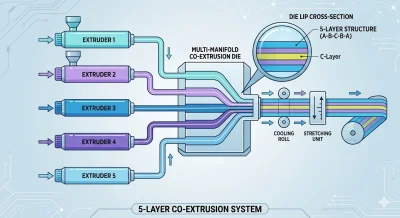
The multi-layer co-extrusion system is the core of a 5-layer stretch film making machine. Instead of relying on one extrusion unit to provide every film property, the system uses multiple independent extruders to process different resins streams.
For a typical five-layer cast stretch film line, five extrusion units can be configured according to the required film formulation. Resins such as LLDPE, LDPE, and mLLDPE can be selected and distributed according to the performance requirements of each layer. Commercial five-layer stretch film lines commonly use multiple extruders with different output capacities, allowing the layer ratio to be adjusted according to the target formulation and film specification.
Each extrusion unit can be controlled independently for key parameters such as temperature, screw speed, and output. This independent control is important because the optimum processing conditions may vary between materials. Maintaining stable melt conditions before the individual streams enter the co-extrusion section helps improve the consistency of the final multilayer structure.
This approach also gives manufacturers greater formulation flexibility. Rather than requiring every layer to use the same resin composition, the production line assigns different functions to individual layers.
Multi-Channel Co-Extrusion Die for Stable Layer Structure
After the individual resins are plasticized and conveyed, the melt streams are combined through a multilayer feedblock or co-extrusion die system. The purpose is to bring the different polymer streams together in a controlled sequence before the melt reaches the casting section.
A five-layer structure can be configured in different ways depending on the required film properties. An ABCAB structure, for example, provides a symmetrical arrangement in which the outer and intermediate layers can be designed around different functional requirements while the core layer provides the main structural contribution.
The exact layer ratio should not be treated as a universal fixed value. It depends on the resin formulation, target gauge, film width, application, and required mechanical properties. Commercial five-layer cast film systems use different layer distributions according to the intended film structure, demonstrating the flexibility of multi-layer co-extrusion technology.
For manufacturers, this flexibility is an important advantage. Layer gauge can be adjusted without changing the overall film architecture, adapting seamlessly to be adapted to different film grades.

Functional Distribution Across Five Layers
The main advantage of a five-layer structure is functional separation. Instead of asking a single resin to deliver every property, each layer can contribute to the overall performance of the finished film.
The outer layers can be formulated to provide suitable surface characteristics and controlled cling. This is particularly important for pallet wrapping because the film must maintain contact with itself and help secure the load without creating excessive handling problems.
The intermediate layers can contribute to flexibility and stress distribution. During stretching, the film experiences considerable deformation, so balanced material distribution can help maintain stable film behavior.
The core layer can be designed to contribute to tensile strength and puncture resistance. Depending on the formulation, resin with suitable mechanical properties can be concentrated in the structural layers rather than being used uniformly throughout the entire film.
This functional approach provides a practical way to optimize the relationship between film performance and resin consumption. It does not mean that every five-layer film will automatically use less resin, but it gives manufacturers greater control over where specific material properties are needed.
Better Film Gauge Control and Resin Utilization
Film gauge consistency is essential for commercial stretch film production. Localized thin areas can become weak points during stretching, while excessive gauge in other areas can increase resin consumption without providing proportional packaging benefits.
A stable multi-layer extrusion process helps maintain consistent output from each extrusion unit. Combined with accurate die design, chill roller, and suitable gauge monitoring, the system can produce a more uniform film profile.
The target gauge depends on the application and formulation. Commercial stretch film systems can be configured for relatively thin films, with some cast-film lines designed for gauge ranges around 8–50 μm. Actual operating gauge should always be determined according to resin properties, film width, wrapping requirements, and machine configuration.
For manufacturers pursuing down-gauged packaging, this control is particularly valuable. The objective is to achieve the required load containment and mechanical performance without simply increasing overall film gauge.
A Practical Solution for High-Performance Stretch Film Production
A modern 5-layer stretch film making machine combines independent extrusion control, multilayer co-extrusion, precision die technology, casting, and winding into one integrated production system. Each section contributes to the final film quality, and stable coordination between these systems is essential for continuous production.
The extrusion section determines how consistently each resin is processed. The co-extrusion system determines how the layers are combined. The die and casting section influence gauge distribution and film flatness, while the winding system determines the quality and consistency of finished rolls.
For this reason, manufacturers should evaluate a complete stretch film production line rather than focusing only on the number of layers or maximum line speed. Resin compatibility, target film gauge, required output, layer ratio, cooling capacity, gauge control, and winding requirements should all be considered when selecting equipment.
Advanced 5-Layer Stretch Film Making Machine for Flexible Production
A multi-layer co-extrusion system gives stretch film manufacturers greater control over resin allocation, layer gauge, and finished-film performance. By separating the functions of different layers, a five-layer structure can provide a practical balance of cling, flexibility, tensile strength, elongation, and puncture resistance for demanding pallet packaging applications.
Our stretch film making machines are designed around the actual requirements of modern stretch film production, with configurations that can be matched to different resin formulations, film widths, gauge ranges, and production targets. The five-layer co-extrusion system provides the flexibility needed to develop customized film structures while maintaining stable processing and consistent output.
If you are planning to upgrade your stretch film production line or develop a new multilayer stretch film specification, contact our technical team with your target film gauge, width, resins, layer structure, and required output. We can help you select a suitable stretch film making machine configuration and develop a production solution based on your specific manufacturing requirements.