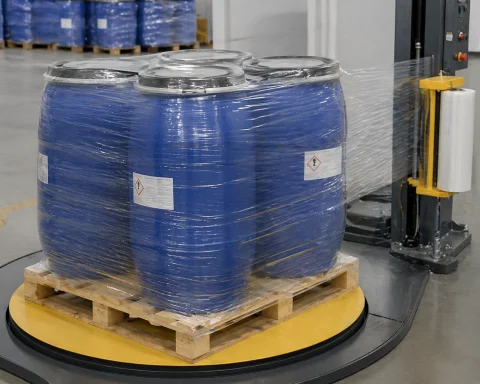
Bulk commodities such as resins, chemical granules, and industrial powders routinely spend three to five weeks at sea before reaching their destination port. Across that voyage, a single pallet or IBC drum is exposed to constant low-frequency vibration from the ship's engines, humidity levels that regularly exceed 95% in sealed containers, and temperature swings of 20°C or more as vessels cross tropical and temperate zones.
For packaging engineers and export logistics teams, the question is rarely whether cargo will move during transit — it is whether the wrapping film can keep absorbing that movement for a month without loosening, tearing, or letting moisture in. This is precisely the performance gap that a modern stretch film manufacturing machine is built to close.
Why Standard Packaging Fails on Long-Haul Ocean Routes
Monolayer or basic three-layer films are designed around short domestic transit times of a few days, not the extended mechanical and climatic stress of transoceanic shipping. Over a month-long voyage, three failure modes tend to appear in sequence. First, the film's elastic memory degrades under sustained tension, so the initial clamping force applied at the wrapping station gradually relaxes, and pallets that were tight in the warehouse arrive loose at the port. Second, humidity cycling inside a steel container causes condensation, and films without a dedicated moisture-resistant layer allow water vapor to reach the product surface, leading to caking, corrosion, or contamination of hygroscopic resins and chemical powders. Third, repeated vibration works sharp pallet edges and drum rims against the film until micro-punctures propagate into tears, breaking the continuous barrier the wrap was meant to provide. Any one of these failures can result in cargo claims, rejected shipments, or costly repackaging at the destination port — costs that dwarf the price difference of upgrading the film itself.
The Role of Stretch Film in Industrial Cargo Security
Stretch film is often treated as a commodity consumable, but on heavy unit loads it functions as an active structural component of the packaging system rather than a passive wrapper. A properly engineered film maintains sustained grip on one-ton IBCs, chemical drums, and flexible intermediate bulk containers (FIBCs) by continuously exerting inward clamping force, which compensates for material settlement as granules or liquids shift inside their containers during the voyage. High elastic recovery allows the film to expand slightly under thermal load in a hot cargo hold and then re-tighten as temperatures drop overnight, rather than staying permanently stretched and loose. A high-tack cling layer forms a near-airtight seal around the load, resisting moisture ingress even in the high-humidity conditions typical of sealed containers on tropical routes. In this sense, the film is not simply holding a pallet together — it is actively managing load stability, moisture exposure, and mechanical protection for the entire duration of the shipment.
How a 5-Layer Stretch Film Manufacturing Machine Delivers This Performance
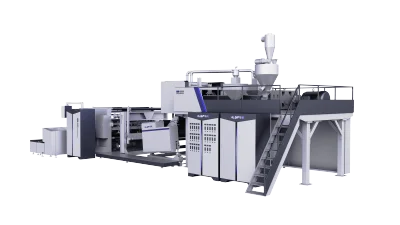
Achieving all of these properties simultaneously is difficult with a single resin formulation, which is why co-extrusion technology matters. A 5-layer stretch film manufacturing machine allows a producer to combine distinct polymer functions into one continuous web in a single production pass, rather than laminating separate films together after the fact. On this type of line, the two outer layers are typically formulated for high-tack cling, giving the finished roll a secure, self-adhering seal that resists unwinding and keeps humidity out. The core layers carry a super-elastic resin blend engineered for high memory and prestretch performance, frequently exceeding 250%, which is what gives the film its contracting "hug" around the load and its ability to recover after thermal expansion. The outermost skin layer is formulated for puncture and tear resistance, providing a rugged shield against the sharp edges of pallets, steel banding, and industrial packaging, and is commonly validated against recognized benchmarks such as ASTM D1709 for impact resistance. Precise control of layer ratios and die temperatures on the machine is what allows these otherwise incompatible material properties — softness for cling, elasticity for memory, toughness for puncture resistance — to coexist in a film that is often no thicker than 17 to 23 microns.
Operational and Economic Advantages for Packaging Lines
Beyond the finished film's field performance, the production technology itself has direct operational value for manufacturers and converters. Because prestretch capability is built into the core layer formulation, films from a well-tuned 5-layer line allow automated high-tension wrapping platforms to apply less raw film per pallet while still achieving the same or greater containment force, which reduces material consumption and per-load packaging cost without compromising load security. Enhanced tear resistance also reduces film breaks during high-speed application, an operational detail that matters more than it might appear: every break on an automatic wrapper triggers a line stop, a re-thread, and lost throughput, so a film engineered for consistent tensile performance translates directly into fewer interruptions and steadier output on export-oriented packing lines. For facilities producing film specifically for bulk commodity exporters — resin producers, chemical processors, agricultural bulk packers — this combination of material efficiency and application reliability is often the deciding factor when qualifying a new film supplier or upgrading in-house production capacity.
A Stretch Film Manufacturing Machine for Export-Grade Film
For any producer supplying packaging into maritime export markets, film specification is no longer just a function of thickness or basic cling strength — it is a function of the co-extrusion equipment behind it. A capable stretch film manufacturing machine needs precise multi-layer die control, stable melt temperature management across five distinct polymer streams, and repeatable prestretch calibration to consistently hit the elastic recovery and containment force that ocean freight demands. Equipment that cannot hold these parameters within tight tolerance will produce film with inconsistent memory and cling from roll to roll, which shows up downstream as variable wrapping performance and, ultimately, as damaged or shifted cargo at the port of arrival.
This is the gap that our 5-layer co-extrusion stretch film manufacturing machine is built to close. Designed for producers who supply industrial and export-grade packaging, our systems deliver the layer precision, prestretch consistency, and structural control needed to manufacture film capable of protecting heavy unit loads through a full month at sea — from resin sacks and chemical drums to FIBCs bound for the most demanding transoceanic routes. If your production line is ready to move from general-purpose film to technical-grade export packaging, we invite you to contact our engineering team for equipment specifications, sample film testing, or a tailored production line proposal built around your target film gauge and output capacity.