Precautions for Using 5-Layer Stretch Film Extrusion Machine
2026-09-01
A 5-layer stretch film extrusion machine is only as good as the process control behind it. Film clarity, puncture resistance, tear strength, and thickness consistency all trace back to how well an operation manages temperature, layer synchronization, and continuous production discipline. A modern 5-layer stretch film production line needs to deliver more than high output. Stable temperature control, precise layer synchronization, and consistent processing throughout the production run are essential to maintaining film quality, material efficiency, and production stability.
How Process Gaps Affect 5-Layer Stretch Film Quality
Many stretch film lines still rely on operator judgment rather than coordinated process control, and the gaps this creates tend to compound rather than stay isolated. Heating zones are often set individually based on experience rather than managed as a synchronized system, and when temperature drifts outside the optimal range for the resin formulation in use, the effects show up as incomplete melting, polymer degradation, or inconsistent viscosity — problems that directly undermine film clarity and strength. This weakness becomes more serious in a 5-layer A-B-C-B-A structure, where screw speed, melt pressure, and feedblock temperature across five separate melt streams all need to move in coordination. When even one of these variables drifts on a conventional line, layer ratios shift, and the result is reduced puncture resistance, weaker tear strength, and unpredictable elongation.
Thickness control and winding quality suffer from the same lack of coordination. Measurement systems calibrated on a fixed schedule rather than tied to real production conditions allow small drift to accumulate unnoticed, while winding tension and edge trim recycling that aren't dynamically linked to actual film output tend to produce wrinkles, telescoping, or uneven rolls. On top of this, many lines still run without real-time visibility into extrusion speed and cooling behavior, which makes frequent start-stop cycles more likely and allows quality to fluctuate from one batch to the next. None of these issues are dramatic on their own, but together they explain why film quality on a conventional line can vary noticeably even when the raw material and target specification stay the same.
Why Layer Precision Matters Across Different Applications
The consequences of these operating gaps look different depending on what the stretch film is protecting, which is exactly why layer precision and thickness consistency matter as much as raw output speed.
In metal coil and heavy steel packaging, film needs to combine high puncture resistance with consistent thickness across sharp edges and irregular surfaces. When layer synchronization is weak, thickness often drops right at the corners and edges of a load — precisely where the packaging is under the most stress — and that localized weakness becomes the point where the wrap fails during transit.
In chemical drum and hazardous container packaging, film has to stay highly transparent for label visibility while still holding strong seal integrity across every layer. Unstable temperature control on a conventional line can leave polymer incompletely melted, which quietly degrades both optical clarity and interlayer bond strength — a combination that matters not just for appearance but for safe handling of the contents.
In retail and fast-moving consumer goods distribution, the priority shifts toward continuous, high-frequency production and efficient material use. Lines that stop and start frequently, or that manage edge trim recycling inconsistently, struggle to keep pace with distribution schedules where cost efficiency and reliable output matter as much as raw film performance.

How Our 5-Layer Stretch Film Extrusion Machine Addresses These Challenges
Our 5-layer stretch film extrusion machine is built around coordinated process control rather than isolated adjustments, which is what allows it to hold performance consistently across the applications above.
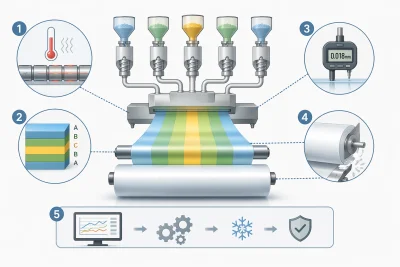
Temperature management works as a linked system across all heating zones rather than as a series of independent settings. Each zone is monitored and adjusted to keep the resin formulation — whether LLDPE, HDPE, or LDPE — within its optimal melting range throughout the run, avoiding both the incomplete melting and the localized overheating that degrade film clarity and strength. In chemical drum and container packaging, this translates directly into film that holds both high transparency for label readability and reliable interlayer seal strength, run after run.
Layer structure control is where the five-stream A-B-C-B-A design depends most on precision. Screw speed, melt pressure, and feedblock temperature are coordinated across all five extruders rather than adjusted independently, keeping layer ratios stable from the center of the roll to its edges. For metal coil and heavy steel packaging, that precision means the puncture resistance and tear strength the film is rated for actually hold at the corners and edges of a load, not just across flat, low-stress surfaces — closing exactly the gap where conventional film tends to fail first.
Thickness uniformity is maintained through inline measurement that responds to real production conditions rather than a fixed calibration interval, keeping tolerance consistently tighter than the ±3% threshold that separates reliable film from inconsistent film. That level of consistency improves material efficiency and gives downstream processes — automated palletizing and wrapping lines in particular — a more predictable input to work with, batch after batch.
Winding and edge trim recycling are managed as a linked system rather than two separate processes. Film tension is held steady through the winding stage while edge trim is fed back into the regrind ratio in a controlled, continuous way, reducing the wrinkles, telescoping, and uneven rolls that come from an unlinked system. For retail and fast-moving consumer goods distribution, this combination of clean winding and efficient regrind utilization has a direct effect on overall packaging cost, particularly at the production volumes those supply chains require.
Underlying all of this is real-time monitoring of extrusion speed and cooling performance, which keeps the entire line running under stable, continuous conditions rather than cycling through frequent starts and stops. That stability is what ultimately protects consistency batch to batch, and it's the difference between a production line that performs well under ideal conditions and one that performs reliably under real operating conditions, day after day.
For manufacturers and procurement teams comparing options, the real value of a 5-layer stretch film extrusion machine shows up less in any single spec and more in how those systems work together — synchronized temperature control, precise layer distribution, tight thickness tolerance, linked winding and recycling, and continuous stable operation. Film performance is the output of all of them working in coordination, and that coordination is exactly what separates a dependable production line from one that only performs well on paper.