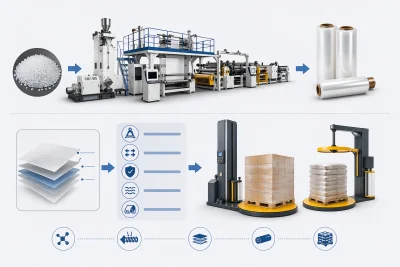
The performance of a roll of stretch film is decided long before it ever reaches a pallet. It's determined on the production floor, by how precisely the equipment processing the raw material controls layer structure, melt formulation, and gauge consistency. Metallocene linear low-density polyethylene, or mLLDPE, has become the material of choice for high-performance stretch film due to its narrow molecular structure, but that potential is realized only when a stretch film line is engineered to process it correctly. This is the foundation our equipment is built on, separating film with genuinely improved properties from stretch film that only looks similar on a spec sheet.
The Limits of Conventional Materials and Basic Extrusion Structures
Stretch film produced from standard LLDPE or LDPE blends, run through simple single or dual-layer extrusion setups, tends to hit a performance ceiling fairly quickly. Elongation and tensile strength plateau at levels that make further downgauging risky, forcing converters end up using more material than they'd like just to maintain adequate holding force. Cling performance in conventional stretch film formulations is also less stable than manufacturers would prefer, and it tends to degrade with temperature swings or extended storage and causing loosened wraps during transit.
The structural limitations are equally significant. Without a manufacturing process capable of differentiating core and surface layer formulations, a stretch film's overall performance gets capped by whatever compromise the single blended structure can achieve, since the same material has to deliver strength, cling, and clarity simultaneously. And on high-speed automated wrapping lines, stretch film produced without tight gauge uniformity and precise tension control is far more prone to breaking under stress, an outcome that has real cost implications wherever pallets move at volume.
How Our Stretch Film Manufacturing Machine Improves Film Performance
This is exactly where our approach to mLLDPE processing changes the outcome. Rather than treating raw material as a fixed input, our multi-layer co-extrusion systems, configurable from two to five layers, give us precise control over how mLLDPE's properties get expressed in the finished roll.
The most immediate improvement is in elongation and stretchability. mLLDPE's molecular structure supports significantly higher pre-stretch ratios than conventional resins, and our equipment is engineered to maximize this capability. The result is stretch film that extends further under controlled tension without weakening, maximizing pallet coverage from a single roll.
Mechanical strength achieves a comparable gain. By concentrating mLLDPE in the core layer, where it contributes the most to tensile strength and structural integrity, our line produces stretch film with significantly improved puncture and tear resistance. This isn't achieved by simply adding gauge; the core layer serves a dedicated structural role rather than balancing strength and surface performance simultaneously.
Surface performance improves in parallel. Optimizing outer layer formulation independently allows our equipment to deliver more stable, longer-lasting cling, maintaining consistent tack across a wider range of environmental conditions than conventional single-layer stretch films. Because our multi-layer systems maintain tight gauge uniformity across the full width of the roll, the resulting stretch film supports meaningful downgauging: reducing material consumption while maintaining load-securing integrity.
Where These Performance Gains Matter Most
Chemical and Bulk Material Packaging
Chemical producers, fertilizer manufacturers, and bulk powder or resin pellet suppliers typically move product in woven bags or bulk sacks stacked high on pallets, creating unique packaging challenges. Bagged materials tend to shift and settle during transit, while rough surfaces exert continuous abrasive pressure on the wrap. Additionally, dust or fine particulate escaping from bag seams can compromise cling performance over time.
The enhanced puncture resistance and tensile strength from mLLDPE core-layer optimization directly address these heavy-duty requirements, holding pallets secure as bagged material shifts and compresses during handling. Furthermore, chemical and bulk shipments often undergo extended storage cycles. Our improved cling stability maintains hold despite temperature fluctuations and long dwell times, preventing the load relaxation common with conventional wraps.
Appliance and Durable Goods Export
Large appliances and furniture present a different set of demands. These products are bulky, often irregularly shaped, and typically packaged in cardboard boxes or wooden crates destined for export by ocean freight, a journey that can involve several weeks in transit and multiple handling points between the factory and the final destination.
The higher pre-stretch capability our equipment achieves through mLLDPE processing is particularly valuable here, as it allows the stretch film to conform tightly around large, irregular packaging profiles rather than leaving gaps or weak points at corners and edges. The improved tear resistance matters just as much, given the abrasive contact cardboard and crate edges create against the wrap during repeated loading and unloading. Because export shipments spend long in transit, the sustained elastic recovery built into our multi-layer stretch film structure keeps pallets tightly secured on the final day of a voyage just as effectively as on the first, unlike lower-performance stretch films that loosen over extended shipping timelines.

Translating Material Performance Into Measurable Value
Across both applications, the underlying value proposition is the same: a stretch film line engineered to process mLLDPE precisely produces stretch film with genuinely superior performance characteristics, not just marginally better numbers on a data sheet. Higher elongation reduces material consumption per pallet. Improved puncture and tear resistance minimizes damaged loads and rejected shipments. More stable cling prevents loosened wraps that lead to load shifts during long storage or transit. Together, these improvements translate into lower material costs, fewer product losses, and consistent performance across production runs, regardless of whether a customer is wrapping chemical sacks for regional distribution or crating appliances for ocean export.
Built Around What the Material Can Actually Deliver
mLLDPE offers real advantages over conventional stretch film resins, but only equipment engineered to precisely control layer structure, gauge uniformity, and formulation can turn those molecular-level advantages into finished stretch film that performs superiorly in the field. That is the standard we build our stretch film line to meet, whether your application calls for holding heavy bagged chemical loads through months of storage or securing bulky export freight across a multi-week ocean voyage. If you're evaluating equipment for a specific production requirement, our engineering team can walk through the layer configuration and material setup tailored to your operation.