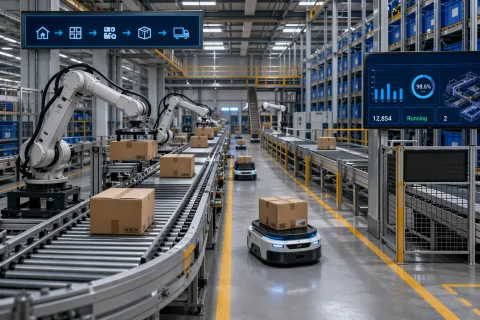
Automated distribution centers require stretch film that can maintain stable performance throughout high-speed pallet wrapping operations. With automatic wrapping machines, conveyor systems, and continuous material handling equipment running for extended periods, inconsistent film quality can lead to film breakage, unstable loads, and unnecessary material consumption.
To meet the demanding requirements of automated packaging applications, we design and manufacture stretch film manufacturing machines that enable customers to produce high-strength, lightweight films with consistent thickness and stable mechanical properties. By integrating multilayer cast co-extrusion technology with advanced materials such as metallocene mLLDPE, our production solutions help film manufacturers create durable and sustainable stretch films that improve packaging efficiency in automated logistics environments.
Packaging Challenges in Automated Logistics Operations
Automated distribution centers operate under continuous production conditions where packaging materials must perform consistently throughout the entire process. Unlike manual wrapping applications, automated systems require stretch film with precise mechanical properties to match high-speed equipment and standardized packaging procedures.
One of the major challenges faced by logistics operators is inconsistent film quality. Traditional stretch films with unstable thickness distribution or insufficient tensile strength may experience breakage during pre-stretching and wrapping. Film failure not only increases material waste but can also cause interruptions in automated packaging lines, reducing overall operational efficiency.
Another challenge is the increasing demand for sustainable packaging solutions. Many logistics companies are seeking ways to reduce plastic consumption while maintaining reliable load containment. Conventional approaches often depend on increasing film thickness to improve strength, which results in higher raw material usage and increased packaging waste.
For large-scale distribution centers processing thousands of pallets every day, even small improvements in film efficiency can create significant economic and environmental benefits. Therefore, manufacturers need advanced production equipment capable of producing lightweight yet durable stretch film with stable performance.
The Role of Stretch Film in Automated Distribution Applications
Stretch film plays an essential role in securing palletized goods throughout storage, transportation, and handling processes. A high-quality film layer provides the necessary holding force to stabilize products, prevent shifting, and protect loads from external impact during logistics operations.
In automated wrapping systems, the performance of stretch film directly influences packaging reliability. Films used in these environments must provide balanced properties, including high tensile strength, excellent elongation, reliable cling performance, and strong puncture resistance. These characteristics allow automated wrapping equipment to operate efficiently while maintaining consistent packaging quality.
Metallocene mLLDPE has become an important material choice for high-performance stretch film production due to its uniform molecular structure and enhanced mechanical properties. Compared with conventional polyethylene materials, mLLDPE offers improved toughness, better stretch capability, and more stable film performance. These advantages allow manufacturers to produce thinner films without sacrificing load stability.
Through optimized material formulation and multilayer film structures, mLLDPE-based stretch film can achieve effective down-gauging. Depending on application requirements, film thickness can often be reduced significantly while maintaining the strength required for industrial pallet wrapping. This helps reduce polymer consumption, lower packaging costs, and support more sustainable logistics operations.
Advanced Multilayer Technology for Sustainable Film Production
The development of multilayer co-extrusion technology has further improved the performance and efficiency of stretch film production. Instead of relying on a single material layer, modern stretch films can be designed with multiple functional layers, each serving a specific purpose.
For example, outer layers can be optimized for surface protection and controlled cling performance, while inner layers can focus on elasticity and tensile strength. This structural design allows manufacturers to achieve better material utilization by placing advanced polymers only where they provide the greatest performance benefits.
A high-quality stretch film manufacturing machine is designed to precisely control each layer during the extrusion process. Accurate temperature management, stable melt distribution, and advanced flow control ensure consistent film formation across the entire width of the web. This is particularly important for automated distribution applications, where every roll must deliver predictable performance during high-speed wrapping.
By improving layer distribution and reducing unnecessary material usage, multilayer technology helps manufacturers produce environmentally responsible stretch film without compromising packaging reliability.
Ensuring High-Speed Wrapping Performance with Consistent Film Quality
Modern automated wrapping systems commonly operate at high speeds, requiring stretch film with stable mechanical behavior throughout the entire roll. Inconsistent film properties can lead to uneven stretching, poor load containment, and increased film consumption.
The stretch film manufacturing machine plays a critical role in solving these challenges by maintaining precise control over extrusion and winding processes. Advanced production systems can achieve uniform thickness distribution, stable web tension, and consistent roll quality, allowing the finished film to perform reliably in automated applications.
During high-speed wrapping, film must withstand continuous stretching forces without tearing or losing its holding capability. mLLDPE-based films produced through optimized extrusion processes provide excellent resistance against puncture and stretching stress, reducing the frequency of film replacement and minimizing production interruptions.
Stable winding performance is also essential for automated logistics. Poorly wound rolls may cause feeding problems or uneven film delivery during application. A precision winding system ensures smooth roll formation, consistent tension control, and reliable operation on automated wrapping equipment.
Reliable Stretch Film Manufacturing Machine for Continuous Automated Film Production
Our stretch film manufacturing machine is developed to meet the production requirements of modern logistics and industrial packaging markets. By integrating multilayer cast co-extrusion technology, precise extrusion control, and stable winding systems, the machine enables manufacturers to produce high-quality stretch film with consistent performance.
The equipment is suitable for producing stretch films based on LLDPE, mLLDPE, and other polyethylene materials, allowing manufacturers to develop films for different applications, including automated pallet wrapping, warehouse logistics, export packaging, and industrial transportation.
With accurate temperature control and optimized extrusion design, the machine helps maintain stable film thickness and mechanical properties during continuous production. This consistency is essential for customers supplying automated distribution centers where packaging performance directly affects operational efficiency.
The advanced multilayer structure also provides greater flexibility in material management. Manufacturers can optimize film formulations according to specific requirements, balancing strength, stretchability, and sustainability. By producing lightweight films with high load containment capability, companies can reduce material consumption while meeting modern environmental goals.
Long-term production stability is another important advantage. Automated distribution markets require reliable film supply, and production downtime can directly affect customer delivery schedules. Our stretch film manufacturing machine is designed for continuous operation with dependable extrusion output and efficient winding performance, helping manufacturers achieve stable production capacity.
Stretch Film Manufacturing Machine Solutions for Modern Automated Logistics
As global logistics continues to move toward automation and sustainability, the demand for high-performance stretch film will continue to increase. Distribution centers need packaging materials that can support faster operations while reducing waste and improving resource efficiency.
A sustainable stretch film manufacturing machine provides manufacturers with the ability to produce advanced mLLDPE-based films that combine strength, efficiency, and environmental responsibility. Through precise multilayer technology, stable production control, and optimized material utilization, the equipment helps film producers meet the changing requirements of automated packaging markets.
Our stretch film manufacturing machine offers a reliable solution for companies seeking to expand their stretch film production capabilities and provide consistent packaging materials for modern logistics applications. With advanced technology, stable performance, and flexible production options, our machines support manufacturers in creating high-quality stretch films that improve packaging efficiency and contribute to more sustainable distribution systems.