The Global Demand for LLDPE Stretch Film Extrusion Machine
2026-08-20
The rapid development of e-commerce, automated warehousing, and global logistics is creating higher demand for reliable pallet packaging. Stretch film is widely used to secure goods during storage, handling, and transportation, and LLDPE remains one of the key materials for producing flexible, strong, and highly stretchable packaging film.
As packaging requirements continue to evolve, film producers need more than basic extrusion capacity. They need stable film thickness, reliable mechanical performance, efficient material utilization, and consistent winding quality. Our stretch film extrusion machine is designed around these practical production requirements, providing a complete cast film extrusion solution for manufacturers producing LLDPE stretch film.
We focus on extrusion stability, multilayer flexibility, precise process control, and efficient production to help customers build stretch film lines that are suitable for both standard pallet wrapping and more demanding packaging applications.
High-Performance LLDPE Stretch Film for Modern Logistics
LLDPE stretch film needs to maintain a balance between elongation, tensile strength, puncture resistance, cling, and load retention. These properties directly influence how effectively the film secures goods throughout the logistics process.
Our stretch film extrusion machine is designed to provide stable processing conditions for LLDPE-based formulations, helping manufacturers achieve consistent film quality across the production width. Through coordinated extrusion, cooling, thickness control, and winding, the production line supports the stable manufacture of stretch film for pallets, cartons, industrial products, warehouse packaging, and export transportation.
For automated wrapping applications, film consistency is particularly important. Uneven thickness or unstable winding can result in film breaks, wrinkles, loose rolls, or inconsistent wrapping performance. Our equipment integrates precise control systems to maintain stable operating conditions and support reliable high-speed production.
The result is a production platform designed to help film manufacturers produce thinner and stronger stretch film while maintaining the mechanical performance required by their target applications.
Flexible Multilayer Extrusion for Different Film Requirements
Different stretch film products require different material structures. To meet these requirements, we provide multilayer stretch film extrusion machine configurations that can be adapted to production capacity, film specifications, and material formulations.
Our two-layer extrusion systems provide a practical solution for standard stretch film applications. They offer a relatively straightforward layer structure while allowing manufacturers to distribute material according to specific film performance requirements. This configuration is suitable for customers who prioritize a balanced combination of production efficiency, equipment investment, and product performance.
For customers requiring greater material and functional flexibility, our three-layer coextrusion systems provide more control over the film structure. Different resin formulations can be assigned to individual layers to optimize properties such as cling, tensile strength, elongation, and puncture resistance.
Our five-layer coextrusion solutions provide an even higher level of layer distribution flexibility. Multiple LLDPE grades and functional formulations can be allocated to different layers according to the target product. Where the film specification permits, selected recycled materials can also be incorporated into suitable inner layers, helping improve material utilization while maintaining the required surface characteristics.
Rather than offering a single standard configuration for every application, we develop the extrusion structure according to the customer's film specifications, target output, and material requirements.
Precision Extrusion and Thickness Control
Stable film quality starts with consistent melt processing. Our stretch film extrusion machine incorporates coordinated screw, barrel, heating, cooling, die, and control technologies to maintain stable extrusion conditions.
The screw and barrel system is designed to provide efficient conveying and plasticization of polyethylene materials. Controlled heating zones help maintain appropriate processing temperatures, while optimized barrel insulation reduces unnecessary heat loss and supports more efficient thermal management.
The T-die plays an important role in producing uniform cast stretch film. Our extrusion systems use precision melt distribution technology to support consistent material flow across the film width. Combined with online thickness monitoring and automatic process adjustment where configured, the system can help reduce thickness variation and maintain stable film specifications during continuous production.
Actual thickness tolerance depends on film thickness, width, resin formulation, machine configuration, and operating conditions. Instead of relying on a single fixed specification, we configure the control system according to the actual production requirements of each stretch film project.
Stable Winding for Reliable Production
High-quality extrusion is only part of the production process. The winding system must also maintain stable film tension and roll formation, especially when the line operates at higher speeds.
Our winding solutions use controlled tension and synchronized drive technology to help maintain consistent roll quality. Stable winding reduces the risk of wrinkles, telescoping, uneven roll edges, and unnecessary film breaks.
For manufacturers supplying stretch film to automated packaging operations, consistent roll quality is essential. A well-controlled winding system helps ensure that finished rolls can be efficiently transferred to storage, transportation, and wrapping operations.
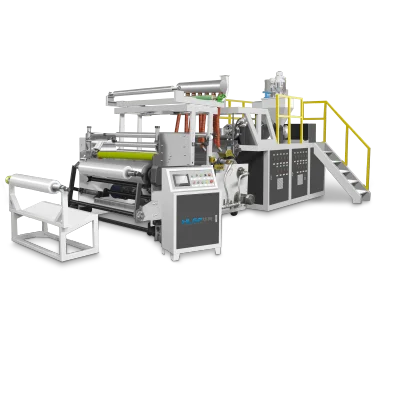
By coordinating extrusion speed, cooling conditions, film tension, and winding parameters, our stretch film extrusion machine provides a complete production solution rather than focusing on extrusion alone.
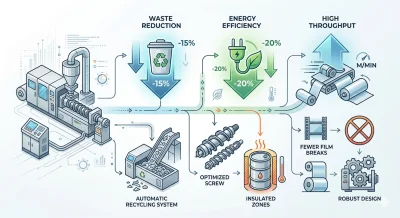
Improving Material Utilization and Energy Efficiency
Production efficiency is closely connected to material consumption and energy use. Our stretch film extrusion machine is designed with these factors in mind.
Accurate material feeding and stable extrusion help reduce unnecessary production variation. Precise thickness control also allows manufacturers to better manage film gauge and avoid excessive material consumption caused by over-thick sections.
For suitable production processes, clean edge trim and compatible production waste can be recovered and reused through an integrated recycling system. The actual recycling ratio depends on the film formulation, product specification, and waste characteristics, but a properly designed recovery process can help reduce material losses.
Energy efficiency is also addressed through optimized screw geometry, efficient drive systems, controlled heating, and improved barrel insulation. These technologies help reduce unnecessary power consumption while maintaining stable extrusion performance. Actual energy consumption depends on output, film thickness, resin type, machine configuration, and operating conditions, so our equipment can be configured according to the customer's specific production targets.
Build Your Stretch Film Production Line With the Right Technology
We understand that every stretch film production project has different requirements. Film width, thickness, output, layer structure, resin formulation, recycled material content, and automation level all influence the final equipment configuration.
Our stretch film extrusion machine solutions are designed to provide a practical balance between production capacity, film quality, material efficiency, and long-term operating stability. From two-layer systems for standard applications to three-layer and five-layer coextrusion lines for more advanced film structures, we provide flexible equipment configurations for different production goals.
With coordinated extrusion, precision T-die technology, effective cooling, thickness control, and stable winding, our machines provide a reliable foundation for producing high-quality LLDPE stretch film.
For manufacturers looking to expand capacity, improve film consistency, or develop more efficient multilayer stretch film production, our stretch film extrusion machine offers a complete solution built around real production requirements. Welcome to choose our stretch film extrusion machine to build a more reliable, efficient, and flexible film production line for the growing global packaging market.