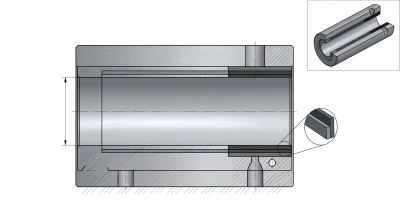
In air bubble film extrusion, maintaining stable processing conditions is essential for achieving consistent product quality and controlling operational costs. Among the key components influencing both thermal performance and energy efficiency is the extrusion barrel. In recent years, heavy-wall barrel design has become an important engineering approach for improving overall system performance, particularly in high-demand production environments.
A primary advantage of heavy-wall barrels lies in their enhanced thermal inertia. Due to increased wall thickness and mass, the barrel can store and retain heat more effectively than conventional designs. This thermal stability helps maintain a more uniform melt temperature along the extrusion process, reducing fluctuations caused by ambient conditions or material variations. As a result, the polymer melt remains within a narrower processing window, which is critical for stable bubble formation and film consistency.
This improved thermal behavior also contributes directly to energy efficiency. In standard barrel systems, heat loss to the surrounding environment can be significant, requiring frequent activation of heating elements to maintain set temperatures. Heavy-wall barrels reduce this heat dissipation, allowing heaters to operate less frequently and more efficiently. Over time, this leads to a measurable reduction in overall energy consumption, particularly in continuous production lines operating for extended periods.
In addition to thermal benefits, the structural strength of heavy-wall barrels supports high-pressure extrusion conditions. Bubble film production often involves processing materials at elevated pressures to achieve proper bubble geometry and layer formation. A thicker barrel structure provides greater mechanical rigidity, helping to maintain dimensional stability under load. This ensures consistent material flow and reduces the likelihood of pressure-induced deformation that could affect product quality.
The combination of stable temperature control and robust mechanical support has a direct impact on final product performance. With fewer thermal fluctuations and more consistent pressure conditions, the extrusion system can produce bubble film with more uniform thickness and reliable bubble integrity. This consistency reduces material waste caused by defects such as uneven bubbles or weak نقاط, improving overall production yield.
Furthermore, improved process stability simplifies operational control. Operators spend less time adjusting temperature settings or compensating for process drift, and startup times can be reduced due to faster thermal equilibrium. This contributes not only to energy savings but also to increased production efficiency and reduced downtime.
In conclusion, heavy-wall barrel design represents a practical and effective solution for enhancing both energy efficiency and process stability in air bubble film machines. By combining superior thermal inertia with structural durability, it enables more controlled extrusion conditions, lower energy usage, and improved product consistency—key factors for manufacturers seeking long-term operational performance and cost optimization.