Minimizing Material Waste During Stretch Film Extrusion Machine Start-ups
2026-08-25
In high-capacity stretch film production, the start-up phase of a multi-layer extrusion line is often the most resource-intensive period a producer faces. Every restart between production runs carries a hidden cost, and that cost adds up fast for manufacturers running multiple grades and specifications through the same line. Our advanced 2-layer, 3-layer, and 5-layer stretch film extrusion machines are built to close the gap between power-on and on-spec production, turning what used to be an expensive transition into a fast, controlled process.
Where Traditional Start-Up Procedures Fall Short
Conventional start-up routines suffer from a familiar set of problems that compound on each other. When multiple extruders ramp up at different rates, melt flow reaching the feedblock is unsynchronized, and achieving the correct layer ratio, particularly in 5-layer co-extrusion, takes far longer than it should. Temperature fluctuations across heating zones add another source of instability, since barrels and die zones rarely reach setpoint at the same moment, producing the gels and gauge variation that plague early production. Gauge control tends to lag as well, with automatic thickness scanners taking longer than necessary to intervene, which stretches out the time it takes to reach saleable quality. And because most conventional lines lack a dedicated recovery path for start-up scrap, off-spec material and edge trim from this phase are typically wasted outright rather than reintroduced into production.
The result is a start-up window measured in hours rather than minutes, with a meaningful volume of virgin resin consumed before the line ever produces a sellable roll. For producers running frequent grade changes or high-volume export orders, that waste isn't a rounding error, it's a recurring cost that erodes margin on every changeover.
Frequent Changeover Producers Serving Mixed Industries
Manufacturers running multiple grades and specifications through the same line typically serve a mix of downstream industries with very different requirements. E-commerce and warehousing customers usually need thinner, cost-efficient standard-grade stretch film, while building materials and industrial manufacturing customers need heavier, custom-layered stretch film built for higher load strength. Alternating between these order types means alternating start-ups, and every changeover that takes longer than necessary compounds the cost of serving both customer bases well.
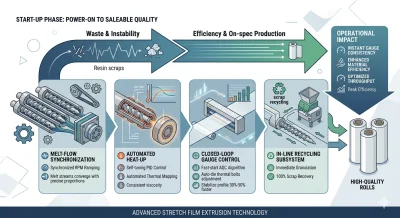
Our Synchronized RPM Ramping technology addresses this directly by coordinating the acceleration of primary and satellite extruder motors in a harmonic sequence, so melt streams converge at the feedblock with precise layer proportions from the first meter of production. Instead of waiting for melt equilibrium to develop gradually, the line reaches steady-state pressure across all extruders almost simultaneously. For a producer switching between e-commerce-grade and industrial-grade stretch film multiple times a week, this shortens every changeover meaningfully, and those savings compound across dozens of grade switches over a production year, giving the operation more flexibility to serve both segments profitably rather than treating frequent changeovers as an unavoidable cost of doing business.
High-Volume Export Producers Serving Cost-Sensitive Industries
Producers running large, standardized export orders operate under a different kind of pressure. Their typical customers, consumer goods exporters shipping household and personal care products, or agricultural input suppliers moving fertilizer and chemical products in bulk, place high-volume orders with tight margins and firm delivery timelines. At export volumes, any waste generated during start-up gets multiplied across an enormous production run, and that waste shows up directly in the cost structure a producer has to quote against competitors.
This is where our Closed-loop Gauge Control and In-line Edge Trim Recycling systems make the clearest difference. Our automatic thickness scanner intervenes within five minutes of start-up, and by linking real-time scan data directly to the auto-die thermal bolts, the system stabilizes the stretch film profile 30 to 50 percent faster than manual adjustment allows. At the same time, our integrated in-line recycling subsystem captures off-spec material and edge trim generated during the transition phase, granulating it and pneumatically conveying it back into the extruder, where it's reintroduced into the core layer at a controlled percentage without compromising finished roll integrity. Recovering close to 100 percent of start-up scrap translates directly into lower cost per roll on high-volume runs, which is exactly the margin producers need to stay competitive when quoting large export orders to consumer goods and agricultural customers operating on thin margins themselves.
The Technology Behind These Results
Four integrated systems work together to deliver this level of start-up performance. Synchronized RPM Ramping coordinates extruder acceleration so layer ratios stabilize from the first meter rather than drifting into balance over time. Automated heat-up with self-tuning PID control brings every heating zone to setpoint simultaneously, while continuous thermal mapping micro-adjusts zones throughout the run to compensate for thermal inertia and eliminate the hotspots that cause gels and inconsistent viscosity. Closed-loop gauge control brings the automatic thickness scanner online within five minutes of start-up, cutting the time to a stable stretch film profile by roughly a third to a half compared to manual adjustment. And in-line edge trim recycling closes the loop entirely, granulating and returning off-spec material to the core layer in real time so start-up waste is recovered rather than discarded.
What This Means for Producers Running Our Equipment
Stabilizing extrusion in minutes rather than hours changes the economics of running a multi-layer line. Producers get instant gauge consistency, reaching saleable, high-quality rolls far sooner after every start-up. Material efficiency improves because less virgin resin is given away during the transition phase, and throughput increases as unproductive downtime shrinks across a full year of production. For manufacturers managing frequent grade changes to serve e-commerce and building materials customers side by side, or for high-volume operations supplying consumer goods and agricultural exporters at scale, these gains translate into real, measurable improvements in cost per roll and annual output.
Engineered to Minimize Start-Up Waste
This is the standard we design every stretch film extrusion machine to meet, whether the configuration is 2-layer, 3-layer, or 5-layer. Our engineering team can walk through how these start-up technologies apply to your specific product mix, whether your operation runs frequent changeovers across diverse customer segments or high-volume runs where every percentage point of material efficiency matters. Reach out to discuss your production requirements, and we'll help you find the configuration that keeps your line moving from power-on to profitable output as fast as possible.