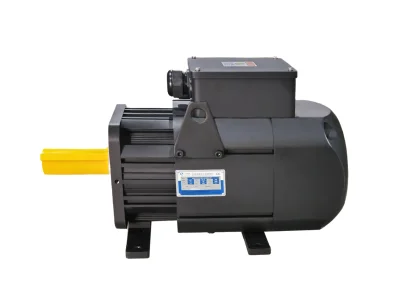
Why Permanent Magnet Synchronous Motors Reduce Energy Consumption
Packaging manufacturers today are under constant pressure to produce stronger, more consistent stretch film and bubble film at a lower operating cost. As logistics networks grow faster and more automated, the equipment behind stretch film and bubble film production has to keep pace, not just in line speed but in precision and energy efficiency. This is one of the reasons we build our stretch film making machines and bubble film making machines around Permanent Magnet Synchronous Motor (PMSM), drive systems rather than relying on older motor technologies.
The Limits of Conventional Motor Drives in Stretch Film and Bubble Film Production
Most legacy stretch film and bubble film extrusion and wrapping equipment still relies on induction motors, and while these motors are simple and inexpensive, they carry real drawbacks in a stretch film or bubble film production environment. An induction motor generates its rotor magnetic field through induced current, and that current produces rotor copper losses that show up as wasted energy and excess heat. In a production line that runs for extended production runs, this heat has to be managed with additional cooling, which adds cost and mechanical complexity.
The bigger issue for stretch film and bubble film making equipment specifically is what happens at low speed or under partial load. Stretch film pre-stretch rollers and bubble film extrusion lines rarely run at a single constant speed; they are constantly adjusting to different roll widths, gauge settings, and line speeds. Induction motors tend to lose efficiency exactly in these variable conditions, and their response to speed and torque commands is comparatively slow. For a process where stretch film tension and bubble film gauge need to stay within tight tolerances, that lag translates directly into inconsistent finished-film quality.
Why We Build Around PMSM Drive Systems
PMSMs take a different approach. Because the rotor field comes from permanent magnets rather than induced current, there is no rotor winding current to generate copper losses, so the motor runs cooler and more efficiently across its operating range. This efficiency advantage is not limited to full-speed operation; it holds up well at low speed and partial load, which matters a great deal in stretch film and bubble film production where line speeds change constantly.
The higher power density of PMSMs also lets us build more compact, lighter drive units without sacrificing torque output, which supports a tighter overall machine footprint. When we pair these motors with field-oriented control, we get precise, near-instant regulation of torque and speed, which is what allows our machines to hold tension and gauge targets even as production conditions shift. Lower losses also mean less heat generation, so our drive systems place a lighter load on cooling and put less thermal stress on surrounding components over years of continuous operation.

What This Means for Our Stretch Film and Bubble Film Making Machines
On our stretch film making machines, PMSMs drive the pre-stretch rollers and main stretch film delivery system, and this is where tension control has the most direct impact on the finished product. Because the motor responds quickly and accurately to control signals, we can hold pre-stretch ratios steady even as roll diameter and line speed change during a production run. The practical result is stretch film that unwinds and stretches more consistently from the first meter to the last, with fewer weak points or uneven sections.
That consistency shows up directly in stretch film performance. Stretch film produced with stable, well-controlled pre-stretch tends to show a higher usable stretch ratio and better puncture resistance, since the polymer chains are drawn more evenly rather than being over-stretched in some areas and under-stretched in others. For customers, this means each roll of stretch film covers more pallets before it runs out, and each wrap holds up better against sharp edges and handing during transit. We have also found that the reduced heat and smoother load profile from PMSM drives translate into fewer unplanned stops for motor maintenance, which keeps our stretch film making machines running closer to their rated output over a full production run.
The same drive technology plays a slightly different but equally important role on our bubble film making machines. Here, PMSM motors control the extrusion and traction sections, where even small speed fluctuations can show up as visible variation in bubble size or bubble film gauge. Because PMSM motors maintain stable torque and speed even at the lower end of the operating range, our bubble film making machines can hold gauge and bubble uniformity steady during startup, gauge changes, and slower production runs, not only at peak speed.
This matters because bubble film is often judged on cushioning consistency rather than raw line speed. A roll with uniform bubble height and wall gauge protects fragile goods more reliably than a roll with visible variation from one section to the next. By keeping the extrusion and traction motors precisely synchronized, our machines reduce that variation and help customers get more predictable protective performance out of every roll. The lower energy draw of PMSM motors during slower or partial-load runs also keeps operating costs down for customers who produce a wide mix of bubble film specifications rather than running one size continuously.
Where These Improvements Show Up in the Field
For companies supplying stretch film into logistics, warehousing, and food and beverage distribution, the practical value of PMSM-driven pre-stretch control is straightforward: pallets stay secure through multiple handling and transit stages, stretch film usage per pallet goes down because the stretch ratio is more efficient, and damaged or rejected loads become less common. Warehouse and e-commerce fulfillment operations in particular benefit from stretch film that behaves predictably across different pallet shapes and weights, since inconsistent stretch is one of the more common causes of load shift during transit.
For bubble film customers serving electronics, precision instruments, glassware, and cross-border e-commerce shipping, the priority tends to be cushioning reliability rather than raw speed. Bubble film with consistent bubble height and wall gauge performs more predictably as a shock absorber, which matters most when a single damaged shipment can outweigh the cost savings of a slightly faster production run. Manufacturers producing bubble film for these markets also benefit from the lower energy consumption PMSMs provide during frequent gauge or width changes, since many bubble film production runs are shorter and more varied than a single continuous run.
Our Approach to Motor Technology Across Product Lines
We see PMSM technology as a shared engineering foundation rather than a feature limited to one machine type. The same underlying advantages, lower rotor losses, higher power density, and precise field-oriented control, apply whether the motor is driving a pre-stretch roller on a stretch film making machine or an extrusion screw on a bubble film making machine. Building both product lines around this drive technology lets us bring the same level of energy efficiency, thermal stability, and control precision to customers regardless of whether they produce stretch film or bubble film.
As packaging manufacturers continue to look for equipment that lowers operating costs without compromising finished-film-quality, we continue to invest in refining how our drive systems, control software, and mechanical design work together. Our stretch film making machines and bubble film making machines are built on that same commitment, and we welcome the opportunity to walk potential customers through the specific configurations available for their manufacturing requirements.