How Advanced Multi-Layer Stretch Film Extrusion Machines Shorten Payback Period
2026-08-21
In today’s packaging industry, manufacturers are under constant pressure to reduce production costs while maintaining reliable film performance. Rising resin prices, labor expenses, energy consumption, and increasingly demanding logistics requirements make production efficiency more important than ever. For stretch film manufacturers, upgrading to an advanced stretch film extrusion machine is not simply a matter of increasing output. It is an investment in better material utilization, stable film quality, and long-term production efficiency.
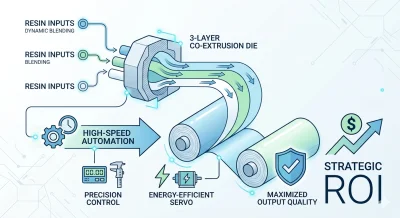
Multi-layer cast extrusion technology, particularly three-layer and five-layer configurations, gives manufacturers greater flexibility to optimize film structures for different applications. When combined with precise extrusion control and efficient winding technology, a modern stretch film production line can help reduce material waste and improve the economics of high-volume production.
Rising Production Costs Make Material Efficiency More Important
Resin is one of the largest costs in stretch film production. Traditional production methods may require a relatively high film thickness to achieve sufficient strength and load stability. For high-volume manufacturers, even a small reduction in average thickness can significantly reduce annual resin consumption.
Modern multi-layer extrusion provides a practical way to approach downgauging. Instead of using the same material throughout the film, different layers can be designed for different functions. LLDPE and mLLDPE, for example, can be combined to balance stretchability, toughness, puncture resistance, and holding force according to the target application.
With the right formulation and process conditions, manufacturers can produce thinner stretch film without simply sacrificing performance. Depending on the application and material structure, commercial stretch films may be produced across a wide thickness range, including approximately 12–23 microns. The appropriate gauge should always be determined by actual packaging requirements and film performance testing.
Multi-Layer Extrusion Improves Film Performance
A key advantage of a multi-layer stretch film extrusion machine is the ability to optimize each layer independently. A three-layer structure can provide a basic balance between surface properties, stretchability, and mechanical strength, while a five-layer structure offers additional flexibility for material distribution.
This is especially valuable when producing high-performance film at reduced thickness. The core layer can be optimized for toughness and cost efficiency, while outer layers can provide the surface characteristics and stretching behavior required during wrapping.
For applications involving heavy loads, irregular products, or long-distance transportation, puncture resistance and load retention are particularly important. A well-designed film structure can help maintain packaging stability while allowing manufacturers to reduce unnecessary material usage.
The goal of downgauging is therefore not simply to make the film thinner. It is to achieve the required packaging performance with a more efficient use of resin.

Precision Control Helps Reduce Production Waste
Material savings can be lost if thickness variation and start-up waste remain high. Stable extrusion conditions are essential for manufacturers producing thin-gauge stretch film because small process fluctuations can affect film quality and increase the average thickness required to meet specifications.
An advanced stretch film extrusion machine can integrate PLC control, automatic parameter adjustment, temperature monitoring, and online thickness control. Depending on the machine configuration, feedback from thickness measurement systems can be used to adjust extrusion conditions and maintain more consistent film thickness across the production width.
Recipe management is also useful for manufacturers producing multiple film specifications. Operators can store established production parameters and recall them when the same product is scheduled again. This can reduce setup time and make production more repeatable.
Lower start-up waste is another benefit of better process control. While actual waste levels depend on materials, film thickness, machine configuration, and operator practices, improved automation can help manufacturers reduce unnecessary material loss during startup and specification changes.
Higher Practical Output Supports Faster ROI
Production speed directly affects the utilization of an extrusion line, but maximum line speed should not be the only consideration when calculating return on investment. Stable production at the required film thickness is more important than achieving a high speed for short periods.
Modern cast stretch film lines can be configured for high-speed production, with some systems reaching approximately 200–250 meters per minute depending on film width, thickness, resin structure, and machine configuration. The actual output should always be calculated according to the complete production setup.
The winding system also has an important role in production efficiency. Accurate tension control helps create stable rolls and can reduce problems such as wrinkles, telescoping, loose winding, and uneven edges. Consistent roll quality is especially important when the finished film is supplied to automatic wrapping operations.
A production line that combines stable extrusion, effective cooling, accurate thickness control, and reliable winding can generate more saleable film from the same operating hours.
Automation Can Reduce Energy and Labor Costs
Energy efficiency is another factor affecting the payback period of a stretch film extrusion machine. Efficient motors, optimized screw and barrel designs, accurate temperature control, and properly matched auxiliary systems can help reduce unnecessary energy consumption.
Electrical drive systems also provide precise speed regulation for extrusion and winding. Compared with older adjustment methods, modern automated control can improve process stability while reducing unnecessary manual intervention.
Automation does not eliminate the need for experienced operators. Instead, it allows operators to spend less time on repetitive adjustments and more time on quality inspection, maintenance, and production management. Centralized PLC and HMI systems can also make operating parameters easier to monitor and adjust.
Invest in Future-Proof Efficiency: Stretch Film Machine Selection
Investing in a modern stretch film extrusion machine can provide more than additional production capacity. A well-configured three-layer or five-layer cast extrusion line can help manufacturers improve material utilization, maintain consistent film quality, reduce production waste, and control operating costs.
Our stretch film extrusion machine solutions are designed for manufacturers seeking efficient cast film production and flexible multi-layer configurations. Machine specifications can be matched to film width, thickness, resin structure, required output, and automation level.
If your factory is looking to reduce resin consumption, improve production stability, or shorten the investment payback period, choosing the right extrusion configuration is an important first step. Contact our technical team to discuss your film specifications and production capacity, and we can recommend a suitable multi-layer stretch film extrusion machine based on your actual manufacturing requirements.