As stretch film production moves toward higher output and greater automation, winding has become an increasingly important part of the manufacturing process. A stretch film making machine may maintain stable extrusion and film thickness, but the finished product still depends on how consistently the film is wound into rolls. Unstable winding tension, poor edge alignment, inconsistent roll hardness, and inefficient roll changes can affect production continuity and the usability of the finished film.
For five-layer stretch film production, these requirements become more demanding because the film structure combines multiple material layers with different functional properties. An automatic winding system helps coordinate film tension, roll formation, cutting, and roll changing, allowing the production line to operate with less manual intervention while maintaining more consistent finished rolls.
Why Traditional Stretch Film Winding Can Limit Production Efficiency
In conventional stretch film production, roll changing may require operators to manually remove finished rolls, install cores, cut the film, and prepare the next winding position. As production speed and roll size increase, these operations can consume valuable production time and increase the workload on operators.
Winding quality can also be affected by unstable tension. If the tension is too high, the finished roll may become excessively tight or develop deformation. If the tension is too low, the roll may become loose or uneven. The appropriate winding condition also changes as the roll diameter increases, making tension management an important part of continuous film production.
Edge alignment is another common concern. If the film does not remain properly positioned during winding, the finished roll can develop uneven edges or telescoping. Air entrainment between film layers may also affect roll formation when winding conditions are not properly matched to film properties and production speed.
These issues do not necessarily come from the winding system alone. Film thickness, temperature, cooling conditions, line speed, material formulation, and winding parameters can all influence the final roll. For this reason, a well-designed stretch film making machine needs coordinated control across the extrusion and winding processes.
Five-Layer Stretch Film for Different Packaging Requirements
Five-layer stretch film is commonly used when manufacturers need to balance several properties within one film structure. Instead of requiring a single material to provide all performance characteristics, different layers can be designed for specific functions.
Depending on the formulation, outer layers may contribute to cling and surface properties, while core layers can provide tensile strength and resistance to puncture or tearing. The actual layer composition and thickness ratio should be determined according to the target film specification and application.
In logistics and pallet transportation, stretch film needs sufficient stretchability and load retention to help stabilize goods during handling and transportation. For food and beverage packaging, consistent film performance supports high-volume wrapping and bundling operations. In industrial manufacturing, the film may be used to protect products and packaging units from dust, moisture, and handling damage. Heavy-duty applications such as construction materials and industrial components can place greater demands on puncture and tear resistance.
A five-layer structure gives film manufacturers greater flexibility when developing products for these different requirements. However, the benefits of multi-layer extrusion depend on accurate material processing and stable film formation throughout the production line.
Automatic Dual-Station Winding for Continuous Film Production
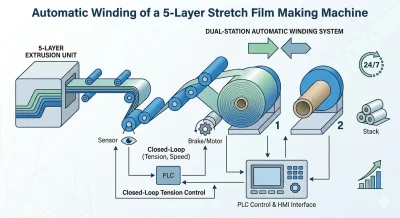
The automatic dual-station winding system is an important feature of our stretch film making machine. The two winding positions are designed to support continuous roll production by allowing the active winding station to complete a roll while the other station is prepared for the next winding cycle.
During automatic roll changing, the system coordinates film cutting, winding position changes, and the preparation of a new core. This reduces the amount of manual intervention required during routine roll changes and can help reduce production interruptions.
For high-volume stretch film manufacturing, this approach provides practical benefits. Operators spend less time performing repetitive winding operations, while the extrusion process can maintain a more consistent production rhythm. The actual changeover time depends on film width, roll diameter, line speed, film properties, and machine configuration, so production performance should always be evaluated according to the complete operating specification.
Closed-Loop Tension Control for Better Roll Formation
Winding tension has a direct influence on the structure of the finished roll. Our stretch film making machine uses tension control to help maintain stable winding conditions as the roll diameter increases.
As the roll becomes larger, the winding conditions change. A suitable control system can adjust the relevant winding parameters according to the operating state, helping maintain more consistent tension throughout the winding cycle. This is particularly important for thin stretch film, where excessive tension can have a greater influence on roll formation.
Stable tension helps reduce the risk of loose rolls, excessively tight winding, uneven roll hardness, and other winding-related defects. It also supports more consistent roll handling and downstream unwinding.
However, tension control should not be viewed as an isolated solution. Good roll formation also depends on film thickness uniformity, cooling, film temperature, line speed, and the characteristics of the resin formulation. Coordinating these factors is essential for achieving consistent winding quality.
Precise Edge Alignment for Consistent Finished Rolls
A well-formed stretch film roll requires stable lateral film positioning during winding. Our automatic winding system is designed to maintain consistent film alignment and produce cleaner roll edges.
Good edge alignment is valuable when the finished rolls are later used on automatic or semi-automatic wrapping equipment. Uneven edges or telescoping can interfere with smooth unwinding and handling, particularly when the film is produced at high speed or in thinner gauges.
The winding system therefore works together with upstream film-forming equipment. A stable film width and thickness profile provide a better foundation for consistent winding, while controlled tension and lateral positioning help maintain the shape of the finished roll.
PLC and HMI Control for Easier Winding Management
Automation also depends on how effectively operators can monitor and adjust the equipment. Our stretch film making machine integrates PLC-based control with an HMI interface to centralize key operating parameters.
Operators can monitor production conditions and adjust relevant winding settings through the control interface. Production parameters for different film specifications can also be organized and stored according to the machine configuration, helping simplify repeated production runs.
The control system can work with sensors and other feedback components to monitor operating conditions such as winding speed and tension. This provides operators with greater visibility into the winding process and makes it easier to identify abnormal conditions before they develop into larger production problems.
Automatic Cutting and Online Edge Trimming
Automatic cutting is another important function during roll changing. Coordinating the cutting operation with the dual-station winding system allows the finished roll to be separated and the next roll to begin with less manual intervention.
Online edge trimming can also help maintain consistent film width by removing uneven edges generated during the film-forming process. The trimmed material can be collected for appropriate recycling or reprocessing where the material formulation and production process allow it.
This approach helps manufacturers manage material use more systematically while keeping the winding process integrated with the rest of the production line.
How Automatic Winding Supports Different Applications
For pallet wrapping and logistics, stable roll formation can contribute to smoother film unwinding on automated wrapping equipment. In high-volume food and beverage packaging, automatic roll changing helps support continuous production with reduced operator intervention.
For electronics and industrial manufacturing, consistent rolls provide predictable handling and unwinding characteristics during packaging operations. In heavy-duty applications involving construction materials, machinery components, and other irregular loads, stable film winding helps ensure that the finished film can be handled and applied consistently.
The role of automatic winding is therefore not limited to improving machine automation. It also contributes to the consistency and usability of the finished stretch film roll.
Key Factors When Selecting a Stretch Film Making Machine
When evaluating a stretch film making machine, manufacturers should consider the winding system together with the complete extrusion process. Important factors include film width, target thickness range, production speed, roll diameter, core size, winding tension control, automatic roll-changing method, edge alignment, cooling performance, PLC control, and maintenance accessibility.
The most suitable configuration depends on the intended film structure and application. A line designed for high-volume pallet wrapping may prioritize continuous winding and automation, while thin-gauge or heavy-duty film production may place greater emphasis on tension control, thickness uniformity, and material processing stability.
Our five-layer stretch film making machine integrates multi-layer extrusion with automatic dual-station winding, tension management, PLC control, and related film-handling functions. By coordinating film formation and winding conditions, the system is designed to support consistent roll quality and efficient production for logistics, pallet wrapping, food and beverage packaging, and industrial applications.