How Upgrading Your Stretch Film Extrusion Machine Improves Efficiency, Quality & Sustainability
2026-08-31
Outdated extrusion lines have a way of quietly becoming the bottleneck that limits an entire operation. Throughput stalls, operational costs creep upward, and the gap between what a facility could produce and what it actually produces widens year after year without anyone pinpointing exactly why. Upgrading to a modern stretch film extrusion machine resolves that gap directly, replacing manual guesswork with the kind of automation and precision engineering that keeps a production line running at its full potential.
Limitations of Older Extrusion Systems in Stretch Film Production
Older extrusion systems rely heavily on manual or analog adjustments, and that dependence on operator judgment is exactly where inconsistency creeps in. Thickness variation across a roll is one of the most common results, and it tends to surface at the worst possible moment, during the extreme stretching a pallet-wrapping application demands, where a thin spot becomes a tear rather than a minor cosmetic flaw. Manual roll changeover compounds the inefficiency further, since every changeover means idle production time that a fully automated system simply does not require.
Single or mono-layer construction limits performance in a different way. Without the ability to engineer distinct functional layers, older machines are stuck offering a single compromise between puncture resistance and cling rather than optimizing each property independently. Standard cooling setups on legacy lines hold back both clarity and achievable line speed, since less efficient cooling means the melt takes longer to stabilize before it can be wound. On top of all this, high resin consumption and limited control over layer distribution mean legacy systems tend to use more material to achieve the same load-bearing performance that a precision-engineered line can deliver with less.
How Stretch Film Extrusion Performance Affects High-Volume Packaging Applications
These shortcomings are not just internal inefficiencies, they show up directly in specific applications where the stakes are higher than average. Beverage and bottled water pallet packaging is a clear example, since these loads are heavy, densely packed, and produced in high volume, which means thickness consistency and puncture resistance both need to hold steady across an entire production run. A stretch film extrusion machine prone to thickness variation risks exactly the kind of localized weak point that lets a pallet shift or a wrap fail partway through a shipment, and at beverage-industry volumes, that kind of failure repeats across enough pallets to become a real cost rather than an isolated incident.
High-volume e-commerce warehouse and logistics operations put a different kind of pressure on the same equipment. These facilities depend on continuous, high-throughput wrapping to keep pace with outbound shipping schedules, and every unplanned changeover or tension inconsistency on the line translates directly into slower fulfillment, particularly during peak shipping periods when warehouse throughput matters most. For operations running at this scale, the winding process and overall line uptime are not secondary concerns, they are the difference between meeting a shipping deadline and missing one.
Automation Built to Keep the Line Moving
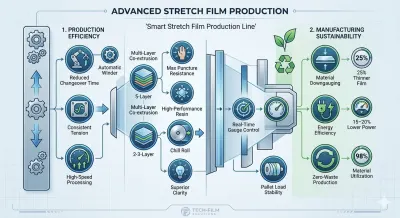
Modern stretch film extrusion machines address the uptime problem directly through PLC-based control and fully automated winding. Rather than depending on manual adjustment throughout the run, an integrated control system maintains consistent film tension from the core of the roll to the finish, which is what prevents the mid-run breaks that plague less automated lines. Automated rewinding equipment paired with these systems is capable of running at speeds up to 1,500 meters per minute, dramatically cutting the idle time that manual roll changeover would otherwise introduce into a high-volume production schedule.
On the extrusion side, higher-output configurations built around multiple independently driven screws support mechanical design line speeds up to 250 meters per minute while maintaining the structural stability needed to keep output consistent rather than sacrificing quality for speed. That combination of automated winding and high-speed, stable extrusion is exactly what allows a warehouse-scale operation to keep pace with continuous outbound shipping demand without the recurring slowdowns a legacy line would introduce.
Precision Layer Engineering for Real Load Performance
Quality improvements come from a similarly precise approach to layer structure. Rather than relying on a single compromised layer, a two-hopper casting design allows one side of the film to be engineered for adhesive cling while the other maintains a smooth, non-tacky surface, giving the finished roll functional properties suited to how it will actually be used rather than a generic middle ground. On higher-output, multi-screw configurations, independently controlled extruders allow resin to be distributed with real precision across each layer, so puncture resistance and load stability can be tuned specifically for demanding applications like beverage pallet wrapping without compromising the clarity that comes from a properly controlled cooling process.
The mechanical components behind that precision matter just as much as the layer design itself. Screws and cylinders built from nitrided alloy steel hold their dimensional accuracy and corrosion resistance far longer than standard components, which keeps output quality consistent well beyond the point where a lesser machine would already be showing wear. Water-cooling systems maintain stable melt temperature throughout the run, which is what ultimately gives the finished film its clarity and helps it hold its load-bearing performance under the stretching a pallet-wrapping application requires.
| Key Feature | Main Benefit |
|---|---|
| Precision Layer Engineering | Better cling, puncture resistance, and load stability |
| Multi-Layer Extrusion | More precise resin distribution and film performance |
| Stable Water Cooling | Improved film clarity and production consistency |
| Nitrided Alloy Components | Longer service life and stable output |
| Precise Thickness Control | Less scrap and more consistent film quality |
| Material-Efficient Design | Lower resin consumption and production costs |
| Energy-Efficient Systems | Reduced energy consumption and operating costs |
Turning Precision Into Lower Material Cost
Sustainability gains follow naturally from this same precision rather than requiring a separate set of tradeoffs. When a stretch film extrusion machine can engineer each layer's properties independently instead of relying on a single, over-built layer to cover every requirement, less resin is needed to achieve the same load-bearing performance, which reduces material cost per roll without asking customers to accept weaker film. Tighter thickness control throughout the run also means fewer thin spots and less scrap generated from inconsistent output, which compounds into meaningful material savings across a high-volume production schedule.
Energy-conscious motor and heating design further reduces the operating cost gap between an upgraded line and a legacy one, since components engineered for efficient operation draw less power to maintain the same output than older induction-based systems typically require. None of these gains depend on dramatic operational changes, they come from an extrusion platform that was engineered from the ground up to use less material and less energy while producing film that performs better under real load conditions.
Built for What Comes Next
Manufacturers under growing pressure to meet tightening environmental expectations, from regulators and from the global brand owners they supply, need equipment that can deliver strong load performance without the excess material consumption legacy lines typically require. A precision-engineered stretch film extrusion machine positions a production line to meet that expectation directly, using tighter layer control and more efficient material use to keep output competitive as sustainability requirements continue to tighten across the packaging industry.
Upgrading away from a legacy extrusion line is rarely just about chasing a faster machine, it is about closing the gap between the throughput a facility needs and what an aging system can actually deliver. Our stretch film extrusion machines are engineered around exactly that goal, combining automated winding, precision multi-layer control, and efficient thermal management to give manufacturers the consistency, durability, and material efficiency that modern beverage packaging and high-volume logistics operations depend on every single day.