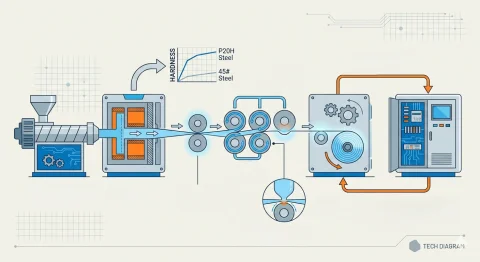
Modern packaging demands structural integrity and flawless surface quality. Our high-efficiency co-extrusion bubble film manufacturing machines are engineered for continuous, high-yield production across diverse applications. From 2-layer and 3–5-layer low-to-medium-speed lines for e-commerce mailers to advanced 7-layer high-speed industrial barrier film solutions, these systems eliminate common manufacturing defects like bubble instability, film popping, and gauge variation.
Premium Extrusion Engineering and Advanced Automation
Die geometry, metallurgy, and automation dictate overall film consistency. While standard machines utilize lower-grade 40Cr or 45# steel, our entire lineup features precision-machined P20H T-dies as a baseline standard. This premium steel resists thermal degradation and wear when processing LDPE, LLDPE, and high-percentage recycled resins. Ultra-smooth internal flow channels eliminate polymer stagnation, preventing die lines, burrs, and carbon black speck contamination. This extreme die stability ensures uniform melt distribution at mechanical outputs reaching 120 m/min on 3–5-layer lines and 150 m/min on 7-layer high-speed lines.
To lock in these tolerances, fully integrateds Siemens PLC system manage the entire production sequence, replacing unstable proprietary circuit boards. Fully closed-loop ultrasonic sensors monitor layflat width in real-time, executing automated adjustments to the haul-off and nip rolls. Concurrently, digital winding controls maintain strict tension tolerances within 0.5 Nm, completely eliminating telescoping rolls, film wrinkling, and product rejection during continuous shift changes.
Proprietary 5-Line Cooling and Ergonomic Architecture
High-output extrusion requires aggressive, uniform thermal management. Standard single-ring cooling causes localized gauge variations and film popping at high linear speeds. To solve this, our high-speed production lines integrate a proprietary 5-line cooling process. This staged architecture utilizes a primary air ring for initial melt solidification, a calibrated sizing cage to lock in precise bubble geometry, dual secondary neck stabilizers to suppress aerodynamic flutter, and a final mist-cooling collar to maximize film clarity and puncture resistance. This comprehensive thermal control maintains total bubble stability, even when processing up to 80% regrind or recycled materials.
To minimize scheduled maintenance downtime, the physical architecture separates high-wear components for rapid servicing. Hydraulic lines and electrical wiring are routed via completely separate utility trays to eliminate thermal damage and simplify troubleshooting.