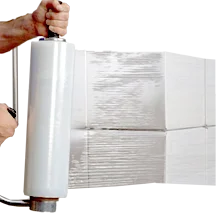
The growing demand for large-format packaging has placed new demands on stretch film production equipment. Industries such as logistics, export packaging, construction materials, and heavy-load transportation increasingly rely on wider stretch film rolls to improve packaging efficiency and reduce wrapping time. Manufacturing wider stretch film, however, requires more than simply expanding die width. Wider stretch film dimensions demand higher processing stability, more robust mechanical support, and superior thermal management throughout the extrusion process.
Maintaining consistent stretch film quality across a wide web is a major engineering challenge in stretch film line design. As web width increases, the volume of molten polymer processed through the extrusion system increases, placing higher demands on temperature control, cooling efficiency, and machine rigidity. Heavy-duty machine structures and advanced cooling systems are essential to achieve stable production, uniform thickness control, and reliable stretch film performance.
Thermal Challenges in Wide-Web Stretch Film Production
To manage the increased thermal load of wide-web stretch film production, modern stretch film lines utilize more efficient cooling systems. Advanced closed-loop cooling designs deliver more precise temperature control and process stability.
A closed-loop cooling system continuously monitors water temperature and flow rates, maintaining stable operating conditions throughout extended production runs. Temperature sensors and automatic control systems minimize thermal fluctuations caused by variations in production speed, ambient conditions, or material characteristics.
The cooling process typically utilizes multiple stages. The primary chill roll rapidly quenches the molten web upon exiting the die. This rapid heat removal locks in stretch film properties and enhances surface finish.
Following primary quenching, additional cooling rolls further reduce core web temperature and relieve residual thermal stress. This gradual cooling process is critical for wide-web stretch film production to prevent shrinkage, inconsistent tension, and deformation during subsequent stretching and winding.
A properly designed cooling system also enhances optical and mechanical properties. Controlled solidification ensures consistent clarity, stable elongation, and reliable puncture resistance—essential for industrial packaging applications.
The Importance of Advanced Cooling Systems for Wide Film Production
To handle the increased thermal load of wider film production, modern stretch film making machines are equipped with more efficient cooling systems. Compared with simple cooling methods, advanced closed-loop cooling designs provide more precise temperature management and better production stability.
A closed-loop cooling system continuously monitors water temperature and flow conditions, allowing the cooling circuit to maintain stable operating conditions during long production periods. Temperature sensors and automatic control systems help reduce fluctuations caused by changes in production speed, ambient conditions, or material characteristics.
The cooling process usually involves multiple stages. The primary chill roll performs the initial cooling of the molten film immediately after it exits the die. This rapid heat removal helps establish the basic film structure and improves surface quality.
After the initial cooling stage, additional cooling rolls further reduce the internal temperature of the film and help release thermal stress. This gradual cooling process is important for wide film production because it reduces the risk of shrinkage, uneven tension, and deformation during subsequent stretching and winding.
A properly designed cooling system also supports better optical and mechanical properties. Controlled solidification helps manufacturers produce stretch films with consistent clarity, stable elongation, and reliable puncture resistance, which are important characteristics for industrial packaging applications.
Feed Zone Temperature Control for Stable Extrusion
Beyond stretch film quenching, temperature in the extrusion feed zone is critical to high-output stretch film production.
During continuous operation, heat generated inside the extrusion barrel can migrate toward the feed throat area. Without proper thermal management, excessive heat causes polymer pellets to soften prematurely before entering the screw channel, leading to pellet bridging, inconsistent solids conveying, and melt pressure fluctuations.
Advanced stretch film line designs feature independent cooling jackets to maintain optimal resin temperatures prior to melting. By keeping the feed section at a stable temperature, the system ensures stable resin transport and prevents feeding interruptions.
Stable feeding is essential to maintain consistent output. When material conveying remains uniform, the extrusion system maintains steady melt pressure, enabling tighter gauge control and superior stretch film quality.
Why Wider Webs Require Heavy-Duty Machine Structures
The mechanical structure of a stretch film line is critical as web width and throughput increase. Wider lines require larger chill rolls, higher-torque drive systems, and heavy-duty structural frames. These demands necessitate greater machine mass and structural rigidity.
A heavy-duty machine frame ensures dynamic stability during continuous operation. Large cooling rolls and drive systems generate significant mechanical forces and vibration during high-speed production. A rigid frame dampens these forces and maintains precise mechanical alignment across all processing zones.
Mechanical stability directly impacts web quality. Precise alignment among extrusion, cooling, orientation, and winding systems maintains uniform tension across the web. This prevents wrinkles, edge defects, and poor roll formation.
For wide-web producers, equipment rigidity is essential, as production interruptions or quality fluctuations cause substantial resin waste. A well-designed heavy-duty structure extends production runs and enhances overall equipment reliability.
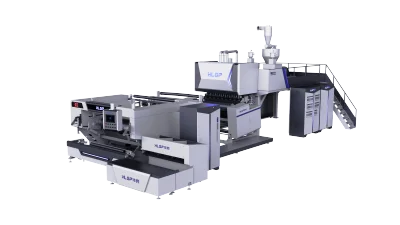
Production Advantages of Heavy-Duty Stretch Film Machines
A properly engineered heavy-duty stretch film line delivers key operational advantages for high-output, wide-web manufacturing.
Precise thermal management ensures stretch film consistency by maintaining uniform cooling throughout the process. This yields tighter gauge tolerances, superior layer distribution, and reliable mechanical properties.
Robust mechanical construction enhances operational stability by suppressing vibration and maintaining precise component alignment. This is critical during high-speed production, where minor mechanical deflection degrades stretch film quality.
Furthermore, consistent extrusion and cooling performance minimize resin scrap. Stable processing conditions eliminate defects stemming from thermal fluctuations, feed instability, or uneven winding tension. For continuous production operations, these performance gains drive higher throughput and lower operating costs.
Heavy-Duty Stretch Film Machines for Wide-Width Film Production
As packaging requirements evolve, wider stretch film formats remain an essential solution for optimizing efficiency in industrial wrapping applications. However, producing high-quality wide-web stretch film requires equipment capable of handling higher extrusion output, greater thermal loads, and higher mechanical demands.
Our stretch film line is designed with a focus on process stability, precise temperature management, and durable mechanical construction. By integrating efficient cooling systems, reliable extrusion control, and a rigid machine structure, our equipment provides manufacturers with a dependable solution for producing high-quality stretch films across different industrial applications.
Whether producing standard packaging stretch film or wider industrial-grade stretch film, selecting a machine with the optimal thermal and mechanical design ensures consistent output, minimized downtime, and long-term production reliability. With advanced engineering and practical manufacturing experience, our equipment empowers producers to achieve efficient and stable stretch film production.