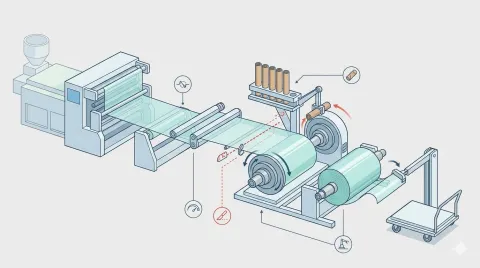
The growing demand for high-quality stretch film in logistics, industrial packaging, and automated warehouse operations has increased the requirements for film production equipment. Manufacturers need production lines that can deliver consistent thickness, stable mechanical properties, and efficient operation while reducing material waste during continuous production.
An advanced stretch film manufacturing machine plays an important role in achieving these goals by integrating precise extrusion control, multi-layer co-extrusion technology, and automated rewinding systems. Among these technologies, the rewinding process has a direct influence on final roll quality, production efficiency, and overall line stability.
Traditional rewinding systems often require manual operations during roll replacement, which can create production interruptions and increase the risk of film defects. To overcome these limitations, modern stretch film production lines are increasingly equipped with automatic rewinder systems designed to complete roll changing, film cutting, and core replacement with improved accuracy and efficiency.
Improving Production Stability with an Automatic Rewinder System
In a conventional stretch film production process, the rewinding stage is one of the key areas affecting continuous operation. When a finished roll reaches the preset length or diameter, the production line needs to complete film cutting and replace the paper core before starting the next roll.
Without an efficient automatic rewinding solution, operators may need to manually handle the roll change process. During high-speed production, this operation can affect line continuity and may result in unstable winding tension, film wrinkles, or unnecessary material loss.
A stretch film manufacturing machine equipped with a patented rewinder system optimizes this transition process through automated core positioning, synchronized film cutting, and controlled roll unloading. The system allows the extrusion and casting sections to maintain stable operation while reducing dependence on manual adjustment.
By improving the connection between film production and rewinding, manufacturers can achieve a smoother workflow from polymer extrusion to finished roll packaging.
High-Precision Flying Knife Cutting and Core Exchange Technology
The automatic rewinder system uses a synchronized cutting mechanism to separate the completed film roll from the continuous film web. The flying knife assembly operates according to the production speed and roll condition, ensuring a clean and accurate cutting process.
Compared with manual cutting methods, automated cutting reduces common issues such as uneven film edges, excessive film tails, and inconsistent roll appearance. A precise cutting cycle also helps minimize material waste during roll replacement.
After film cutting, the automatic core changing mechanism quickly positions a new paper core into the winding station. The coordinated movement between the cutting system, winding shaft, and core loading structure improves production efficiency while maintaining stable film handling.
Advanced Tension Control for High-Quality Stretch Film Rolls
Winding tension is a critical factor affecting the performance of finished stretch film rolls. During the production of thin gauge films, especially multi-layer stretch films, unstable tension control may lead to uneven roll hardness, edge deformation, or inconsistent stretching performance.
A modern stretch film manufacturing machine integrates closed-loop tension control technology to maintain stable winding conditions throughout the entire roll-building process. Sensors continuously monitor film tension, and the control system adjusts motor output according to real-time production conditions.
This automatic adjustment helps maintain uniform tension from the inner layer to the outer layer of the finished roll. As a result, the produced stretch film can achieve better roll appearance, improved edge stability, and more reliable performance during transportation and pallet wrapping applications.
For machine-grade stretch film used in automated packaging systems, stable winding quality is especially important because irregular rolls can affect wrapping efficiency and increase the possibility of film breakage during operation.
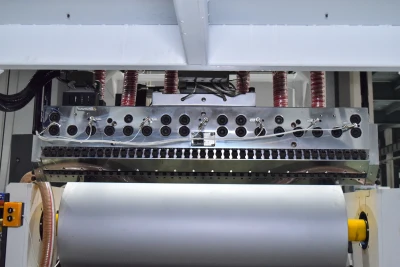
Reducing Material Waste Through Intelligent Rewinding Control
Material efficiency is an important consideration for modern stretch film manufacturers. Raw materials represent a significant part of production costs, and reducing unnecessary waste directly improves manufacturing profitability.
The automatic rewinder system helps reduce waste by improving the accuracy of film cutting and roll transition. Compared with traditional manual operations, automated systems can better control the starting and ending positions of each roll, reducing excessive film loss during changeovers.
In addition, stable rewinding conditions help prevent defects such as wrinkles, loose winding structures, and uneven roll formation. These improvements contribute to higher product consistency and reduce the amount of film that needs to be downgraded or discarded.
When combined with precise extrusion control and thickness monitoring technology, an automatic rewinding solution helps manufacturers maximize material utilization throughout the entire production process.
Technical Advantages of Stretch Film Manufacturing Machine with Automatic Rewinder
Modern industrial stretch film production lines are designed to support continuous manufacturing requirements while maintaining product quality. Depending on production needs, the machine configuration can support different film structures and application requirements.
Typical technical features include:
Film Structure: Two-layer, three-layer, and multi-layer co-extrusion configurations.
Film Thickness Range: Suitable for thin gauge stretch film production from approximately 10 microns to 35 microns according to material selection and application requirements.
Production Speed: Designed according to different machine configurations, film specifications, and production conditions.
Automatic Rewinding System: Integrated roll changing, film cutting, and paper core replacement functions for improved production continuity.
Control System: PLC-based operation with touchscreen interface, production parameter management, and real-time monitoring functions.
Tension Control: Closed-loop adjustment system to maintain stable winding quality during continuous operation.
The specific performance of each production line depends on machine configuration, raw material characteristics, operator experience, and production environment. A professional equipment supplier can provide customized solutions according to different film types and output requirements.
Enhancing Manufacturing Capability for Global Packaging Markets
As packaging industries continue to require more efficient and reliable film solutions, stretch film manufacturers are focusing on improving automation levels and production stability. A stretch film manufacturing machine with an advanced automatic rewinder system provides an effective solution for companies looking to improve output consistency, reduce production waste, and optimize labor efficiency.
The patented rewinding system developed for modern production lines helps solve common challenges in traditional roll changing processes by improving automation, reducing manual intervention, and maintaining stable film quality throughout production.
For manufacturers producing industrial stretch film, machine-grade stretch film, and high-performance packaging films, selecting reliable equipment with advanced rewinding technology is essential for long-term production efficiency.
With professional experience in stretch film machinery design and manufacturing, we provide high-performance stretch film manufacturing machines equipped with advanced rewinding solutions, precise tension control systems, and flexible production configurations. Our machines are engineered to help customers achieve stable film quality, efficient operation, and reliable performance for different packaging applications. Contact us to discuss your production requirements and find a suitable stretch film production solution for your business.