Stop Stopping Your Stretch Film Extrusion Machine: Eliminate Winding Downtime
2026-07-03
In modern packaging manufacturing, stretch film extrusion machines are expected to deliver not only high output but also uninterrupted production stability. As production speeds continue to increase and multi-layer film structures become more complex, the winding section has become one of the most critical bottlenecks in the entire extrusion line. Even a short interruption during roll change can destabilize the entire system, affecting melt pressure, film quality, and overall equipment efficiency.
For manufacturers producing both standard 2-layer pallet wrap films and advanced 5-layer stretch films, winding performance directly determines whether the line can maintain consistent quality and output. Eliminating winding downtime is no longer an optional upgrade but a core requirement for competitive production.
The Hidden Instability Behind Traditional Winding Systems
In conventional stretch film extrusion machines, roll changes are often handled through semi-automatic or manually assisted winding systems. While these configurations may appear functional at lower production speeds, they introduce serious instability in high-output environments.
A key issue is the delay during roll change. Even a 30-second interruption in winding can trigger a cascade of process disruptions. The extrusion screw responds immediately to changes in back-pressure, causing fluctuations in melt flow. These fluctuations disturb layer uniformity in co-extruded structures, particularly in multi-layer films where each layer depends on precise flow balance from the feedblock.
As a result, manufacturers often experience inconsistent film thickness, gel formation, and localized degradation of polymer chains inside the die. Once these defects appear, they cannot be corrected downstream and often lead to downgraded or scrapped rolls.
Another limitation of traditional systems is unstable tension control. Without advanced feedback regulation, tension varies significantly as roll diameter increases. This leads to issues such as telescoping, uneven roll hardness, and wrinkling. In high-performance applications where stretch film must maintain controlled pre-stretch ratios, these defects directly reduce product reliability.
Why Winding Stability Defines Extrusion Line Performance
The winding unit is not simply a collection system; it is an active component of process control. In stretch film extrusion machines, any variation in winding speed or tension immediately reflects back into the extrusion system.
When roll change causes a temporary slowdown or stoppage, the extruder does not operate in a steady-state condition. Instead, melt temperature distribution becomes unstable, and polymer residence time inside the die increases. This creates thermal stress, carbon buildup, and inconsistent layer distribution across the film width.
After restart, the system typically requires 10 to 15 minutes to stabilize fully. During this period, film produced is often outside acceptable thickness tolerances. For high-volume manufacturers, this stabilization phase results in significant material waste and reduced overall equipment effectiveness.
This is why modern production lines are increasingly focused on eliminating winding interruptions entirely rather than simply minimizing them.
High-Speed Automatic Winding Systems as a Structural Upgrade
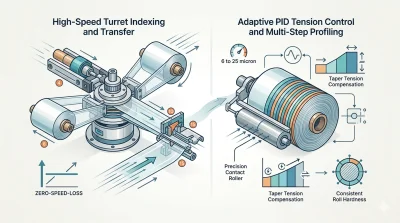
Modern stretch film extrusion machines are increasingly integrated with fully automatic turret winding systems designed to eliminate speed loss during roll changes. These systems use servo-driven indexing mechanisms that allow continuous production without deceleration.
In advanced configurations, roll transfer can be completed in less than 0.8 seconds, effectively eliminating any measurable interruption in the extrusion process. The film is automatically cut, clamped, and transferred to a new core while maintaining constant line speed, often reaching up to 250 meters per minute.
This zero-speed-loss transfer is essential for maintaining stable back-pressure in the extruder. With consistent pressure, the melt flow remains uniform, ensuring that each layer in a multi-layer structure retains its designed thickness ratio. For 5-layer stretch film machines producing ultra-thin nano films, this stability is particularly critical, as even minor fluctuations can affect optical clarity, puncture resistance, and pre-stretch performance.
By maintaining uninterrupted flow, the system ensures that film quality remains consistent from the first meter to the final layer of every roll.
Adaptive Tension Control for Multi-Layer Film Precision
A major advancement in modern winding technology is the integration of adaptive PID tension control systems. These systems continuously monitor and adjust winding force based on real-time feedback from roll diameter, film thickness, and material behavior.
As the roll grows, tension must be carefully reduced to prevent excessive compression of inner layers. Without this control, core deformation and internal stress buildup can occur, compromising roll integrity. Adaptive control systems solve this problem by applying taper tension compensation, automatically reducing torque as diameter increases, often up to 1200 mm final roll size.
This ensures consistent roll hardness from core to outer layers, which is essential for maintaining mechanical stability during storage and transportation.
In addition, precise tension control eliminates common defects such as film wrinkling, air entrapment between layers, and uneven winding edges. These improvements are especially important for stretch film extrusion machines designed for high pre-stretch ratios ranging from 100% to 250%, where film uniformity directly affects end-use performance in pallet wrapping applications.
Multi-Step Tension Profiling for Advanced Film Structures
For multi-layer co-extrusion systems, simple tension control is no longer sufficient. Advanced winding systems now utilize multi-step tension profiling strategies that adjust parameters dynamically across different production stages.
During the initial winding phase, higher tension ensures stable lay-flat formation. As diameter increases, the system gradually transitions to lower tension modes to protect inner layers. This staged approach allows manufacturers to process ultra-thin films in the range of 6 to 25 microns without sacrificing structural integrity.
By tailoring tension curves to specific film recipes, stretch film extrusion machines can achieve higher consistency in puncture resistance, elongation strength, and optical clarity. This level of control is especially important in high-performance packaging applications where film failure is not acceptable.
Production Efficiency and Measurable OEE Improvement
One of the most significant advantages of upgrading to fully automatic winding systems is the measurable improvement in overall equipment effectiveness. By eliminating roll change downtime and reducing stabilization periods after restart, manufacturers can achieve substantial gains in productivity.
In practical industrial applications, upgrading winding systems on stretch film extrusion machines has been shown to improve OEE by approximately 12% to 18%. This improvement is primarily driven by reduced downtime, lower scrap rates, and more stable continuous operation.
Additionally, maintaining steady-state extrusion conditions prevents polymer stagnation inside the die, reducing carbon buildup and extending equipment maintenance intervals. This results in lower operational costs and improved long-term reliability of the entire production line.
Material waste is also significantly reduced, as fewer off-specification rolls are produced during start-stop cycles. Over time, these savings accumulate into a substantial reduction in production costs, particularly in high-volume manufacturing environments.
Building a Fully Continuous Extrusion Process
The evolution of stretch film extrusion machines is moving toward fully continuous production systems where every component is synchronized for uninterrupted operation. In this context, the winding system is no longer a secondary module but a central element of process stability.
By integrating high-speed automatic winding, adaptive tension control, and intelligent profiling systems, manufacturers can eliminate the traditional limitations associated with roll change downtime. The result is a production line that operates in true steady-state conditions, maximizing output while maintaining strict quality control.
For manufacturers producing both standard pallet wrap films and advanced multi-layer nano films, this transition represents a major technological upgrade. It transforms extrusion from a stop-start process into a continuous, highly controlled manufacturing system.
The Future of High-Efficiency Stretch Film Manufacturing
Winding performance is no longer a secondary consideration in modern stretch film extrusion machines—it is a decisive factor in overall production competitiveness. As global demand for higher output, tighter gauge control, and more consistent roll quality continues to increase, manufacturers need equipment that ensures uninterrupted, stable operation from start to finish.
By integrating fully automatic high-speed winding systems with adaptive tension control and zero-speed-loss transfer technology, stretch film production lines can achieve a new level of efficiency and reliability. These advanced systems not only eliminate winding downtime but also optimize the entire extrusion process by stabilizing melt pressure, improving film uniformity, and reducing material waste.
For manufacturers aiming to upgrade their production capability, adopting an advanced winding solution is a direct investment in higher output, better product consistency, and lower operational cost. Our stretch film extrusion machines are engineered to deliver this level of performance, helping customers build truly continuous, high-efficiency production lines that meet the demands of today’s competitive global packaging market.