How Smart Winders on Stretch Film Extrusion Machines Boost Net Profit
2026-07-02
In modern packaging manufacturing, the winding section of stretch film extrusion machines plays a decisive role in both product quality and overall plant profitability. While extrusion and co-extrusion systems are often seen as the “core technology” of production lines, the profit loss frequently originates at the final stage of winding.
Defects such as telescoping rolls, edge wrinkles, inconsistent tension distribution, and excessive trimming waste directly reduce usable output and increase operational costs. As production speeds continue to increase across 2-layer, 3-layer, and 5-layer stretch film extrusion lines, traditional winding systems are no longer sufficient to maintain stable quality. This is where smart winder technology becomes a critical upgrade, transforming Stretch Film Extrusion Machines into high-efficiency, profit-optimized systems.
The Hidden Profit Loss in Conventional Winding Systems
In many conventional Stretch Film Extrusion Machines, the winding section is still based on open-loop or semi-automatic control systems. Although these systems can operate under basic conditions, they lack the precision required for modern high-speed production.
One of the most common issues is inconsistent tension control. As roll diameter increases during winding, the tension behavior changes significantly. Traditional systems cannot dynamically adjust taper tension in real time, leading to internal stress imbalance. This results in telescoping rolls, where layers shift sideways and cause unstable roll geometry.
Another frequent problem is surface wrinkling. Without precise edge control and air management, film layers may trap air or deviate during winding. This creates uneven roll surfaces, which not only affect appearance but also reduce functional performance during downstream pallet wrapping applications.
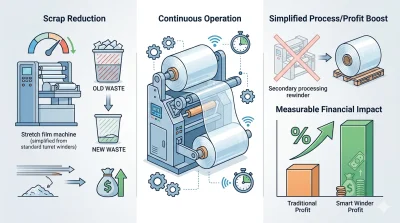
Edge waste is another major contributor to profit loss. Conventional systems typically generate 3% to 5% trimming waste due to unstable edge control and inconsistent film laydown. Over long production cycles, this waste translates into significant raw material losses, especially in high-output facilities.
Finally, downtime caused by frequent roll changes and secondary rewinding further reduces operational efficiency. In traditional systems, non-continuous winding leads to production interruptions that directly reduce OEE (Overall Equipment Effectiveness).
Why Traditional Stretch Film Extrusion Machines Struggle at High Speed
As demand for high-performance stretch film continues to grow, manufacturers increasingly rely on multi-layer co-extrusion technologies such as 2-layer, 3-layer, and 5-layer film structures. These advanced configurations require extremely stable winding behavior due to their complex layer composition and tighter gauge tolerance requirements.
However, conventional winding systems are not designed for such precision. At higher line speeds, even small fluctuations in tension or edge alignment can cause cumulative defects across long production runs. This instability becomes more severe in wide-width films and high-output production lines.
In addition, traditional systems lack real-time feedback mechanisms. Without closed-loop monitoring, adjustments are reactive rather than predictive. This limits the ability of Stretch Film Extrusion Machines to maintain consistent quality across varying production conditions such as temperature drift, resin variation, or speed changes.
Smart Winder Technology: A New Standard for Stability and Control
Smart winders introduce a fundamentally different approach to winding control in Stretch Film Extrusion Machines. Instead of relying on static parameters, they use real-time feedback systems to continuously optimize tension, alignment, and roll formation.
At the core of this system is closed-loop tension control. Sensors continuously measure actual film tension at the nip point, allowing the system to automatically adjust taper tension as the roll diameter increases. This ensures that internal stress remains stable from the core to the outer layers, significantly reducing the risk of telescoping and deformation.
Another key innovation is dynamic edge stabilization. By actively controlling air flow and film positioning at the winding interface, smart winders prevent edge wandering and eliminate air entrapment. This results in smoother roll surfaces and more consistent roll geometry, even at high production speeds.
For multi-layer co-extrusion lines, smart winders also maintain inter-layer stability. Whether operating on a 2-layer stretch film machine for standard packaging applications or a 5-layer system for high-performance industrial films, the winding system ensures that layer integrity is preserved throughout the entire roll formation process.
Continuous Winding and Waste Reduction Advantages
One of the most significant advantages of smart winding systems is the ability to support non-stop roll change functionality. In traditional Stretch Film Extrusion Machines, roll changes require machine slowdown or temporary stoppage, which creates waste at the beginning and end of each roll.
Smart winders eliminate this inefficiency by enabling continuous winding transitions. This reduces downtime and ensures that production remains stable even during roll change operations. As a result, factories can achieve higher throughput without increasing line speed.
Material efficiency is also significantly improved. By maintaining precise tension and edge control, smart winders reduce edge trimming waste to below 1% in optimized production environments. Compared to conventional systems, this represents a substantial improvement in raw material utilization, especially for large-scale manufacturers processing tons of resin daily.
In addition, the elimination of secondary rewinding processes reduces labor dependency and machine utilization costs. Finished rolls produced directly from the extrusion line meet quality standards without additional processing, streamlining the entire production workflow.
Measurable Impact on Net Profit and Production Efficiency
The integration of smart winders into Stretch Film Extrusion Machines delivers measurable financial improvements across multiple operational dimensions.
Raw material savings represent one of the most significant gains. By reducing waste from 3–5% down to below 1%, manufacturers can save substantial amounts of polymer resin annually. Given the scale of industrial production, even small percentage improvements translate into large cost reductions.
Operational efficiency also increases due to reduced downtime and improved continuous production capability. Non-stop winding reduces interruptions, allowing higher effective production hours and improving overall equipment efficiency (OEE).
Product quality consistency leads to additional indirect financial benefits. Fewer defective rolls mean lower rejection rates, reduced customer complaints, and stronger market competitiveness. This improves brand reliability and strengthens long-term customer relationships.
System-Level Optimization Across Multi-Line Production
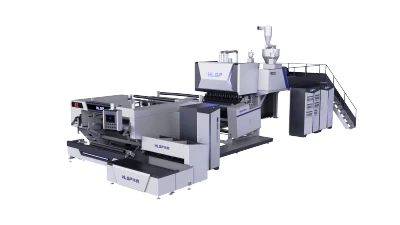
Many manufacturing facilities operate multiple stretch film extrusion machines simultaneously, often combining different configurations to serve diverse market needs. Our typical setup include a 2-layer stretch film machine for general-purpose packaging, a 3-layer machine for enhanced mechanical performance, and a 5-layer machine for premium industrial applications.
Smart winder technology provides a unified control advantage across all these systems. By standardizing winding performance, factories can ensure consistent output quality regardless of machine configuration. This reduces variability between production lines and simplifies quality management processes.
Furthermore, centralized optimization of winding parameters allows manufacturers to fine-tune production strategies based on product type, resin cost, and customer requirements. This level of control enhances overall plant flexibility and profitability.
Smart Winders as a Profit Engine for Modern Production
The evolution of stretch film extrusion machines is no longer defined only by extrusion speed or co-extrusion capability. The winding section has become a critical determinant of final profitability.
Smart winders transform this traditionally overlooked stage into a precision-controlled profit engine. Through closed-loop tension management, dynamic edge stabilization, continuous winding capability, and waste reduction, manufacturers can significantly improve both product quality and operational efficiency.
In highly competitive packaging markets, these improvements directly translate into measurable financial gains. By upgrading to smart winding systems, manufacturers are not only improving their machines—they are fundamentally enhancing their entire production profitability model.