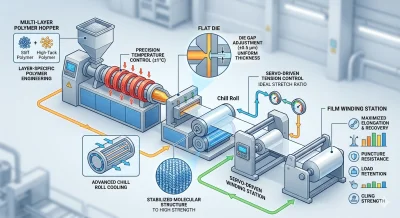
In high-speed stretch film manufacturing, precision is the difference between premium output and costly waste. Modern production demands—ranging from 2-layer cardboard bundling films to advanced 5-layer co-extruded barrier films—require absolute control over every mechanical variable. The Programmable Logic Controller (PLC) serves as the central nervous system of these machines, transforming complex extrusion processes into a streamlined, high-efficiency operation.
Precision Control for Superior Film Quality
The primary function of a PLC control system is to manage the critical parameters of the extrusion process. By integrating real-time data acquisition and closed-loop feedback, the PLC ensures:
- Thermal Stability: It maintains extruder barrel temperatures within a precise ±1°C range, ensuring melt consistency.
- Layer Uniformity: For 3-layer and 5-layer machines, the PLC synchronizes motor drives to achieve exact thickness tolerances, typically between 7 to 25 microns.
- Optimized Film Properties: Precise regulation enhances the film's elongation, puncture resistance, and cling performance—essential for load stability in heavy-duty applications.
Dynamic Tension and Speed Synchronization
A major challenge in stretch film production is maintaining consistent tension during high-speed winding. The PLC system utilizes adaptive algorithms to modulate tension control assemblies. This prevents common defects such as film stretching, wrinkling, or breakage.
- Reduced Material Waste: Precise tension management can reduce film breakage by up to 30%.
- High-Speed Output: In fully automatic lines, PLC-driven synchronization allows for production speeds of up to 180 rolls per hour while maintaining pre-stretch ratios of 250%–300%.
Operational Agility and Maintenance
The transition to PLC-based automation allows factories to handle diverse film structures (like A/B/A co-extrusion) with minimal downtime.
- Rapid Recipe Switching: Changeover times between different film specifications are reduced from hours to minutes through pre-programmed digital recipes.
- Predictive Maintenance: Modern PLCs analyze wear on heaters, drives, and rollers. By forecasting component fatigue, these systems can extend the overall machine lifespan by 20–40%.
Industry 4.0 and Future Efficiency
The evolution of the stretch film manufacturing machine is moving toward Industry 4.0 integration. Cloud-connected PLCs now enable remote diagnostics and real-time OEE (Overall Equipment Effectiveness) dashboards. This technical integration results in:
- Energy Savings: Optimization of motor and heater cycles can reduce energy consumption by 15–25%.
- Data-Driven Optimization: AI-assisted parameter tuning ensures zero-defect production even with volatile raw material grades.
- By centralizing control and automating critical adjustments, PLC systems ensure that stretch film production remains stable, efficient, and capable of meeting the highest industrial standards.