How is the Tack of Stretch Film Extrusion Machine Generated?
2026-09-02
Tack, or cling, is what allows a roll of stretch film to hold itself against a pallet load without adhesives, hooks, or straps. It sounds like a small detail, but it is often the single property that decides whether a wrapped load survives transit intact or arrives loose and shifted. Understanding how a stretch film extrusion machine actually generates and controls this tack is essential for anyone trying to improve load stability, reduce film usage, or cut down on damaged shipments.
Where Inconsistent Cling Really Comes From
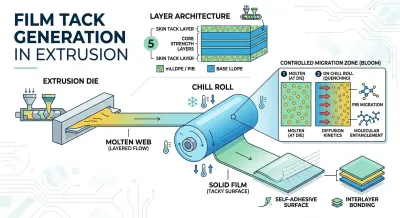
Tack is not simply added to stretch film; it is influenced by polymer selection, formulation, layer structure, and extrusion conditions. Polyisobutylene (PIB) is commonly used to improve cling, while selected mLLDPE grades can contribute to the balance of stretchability, strength, and adhesion. In multilayer stretch film, these materials can be assigned to different layers according to their intended function, giving manufacturers greater control over surface cling and core mechanical properties.
Temperature stability is also important. Variations in melt temperature, flow, cooling, or film thickness can affect the consistency of stretch film surface properties from one production run to another. Stable extrusion conditions help maintain more predictable film performance.
High stretch ratios add another challenge. During wrapping, the stretch film is elongated and the outer layers are also deformed. If the formulation and layer distribution are not properly matched to the target stretch level, cling performance may not remain consistent after stretching. Precise layer-specific control therefore helps manufacturers balance cling, strength, and stretchability more effectively.
Why Reliable Cling Matters Across Different Loads
These technical shortcomings translate directly into real packaging failures across a wide range of industries. In food and beverage pallet packaging, inconsistent tack means individual wrap layers do not bond securely to one another. Under the vibration and shifting that comes with standard freight transport, that weak interlayer bond allows cases to loosen and shift within the wrap, even when the film itself never tears.
Hardware and building material loads present a different challenge. These products are frequently irregular in shape, with sharp corners, uneven stacking profiles, and protruding edges. A film without sufficient surface tack cannot conform tightly around these irregularities, leaving gaps where the wrap fails to grip and the load loses containment exactly at its weakest points.
High-speed automatic wrapping lines are especially sensitive to tack variability. These systems are calibrated around an expected film cling and tension profile, so when incoming film batches show inconsistent tack, operators are forced to make frequent manual adjustments to wrapping tension just to keep loads secure. That constant recalibration slows down throughput and introduces variability into what should be a fully automated process.
Precision Engineering Behind Reliable Tack Performance
A properly engineered stretch film extrusion machine addresses tack generation at its source, starting with true layer-specific formulation control. Rather than blending tackifiers into a single film layer, multi-layer co-extrusion allows PIB or mLLDPE to be concentrated specifically in the outer skin layers, while the core layer is optimized independently for structural strength. This separation of function is what allows a film to deliver strong, consistent cling without sacrificing puncture resistance or overall toughness — two properties that would otherwise work against each other in a simpler single-layer design.
Closed-loop temperature and pressure control across the extrusion and chill roll cooling stages is what keeps this migration process repeatable from roll to roll. By holding thermal conditions steady as the melt passes over the chill roll, additive bloom occurs uniformly across the full width of the film and consistently from the beginning of a production run to the end. This is the difference between a film that clings reliably every time it is unrolled and one that varies unpredictably depending on which section of the roll is being used.
Layer-specific formulation flexibility adds another dimension of control. Because outer and core layers can be adjusted independently, extrusion parameters and tackifier ratios can be tuned to match different climate conditions or application requirements — a film destined for a humid coastal warehouse can be formulated differently from one built for a cold, dry logistics environment, without changing the underlying machine platform.
Turning Precise Tack Control Into Dependable Load Security
When formulation precision, thermal stability, and stretch ratio control all work together, the practical benefits are immediate and measurable. In food and beverage pallet packaging, our stretch film extrusion machines produce film with consistent interlayer bonding, so wrapped cases stay securely bundled even after the vibration and handling of standard freight transit. For hardware and building material loads with irregular shapes and sharp edges, our machines are engineered to maintain strong surface tack even under high stretch ratios, allowing the film to conform tightly around corners and protrusions rather than leaving gaps in coverage. On high-speed automatic wrapping lines, film produced with stable, batch-to-batch consistent tack reduces the need for constant tension recalibration, helping operators keep throughput steady and unplanned stops to a minimum.
This is the core advantage we build into every stretch film extrusion machine we manufacture — precise, layer-specific control over how and where tack develops, rather than leaving it to chance. Whether producing 2-layer film for standard manual wrap applications, 3-layer film that balances cost and performance for general logistics use, or 5-layer film with a dedicated tack layer for premium pre-stretch applications, our machines are designed to deliver the same underlying benefit: cling performance that customers can count on, roll after roll. For operations where load containment, material efficiency, and packaging line uptime all depend on getting tack right, that is exactly what our stretch film extrusion machines are built to deliver.