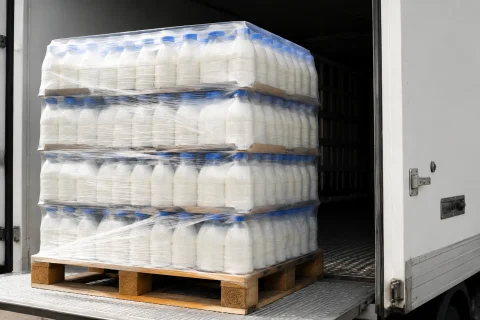
The dairy industry requires reliable packaging solutions to maintain product safety and stability throughout refrigerated transportation. Milk cartons, yogurt cups, cheese blocks, and frozen dairy products often experience challenging conditions, including low temperatures, moisture exposure, vibration, and long-distance handling. Conventional stretch films may lose adhesion, tear under heavy loads, or provide insufficient protection in cold chain environments. A modern stretch film manufacturing machine enables producers to manufacture high-performance stretch films with customized layer structures, improved mechanical properties, and consistent quality for demanding dairy logistics applications.
Dairy Logistics Packaging Challenges in Cold Chain Transportation
Dairy products require strict temperature control from production facilities to distribution centers and retail locations. During cold storage and transportation, packaging materials must continue providing stable load containment despite environmental changes. Refrigerated warehouses commonly operate at temperatures close to 0°C, while frozen dairy products may be stored and transported at temperatures below -20°C. These conditions create additional requirements for stretch film performance.
One of the main challenges in dairy logistics is maintaining film adhesion in low-temperature environments. Standard stretch films may experience reduced cling performance when exposed to cold air or frost, causing wrapped pallets to become loose during handling. When pallet stability decreases, cartons or containers can shift during transportation, increasing the possibility of product damage.
Heavy dairy pallets also create significant mechanical stress on packaging films. Products such as cheese blocks, butter cartons, and large liquid dairy containers often generate high load pressure. Sharp carton corners, plastic crate edges, and uneven pallet surfaces can puncture low-strength films. Without sufficient puncture resistance, the film may break during wrapping or transportation, affecting the overall security of the pallet.
Moisture is another important factor in refrigerated logistics. Condensation, ice formation, and humidity exposure can weaken corrugated cartons and affect packaging durability. Stretch film used for dairy transportation needs to provide a protective barrier that helps reduce moisture penetration while maintaining the required flexibility and strength.
In addition, dairy companies often handle different product categories with different packaging requirements. Lightweight yogurt cups require flexible films that prevent excessive compression, while frozen butter and cheese products require stronger films with higher load retention capability. A single standard film structure may not provide the optimized balance between elasticity, strength, and adhesion for all applications.
The Role of Stretch Film in Dairy Cold Chain Packaging
Stretch film plays an important role in securing dairy products throughout the supply chain. By applying controlled stretching force during pallet wrapping, the film creates recovery tension that holds products together and reduces movement during transportation. This load containment function is essential for maintaining pallet integrity during loading, unloading, and long-distance delivery.
High-performance stretch films used in dairy logistics are typically designed with multiple functional layers. Each layer can provide different characteristics, such as surface cling, impact resistance, tensile strength, and flexibility. Through advanced resin selection and layer distribution, manufacturers can produce films that are better adapted to refrigerated and frozen environments.
For cold chain applications, low-temperature cling performance is particularly important. Specialized film formulations help maintain self-adhesion even when exposed to freezing conditions. This allows wrapped pallets to remain secure during storage in cold rooms and transportation in refrigerated vehicles.
The mechanical strength of stretch film also directly influences packaging reliability. Multi-layer films produced with optimized structures can improve puncture resistance and reduce the risk of film failure caused by sharp edges or heavy loads. This is especially valuable for dairy pallets containing dense products such as cheese blocks, butter packages, and mixed beverage cartons.
Another advantage of high-performance stretch film is material efficiency. Films with higher tensile strength and controlled elasticity can achieve the required load stability with reduced thickness compared with traditional packaging films. This helps dairy companies improve packaging efficiency while maintaining transportation safety.
How Stretch Film Manufacturing Machine Supports Dairy Packaging Production
A modern stretch film manufacturing machine provides the production capability required to manufacture customized films for dairy cold chain applications. Through multi-layer co-extrusion technology, manufacturers can precisely control the composition and function of each film layer. This allows different resin combinations to be used according to specific packaging requirements.
Five-layer stretch film manufacturing machines are widely used for demanding applications that require higher performance. These systems can produce films with dedicated functional layers, including a high-cling surface layer for freezer environments, strong intermediate layers for puncture resistance, and a flexible core layer for improved stretching performance. With optimized material distribution, five-layer films can achieve pre-stretch ratios up to approximately 300%, helping reduce material consumption while maintaining pallet stability.
For heavy dairy shipments, five-layer structures provide additional protection against transportation stress. Frozen butter pallets, cheese blocks, and mixed dairy loads often require stronger load retention because of their weight and uneven distribution. The ability to customize each layer enables manufacturers to balance adhesion, toughness, and elasticity according to the final application.
Three-layer and two-layer stretch film manufacturing machines provide efficient solutions for standard dairy transportation. These systems are suitable for common chilled products such as milk cartons, yogurt containers, and retail-ready pallets. By maintaining consistent thickness control and stable extrusion performance, they can produce reliable films with balanced strength and flexibility for everyday logistics operations.
The extrusion system of a stretch film manufacturing machine directly affects film quality. Precise temperature control, stable resin melting, and accurate layer distribution help maintain uniform film thickness across the entire production width. Consistent thickness is important because uneven gauge distribution can lead to weak points, film snapping, or unstable wrapping performance.
Intelligent Control Systems for Consistent Film Quality
Modern stretch film manufacturing machines integrate PLC control systems to improve production consistency and simplify operation management. These intelligent systems allow operators to store and manage production parameters for different film applications, including dairy packaging profiles.
For chilled yogurt packaging, production parameters can be adjusted to create films with higher flexibility and suitable holding force. This helps prevent excessive pressure on lightweight containers while maintaining pallet stability.
For frozen butter or cheese products, the machine can be configured with stronger film structures that emphasize puncture resistance and low-temperature adhesion. By optimizing extrusion recipes, manufacturers can produce films designed for harsh cold chain conditions.
PLC-based recipe management also improves repeatability between production batches. Instead of relying only on manual adjustments, operators can recall established parameters for specific film grades, helping maintain stable quality during continuous manufacturing. This reduces variation and supports consistent performance for large-scale dairy packaging requirements.
Automation features such as thickness monitoring, extrusion control, and process data management further improve production efficiency. Stable film quality is especially important for dairy suppliers that require reliable packaging materials for automated wrapping lines and high-volume distribution operations.
Supporting Reliable Dairy Cold Chain Packaging with Advanced Film Production
Dairy logistics requires packaging materials that can withstand temperature fluctuations, mechanical stress, and long transportation cycles. Traditional stretch films may struggle to maintain performance under these demanding conditions, creating challenges for pallet stability and product protection.
A stretch film manufacturing machine provides manufacturers with the technology needed to produce specialized films for refrigerated and frozen dairy applications. Through multi-layer co-extrusion, precise process control, and intelligent production management, these machines help create stretch films with optimized adhesion, strength, and elasticity.
By selecting suitable machine configurations, including two-layer, three-layer, and five-layer systems, film producers can develop solutions for different dairy packaging requirements. Whether for chilled retail distribution or frozen cold chain transportation, advanced stretch film production technology supports more reliable packaging performance and helps dairy companies improve logistics efficiency.