How to Adjust Stretch Film Extrusion Machine for Single vs Double-Sided Cling
2026-08-19
Achieving consistent single-sided or double-sided cling is a key challenge in modern stretch film production. As film gauges become thinner and production speeds increase, small variations in additive dosage, layer thickness, melt temperature, and cooling conditions can significantly affect cling performance. Traditional extrusion equipment often relies heavily on manual adjustment and operator experience, which can result in uneven additive distribution, excessive migration, thermal degradation, blocking, and unnecessary material waste. A modern stretch film extrusion machine provides more precise control of these variables, making it easier to produce different cling structures with stable and repeatable results.
Why Cling Control Matters in Stretch Film Production
Stretch film is widely used for pallet wrapping, logistics, warehouse packaging, export packaging, and industrial load containment. Its cling performance directly affects how securely products remain wrapped during transportation and storage.
Single-sided cling is designed to provide stronger adhesion on one surface while keeping the opposite surface relatively smooth or low-cling. This structure helps the film grip the load while reducing unwanted adhesion between adjacent film layers during unwinding. It is suitable for applications where controlled release and smooth roll handling are important.
Double-sided cling provides adhesion on both surfaces and can be used where strong interlayer contact is required. However, excessive adhesion can cause blocking, difficult unwinding, or unstable roll handling. The objective is therefore not maximum cling, but controlled cling that matches the application and film specification.
Adjusting the Stretch Film Extrusion Machine for Single-Sided Cling
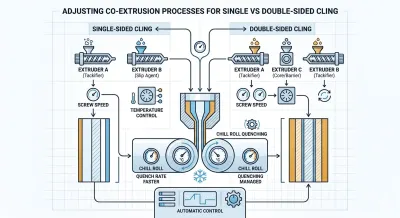
Single-sided cling is normally produced using a multilayer cast film structure, such as a three-layer or five-layer configuration. The cling function is concentrated in the designated outer layer, while the opposite surface can be formulated with suitable slip characteristics.
PIB or a compatible cling masterbatch can be introduced into the cling layer, while erucamide or another suitable slip additive may be used on the opposite surface when lower adhesion is required. The actual dosage should be determined according to the selected resin system, additive supplier recommendations, and required cling level rather than using a fixed ratio for every product.
Stable layer distribution is equally important. Each extruder must maintain consistent output so that the functional layer remains within its designed thickness range. Screw speed, feeding rate, and layer ratio should be coordinated to prevent local variations that could change the effective surface concentration of the cling additive.
Temperature control also requires careful attention. Excessive melt temperature or long residence time may affect certain additives and polymer systems, while insufficient temperature can cause poor melting and dispersion. Barrel and T-die temperatures should therefore be optimized according to the specific resin and additive combination.
After the melt leaves the T-die, controlled cooling on the chill roll helps stabilize the film structure. Appropriate chill-roll temperature and contact conditions can support consistent film formation and help limit unwanted additive movement. Cooling should always be considered together with film thickness and line speed.
| Comparison | Single-Sided Cling | Double-Sided Cling |
|---|---|---|
| Cling Surface | Cling on one side, with the opposite side designed for lower adhesion or better slip | Cling on both sides for stronger interlayer adhesion |
| Additive Distribution | Cling additive is mainly concentrated in one outer layer | Cling additives are distributed across both outer layers |
| Film Structure | Suitable for multilayer structures with separate cling and slip functions | Uses a multilayer structure with two functional cling layers |
| Process Control | Focuses on layer ratio, additive dosage, cooling, and smooth unwinding | Requires balanced layer output, cooling, additive dosage, and winding tension |
| Main Applications | Pallet wrapping, logistics, warehouse, and general packaging | Heavy-duty wrapping and applications requiring stronger load containment |
Adjusting for Double-Sided Cling
Double-sided cling requires both outer surfaces to provide controlled adhesion. In a symmetrical multilayer structure, compatible cling formulations can be introduced into both outer layers, while the core provides mechanical support and separates the two functional surfaces.
The two outer-layer extruders should maintain synchronized output. Accurate feeding and stable screw speeds help keep the two cling layers at the intended thickness. If one side receives significantly more material than the other, the finished film may show inconsistent cling performance.
The core layer can also help control interaction between the two surface formulations. A suitable core resin structure provides mechanical strength and separates the functional layers. However, additive migration depends on polymer compatibility, temperature, molecular mobility, layer thickness, and storage time, so the core should not be considered an absolute migration barrier.
Cooling is especially important for double-sided cling film. Because both surfaces are adhesive, unstable cooling or excessive winding pressure can increase the risk of blocking. Chill-roll temperature, line speed, film temperature, winding tension, and roll hardness should therefore be optimized as part of one integrated process.
Controlling Film Gauge and Production Speed
Film gauge has a direct effect on cling consistency. Thin stretch film grades, such as approximately 12–15 μm, require particularly stable layer distribution because even a small thickness deviation represents a significant percentage of the total film structure.
Higher production speeds also reduce cooling time and can make process instability more noticeable. A modern stretch film extrusion machine can combine stable extrusion output with online thickness monitoring to maintain a more consistent film profile. When deviations are detected, the control system can support timely process adjustments and reduce the amount of off-specification material.
Finished film should also be evaluated through application-specific testing. Cling force, unwind performance, tensile strength, elongation, puncture resistance, coefficient of friction, and thickness uniformity can all help determine whether the selected process parameters are suitable for the target application.
Preventing Blocking and Additive Migration
Too much cling can create production and storage problems just as easily as insufficient cling. Excessive surface adhesion may cause finished rolls to block together or become difficult to unwind. Storage temperature, winding pressure, film temperature, and additive migration can all influence this behavior.
Stable thermal management is therefore essential. Controlled barrel and die temperatures help reduce the risk of thermal degradation, while suitable residence time supports consistent processing. Effective cooling after the T-die helps stabilize the film before winding.
Additive migration should also be considered during product development. Cling performance can change after storage because certain additives may gradually move through the polymer matrix. Proper resin selection, multilayer design, temperature control, and storage testing can help establish a more reliable production process.
How Automation Improves Cling Control
Automation can significantly improve repeatability when manufacturers produce different stretch film grades. A PLC-controlled stretch film extrusion machine can coordinate extruder speeds, material feeding, temperature zones, cooling, thickness monitoring, and winding parameters through a centralized control system.
Recipe management is particularly useful when switching between single-sided and double-sided cling products. Validated production parameters can be stored for different film structures and gauges, allowing operators to recall the appropriate settings and make controlled adjustments instead of repeatedly relying on manual trial and error.
Online thickness monitoring provides another important advantage. Continuous measurement of the film profile helps identify deviations during production and supports faster corrective action. Together with stable extrusion and winding control, automation can reduce process variation and improve material utilization.
Upgrade Your Stretch Film Line for Precise Single & Double-Sided Cling
Consistent single-sided and double-sided cling depends on precise control of raw materials, layer structure, extrusion output, temperature, cooling, film thickness, and winding. Our stretch film extrusion machines integrate these key processes to provide stable and repeatable production for different film gauges and packaging requirements.
For manufacturers upgrading an existing line or building a new production facility, our multilayer extrusion solutions combine precise feeding, reliable T-die performance, efficient cooling, online thickness monitoring, PLC automation, and stable winding control. These technologies help improve film consistency, reduce material waste, and support efficient production. Welcome to choose our stretch film extrusion machine to build a more reliable and flexible film production line.