Stretch Film Making Machine: Advantages of Using PCR-PE Raw Materials

2026-09-09

The packaging industry is increasingly adopting recycled materials as manufacturers seek to reduce reliance on virgin plastics and improve material efficiency. For stretch film production, post-consumer recycled polyethylene (PCR-PE) offers a viable resin alternative when its quality and processing characteristics are properly controlled. However, incorporating PCR-PE into stretch film is more complex than merely replacing virgin resin. Differences in melt flow index, contamination levels, molecular weight distribution, and material history can compromise extrusion stability and finished stretch film performance.

Consequently, matching PCR-PE with the right stretch film extrusion line is critical. We design our cast stretch film extrusion systems to provide stable feeding, effective melt filtration, precise temperature control, reliable melt distribution, and flexible multilayer coextrusion capabilities. When these hardware capabilities are paired with rigorous resin selection and optimized process parameters, manufacturers can produce PCR-PE stretch film for applications where recycled content and mechanical film performance must be balanced.

The Growing Demand for More Sustainable Stretch Film Production

Stretch film is widely used for pallet stabilization, unit load containment, and industrial logistics. Traditionally, many stretch films have relied heavily on virgin polyethylene due to its predictable processability and consistent mechanical properties. However, packaging manufacturers are face increasing pressure to optimize material efficiency and incorporate recycled content where commercially and technically feasible.

European regulatory frameworks illustrate this global shift. The EU Packaging and Packaging Waste Regulation(PPWR) mandates to packaging waste prevention, recyclability, and minimum recycled content, with stipulations tailored to specific packaging type and categories. While these rules do not dictate a uniform PCR-PE ratio across all stretch films, they signal a broader movement toward circular plastic packaging. Consequently, manufacturers must navigate distinct, application-dependent compliance standards across different markets.

PCR-PE upports this transition by displacing a portion of virgin polymer feedstock with post-consumer waste streams. Its practical viability, however, hinges on resin purity and batch consistency. A tightly characterized PCR-PE grade is fully capable of meeting demanding extrusion requirements, whereas inconsistent or highly contaminated material triggers severe process instability and film defects.

Why PCR-PE Requires Careful Process Control

Compared to virgin polyethylene, PCR-PE exhibits higher batch-to-batch variation. Its properties depend on the source waste streams, collection and sorting, washing, reprocessing, filtration, and pelletizing conditions. As a result, melt flow index (MFI), contamination levels, color, odor, and mechanical properties vary depending on the recycled material source.

For stretch film manufacturers, these variations are critical because thin-gauge cast stretch film requires stable processing conditions. Variations in melt flow can disrupt extrusion pressure and output, while solid contaminants can cause stretch film defects, web breaks, or die buildup.

Therefore, processing PCR-PE must start with strict incoming quality control. We evaluate recycled resin against target stretch film specifications, including melt flow rate, contamination levels, moisture content, density, and mechanical performance where relevant. Qualified PCR-PE can then be matched with an extrusion process designed around its actual properties.

Equipment alone cannot compensate for unsuitable resin. Instead, we design our extrusion lines to provide a stable and controllable processing environment in which properly selected PCR-PE can be processed consistently.

Multi-Layer Co-Extrusion Provides Greater Material Flexibility

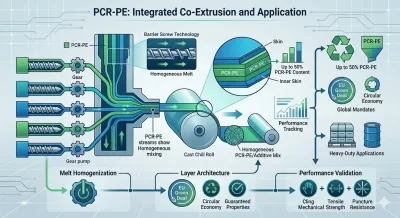
One of the most practical approaches to incorporating PCR-PE into stretch film is multilayer co-extrusion. Our two-layer, three-layer, and five-layer cast stretch film configurations allow manufacturers to distribute different materials across distinct layers instead of requiring a single formulation throughout the entire stretch film.

For example, a selected PCR-PE grade can be incorporated into the core layer while the outer layers use materials tailored for specific surface or processing requirements (such as cling or slip). The exact structure depends on resin properties, target film gauge, required mechanical performance, and intended application.

There is no universal PCR-PE percentage suitable for every stretch film. The optimal recycled content level should be established through formulation development and production testing. Factors such as PCR quality, film gauge, pre-stretch ratio, and target load stability all need to be evaluated.

Multilayer technology provides formulation flexibility rather than a guaranteed performance result. By controlling the position and proportion of recycled material within the stretch film structure, manufacturers can find a practical balance among recycled content, cost, processability, and final stretch film performance.

Stretch Film Samples

Extrusion System Design for PCR-PE Processing

Stable extrusion is essential when processing recycled polyethylene. We design our extrusion systems to provide consistent feeding, thorough plasticization, uniform mixing, and stable melt delivery without exposing the material to excessive thermal stress.

Our screw configurations are tailored to the PCR-PE grade and production requirements, ensuring effective melting and mixing while maintaining stable throughput. Processing temperature profiles are also tightly controlled, since different recycled resins may have varying thermal histories and rheological behavior.

Melt filtration is a critical component of our systems. PCR-PE may contain residual solid contaminants even after recycling and pelletizing, so our filtration systems are designed to remove these particulates before the melt reaches the T-die. Filtration fineness and screen configuration are matched to the quality of the incoming PCR-PE and the required stretch film clarity.

Real-time melt pressure monitoring provides vital process feedback. Changes in melt pressure indicate variations in feeding conditions, resin viscosity, or filter loading. Through our integrated control systems, operators can monitor these conditions and make timely process adjustments.

Ultimately, we design our stretch film lines to function as integrated extrusion systems rather than merely high-output extruders.

Maintaining Stretch Film Performance with PCR-PE

The main objective of PCR-PE stretch film production is to incorporate recycled content without compromising the mechanical properties required for the target application.

Stretch film demands a combination of tensile strength, elongation, puncture resistance, tear resistance, cling, and load containment. The weight of each property varies based on film gauge and end use.

PCR-PE does not inherently match the same performance as virgin resin. Properties depend on feedstock source and recycling history, so manufacturers must validate formulations empirically rather than assuming a set PCR ratio yields predictable performance.

Our multilayer coextrusion technology offers further formulation flexibility. The core layer can be optimized for PCR loading, while the skin layers can be tailored for surface properties such as cling or slip.

For demanding applications, we recommend rigorously testing finished stretch film properties—including load retention, roll profile, and puncture resistance—under operational conditions. This data-driven approach is essential to verify whether a PCR-PE formulation is suitable for commercial production.

Applications of PCR-PE Stretch Film

PCR-PE stretch film is suitable for a variety of logistics and industrial packaging applications where recycled content is appropriate. Common uses include pallet wrapping, warehouse storage, carton stabilization, and transportation protection.

For standard logistics applications, a properly formulated PCR-PE stretch film offers a practical option for manufacturers seeking to increase recycled content while maintaining the performance required for pallet stabilization.

More demanding applications require further evaluation. Heavy industrial products, sharp-edged components, and irregularly shaped loads can place greater demands on puncture resistance and load containment. In these cases, we recommend validating the recycled content level and stretch film structure through real-world packaging trials.

Food-contact applications require special consideration. PCR plastics intended for food contact are subject to strict regulatory and safety requirements, and standard PCR-PE cannot be assumed suitable for direct food contact. Manufacturers must ensure compliance with the market-specific regulations governing their intended market.

The Stretch Film Making Machines for PCR-PE Production

Selecting a stretch film extrusion line for PCR-PE production requires evaluating the entire production process. Key considerations include film width, target gauge, required output, layer configuration, PCR-PE grade, extrusion capacity, melt filtration, temperature control, T-die design, cooling capacity, and winding requirements.

Our stretch film extrusion lines can be configured for various multilayer cast stretch film requirements, including two-layer, three-layer, and five-layer structures. Depending on the manufacturer's material formulation and target film specifications, we tailor the extrusion and layer configuration to the intended PCR-PE application.

Final production quality is determined by the combination of resin quality, formulation, machine configuration, and process parameters. There is no single machine setting or PCR percentage that guarantees uniform results for every recycled resin. A reliable production solution begins with understanding material and stretch film requirements before selecting the appropriate extrusion configuration.

For manufacturers planning to introduce PCR-PE into stretch film production, our technical team can evaluate required film width, gauge, layer structure, resin characteristics, and target output to develop an optimal stretch film line configuration. By combining stable cast stretch film extrusion with flexible multilayer coextrusion technology, we help manufacturers implement recycled-content solutions while maintaining the control required for consistent commercial stretch film.

Stretch Film Making Machine: Advantages of Using PCR-PE Raw Materials

GET IN TOUCH NOW

*We respect your privacy. When you submit your contact information, we agree to only contact you in accordance with our Privacy Policy.