How to Prevent Film Breakage During High-Speed Stretch Film Extrusion
2026-08-20
Film breakage is one of the most disruptive problems in high-speed stretch film production. A sudden web break can interrupt continuous production, increase material waste, require operator intervention, and affect the consistency of finished rolls. As production speeds increase and film gauges become thinner, even small variations in melt temperature, film thickness, cooling, or winding tension can become more significant.
For manufacturers looking to improve production stability, preventing film breakage requires more than simply increasing machine speed. A reliable process depends on coordinated control of extrusion, die performance, cooling, film transport, and winding. A properly configured stretch film extrusion machine can help maintain stable processing conditions and reduce the process variations that commonly contribute to web breaks.
Why Film Breakage Becomes More Common at High Production Speeds
High-speed stretch film extrusion places greater demands on every part of the production line. When line speed increases, the available process window can become narrower. Small fluctuations that may have little effect at moderate speeds can become visible defects when the film is produced and stretched at a higher rate.
One common source of instability is uneven thermal control. If the polymer is not heated and mixed consistently, variations in melt viscosity can affect material flow through the extrusion system and T-die. These variations may contribute to uneven film thickness or localized weak areas. Precise temperature control across the barrel, adapter, and die therefore plays an important role in maintaining stable extrusion.
Film thickness consistency is equally important. Thin-gauge stretch film requires uniform distribution across the web because a localized thin section has less material available to withstand mechanical stress. A well-maintained T-die, stable melt pressure, and appropriate die-gap adjustment can help improve cross-web thickness consistency.
Winding conditions also become increasingly important as speed rises. Excessive or unstable tension can place unnecessary stress on the film, while insufficient control can result in wrinkles, telescoping rolls, or unstable winding. The winding system must therefore work together with the extrusion and film-handling sections rather than operating as an isolated component.
Limitations of Traditional Stretch Film Production
Older or less precisely controlled production equipment can make high-speed operation more difficult. Conventional temperature-control systems may provide less precise regulation between different heating and cooling zones, making it harder to maintain stable melt conditions during long production runs.
The extrusion screw also has a direct influence on melt quality. A screw design that is not properly matched to the resin formulation and target output may produce insufficient mixing or excessive shear. For stretch film production, the objective is to create a stable and homogeneous melt without introducing unnecessary thermal degradation.
Mechanical tension control can present another challenge. At higher speeds, changes in roll diameter, drive response, film friction, and machine vibration can affect web tension. Without coordinated drive and winding control, these variations may increase the risk of wrinkles, edge instability, or film breaks.
Contamination is another practical concern. Polymer residue, degraded material, dust, and other foreign particles can accumulate around the extrusion and film-contact areas. If contaminants enter the melt or remain on critical film-contact surfaces, they may contribute to surface defects or localized damage. Regular cleaning, appropriate filtration, and good housekeeping around the production line remain essential even when advanced automation is installed.
Why High-Performance Stretch Film Matters for Modern Packaging
Stretch film is widely used for pallet stabilization, warehouse packaging, logistics, transportation, and industrial unitizing. Its ability to provide containment force while using relatively little material makes it an important packaging solution for modern supply chains.
However, producing thinner film does not simply mean reducing film thickness. The material must maintain sufficient tensile strength, elongation, puncture resistance, tear resistance, and cling characteristics for the intended application. A film that is too thin or poorly controlled may fail during wrapping, transportation, or handling.
High-performance stretch film production therefore requires a balance between material formulation and machine performance. Resin selection, layer distribution, extrusion temperature, cooling conditions, film thickness, and winding parameters all influence final film performance.
For manufacturers pursuing material savings, stable high-speed production is particularly important. A controlled process can help reduce unnecessary scrap and improve consistency from roll to roll, supporting more predictable production costs and finished-film quality..
How a Stretch Film Extrusion Machine Helps Prevent Film Breakage
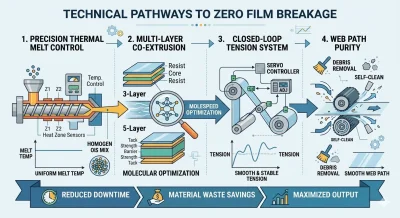
A modern stretch film extrusion machine is designed to provide more stable control across the complete cast film production process. Instead of relying on a single improvement, the most effective approach is to coordinate melt processing, film forming, cooling, transport, and winding.
Precise Temperature Control for Stable Melt Processing
Stable thermal conditions are fundamental to reliable stretch film extrusion. A properly configured extrusion system uses independent temperature-control zones to manage the barrel and melt-processing stages according to the selected resin and production conditions.
Consistent temperature management helps maintain predictable melt viscosity and supports stable flow through the T-die. When combined with an appropriately designed screw and controlled extrusion output, this can reduce process fluctuations that may contribute to uneven film formation.
A uniform T-die is also important. Accurate die manufacturing and adjustment help distribute the melt across the film width and maintain consistent gauge. While no extrusion system can completely eliminate every source of variation, precise thermal and die control can significantly improve process stability when the equipment is correctly configured and maintained.
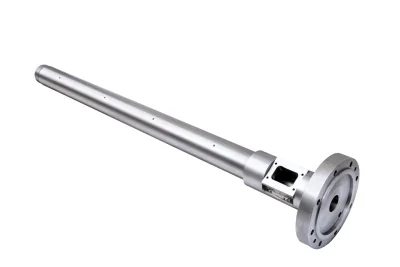
Optimized Screw and Mixing Design
The extrusion screw must be matched to the materials being processed, including commonly used polyethylene-based stretch film resins such as LLDPE and mLLDPE.
An appropriately designed screw can provide effective melting and mixing while maintaining stable output. Good material distribution is particularly important for multilayer stretch film because different layers may use different formulations to provide specific functions, such as strength, cling, or surface performance.
Stable melt pressure and output also help the downstream casting and winding systems operate under more consistent conditions.
Multilayer Coextrusion for Functional Film Structures
Three-layer and five-layer coextrusion can provide manufacturers with greater flexibility in stretch film formulation. Instead of requiring every layer to perform the same function, different layers can be designed for specific performance requirements.
For example, a multilayer structure may combine a high-strength layer with dedicated cling or surface layers. This approach can help optimize material usage while maintaining the mechanical and handling properties required for the final application.
The exact layer structure should be determined according to the resin formulation, film thickness, target performance, and application. Multilayer extrusion does not automatically guarantee higher film strength, but when properly engineered, it provides a useful way to distribute material functions throughout the film structure.
Closed-Loop Drive and Winding Control
Stable winding tension is critical when producing stretch film at high speed. Modern drive systems can coordinate motor speed and winding parameters to respond to changes in production conditions.
A controlled winding system helps maintain more consistent tension as the roll diameter changes. This can reduce the risk of excessive tension, wrinkles, loose winding, and other problems that may ultimately contribute to film damage.
Servo-based control can also improve response accuracy compared with basic mechanical adjustment systems. However, the actual performance depends on the complete machine configuration, drive tuning, roll design, and operating conditions.
Clean Film Handling and Reliable Cooling
After leaving the T-die, the molten film must be cooled and transported under controlled conditions. The casting surface, cooling system, air environment, and film-contact components all influence film stability.
Clean, properly maintained rollers and film-contact surfaces help minimize contamination and surface damage. Cooling conditions should also be matched to the film formulation and production speed so that the film develops the required properties before entering the subsequent handling and winding stages.
Preventive maintenance is therefore an important part of film-breakage prevention. Even a high-performance stretch film extrusion machine cannot compensate for contaminated rollers, worn components, incorrect temperature settings, or unsuitable process parameters.
A Reliable Stretch Film Extrusion Technology for Stable Production
Reducing film breakage during high-speed production requires more than adjusting a single machine parameter. Stable extrusion, accurate temperature control, uniform film thickness, effective cooling, controlled web handling, and consistent winding tension all work together to determine the reliability of the production process. A well-engineered production line can help manufacturers reduce avoidable interruptions, control material waste, and maintain more consistent film quality.
Our stretch film extrusion machine is designed to provide a reliable foundation for high-speed cast stretch film production. With multilayer coextrusion configurations, optimized extrusion components, precise temperature management, stable film handling, and automated winding control, the machine can be configured to meet different film structures, output requirements, and production goals. Three-layer and five-layer solutions are available for manufacturers looking to balance film performance, material efficiency, and production capacity.
Whether you are upgrading an existing stretch film production line or planning a new manufacturing facility, our technical team can develop a machine configuration around your target film width, thickness, layer structure, resin formulation, output, and factory conditions. Choose our stretch film extrusion machine to build a more stable and efficient production process, improve operational consistency, and support reliable long-term stretch film manufacturing.