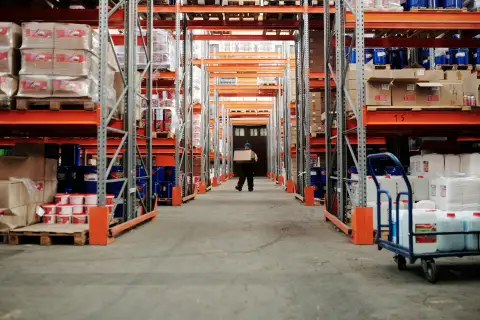
Industrial warehousing and logistics systems handle thousands of tons of cargo daily. Ensuring pallet stabilization, load containment, and environmental protection during long-distance transit remains a core operational challenge. As supply chains move faster and automated high-throughput packaging lines become the norm, traditional product wrapping methods are failing to meet requirements.
Securing heavy, irregular, or unstable loads requires specialized packaging materials. Advanced multi-layer films engineered by modern stretch film extrusion machines offer the structural toughness, high transparency, and optimized pre-stretch ratios needed to handle these demanding tasks. Shifting to advanced manufacturing technology helps production plants eliminate containment failures, reduce plastic consumption, and lower operational overhead.
Industrial Warehousing Bottlenecks and Traditional Packaging Failures
Modern distribution networks present major logistical risks. Freight suffers constant vibrations, sudden braking, and mechanical impacts during transport. When individual boxes or heavy goods are not anchored to their pallets, load shifting occurs. This movement causes costly product damage, structurally compromises safety in the warehouse, and leads to expensive product rejections from distributors. Traditional structural bindings, such as rigid plastic straps or single-layer low-density wraps, do not provide the dynamic recovery force needed to keep unstable shipments intact.
Environmental exposure creates further supply chain complications. In cold storage facilities and high-humidity environments, dramatic temperature shifts cause rapid moisture condensation on product surfaces. Standard wrapping materials offer poor moisture resistance and insufficient barrier performance. This allow dust, grime, and humidity to ruin corrugated boxes, degrade pharmaceutical cartons, and short-circuit sensitive electronics. When structural packaging absorbs moisture, cardboard weakens and collapses under heavy stacked loads, creating a domino effect across the warehouse floor.
Operational inefficiencies also hurt profitability. Low-performance films with uneven gauge distribution often tear on automated, high-speed wrapping equipment. Frequent film breakage stops high-throughput packaging lines, requiring manual intervention and causing unexpected downtime. To compensate for weak mechanical properties, operators often wrap pallets multiple times, which leads to massive material waste, higher costs per pallet, and a larger corporate carbon footprint.
How Multi-Layer Co-Extrusion Film Solves Modern Packaging Challenges
Multi-layer cast stretch films offer much higher performance than basic, single-layer options. Produced using co-extrusion technology, these advanced films use an engineered, layered structure to combine different polymer properties into a single, high-performance web. This architecture delivers incredible tensile strength, tear propagation resistance, and excellent puncture protection. It allows the film to wrap sharp pallet corners and irregular product shapes without tearing or puncturing.
This material excels because of its elastic recovery and continuous holding force. Once applied to a pallet, the film tries to return to its original unstretched state, creating a permanent, tight compressive force around the cargo. This constant tension keeps heavy loads completely stable through transit shocks, forklift handling, and multi-tier warehouse stacking. Its excellent cling performance ensures the film sticks securely to itself without requiring extra adhesives, heat sealing, or metal buckles.
Advanced films protect sensitive commodities while supporting automated tracking. For electronics and medical supplies, these films provide complete environmental isolation and structural stability without applying excessive crush forces that could damage delicate retail cartons. Additionally, high optical clarity and transparency allow warehouse scanners to read barcodes and inventory tags directly through the film. This transparency ensures seamless integration with automated storage and retrieval systems (ASRS), keeping tracking data accurate across the entire logistics chain.
Versatile Stretch Film Extrusion Machines Series (2, 3 & 5 Layers)
To satisfy diverse market demands, our comprehensive stretch film extrusion machines series offers scalable 2-layer, 3-layer, and 5-layer co-extrusion engineering platforms designed for reliable, industrial-scale film manufacturing.
Entry-Level 2-Layer Machinery Series
Designed for foundational packaging requirements, our 2-layer machinery series delivers cost-effective manufacturing for light to regular-shaped loads. This series utilizes a practical AB structure to balance surface cling and basic film strength, providing a dependable, budget-friendly entry point into automated stretch wrap production with optimized energy consumption.
Professional 3-Layer Machinery Series
Engineered for advanced material efficiency, our 3-layer machinery series incorporates a versatile ABC structure that enhances puncture resistance by 30% to 50% compared to baseline films. This high-efficiency line allows factories to reduce raw material costs by 15% to 20% by using recycled materials in the middle layer, all while achieving higher stretch ratios up to 400% for securing heavy and irregular shipments.
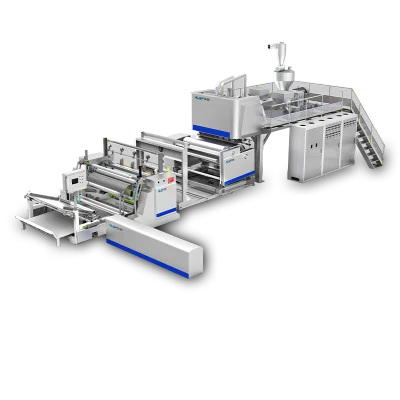
High-Capacity 5-Layer Machinery Series
For extreme-demand packaging environments, our premium 5-layer machinery series delivers the ultimate throughput. Featuring a heavy-duty three-extruder configuration with a 33:1 screw L/D ratio, this series generates a massive production capacity ranging from 320 kg/hr to 600 kg/hr. With mechanical design speeds reaching 250 m/min, the machinery effortlessly extrudes ultra-thin films between 0.01 mm and 0.05 mm, smoothly handling widths from 1500 mm to 2000 mm to output 3 or 4 standard 500mm commercial rolls simultaneously. Operating under 150 kW to 350 kW of total power, this robust 14-meter-long structural series ensures flawless gauge control and maximum puncture resistance.
Advanced Co-Extrusion Tech and Precision Molecular Engineering
Manufacturing high-performance cast film requires sophisticated stretch film extrusion machines. Industrial production systems use multi-layer co-extrusion technology to alter polymer structures at a molecular level. By separating the film into distinct functional layers, producers can use cost-effective resins in the core while placing specialized polymers on the outer surfaces.
These lines feature gravimetric dosing systems that precisely meter raw materials, blending linear low-density polyethylene (LLDPE) with premium metallocene resins (mLLDPE), tackifiers, and specialized ultraviolet inhibitors. Advanced vacuum boxes and dual-chamber air knives quickly pin the molten web to the primary chill roll. This rapid cooling creates an amorphous polymer structure that maximizes film clarity, gloss, and puncture resistance.
Automated Gauge Regulation and High-Speed Continuous Winding
Consistent material thickness is critical for automated packaging lines. Modern extrusion equipment uses automatic T-dies integrated with online thickness scanners. These thickness gauges scan the moving film web in real time, measuring variations down to the micron. If the system detects a thick or thin spot, it automatically adjusts thermal bolts across the die lip, altering the gap to correct the film thickness profile within seconds.
This precise gauge control ensures uniform mechanical strength across the entire width of the roll. The film runs smoothly on high-speed automated packaging lines without thin spots that cause tearing. Paired with fully automated turret winders, these machines handle continuous roll changes at high line speeds, ensuring clean roll edges, perfect tension control, and flawless rolls ready for commercial use.
High-Ratio Pre-Stretch Engineering for Eco-Friendly Logistics
The defining feature of premium stretch film extrusion machines is their ability to produce films with high pre-stretch ratios, often exceeding 300%. Pre-stretching mechanically elongates the film between two rollers running at different speeds before it wraps the pallet. A high-ratio film stretches further without breaking, increasing its yield and allowing a single roll of raw film to protect far more pallets than conventional wraps.
This capability helps companies meet modern corporate sustainability goals and reduce overall plastic consumption. By shifting production to ultra-thin, highly engineered films, manufacturers can significantly reduce the total volume of plastic needed per pallet. This material reduction cuts raw material costs, lowers shipping weights, and minimizes post-consumer plastic waste, all while maintaining excellent containment strength for transport safety.
Upgrading Production with Next-Generation Extrusion Technology
Investing in advanced stretch film extrusion machines allows manufacturers to match the evolving needs of the logistics and warehousing industries. Moving away from thick, low-performing single-layer films toward thin, multi-layer co-extruded alternatives resolves the balance between transport safety and material cost management.
These automated production systems give film manufacturers the tools to produce uniform, puncture-resistant, and high-stretch films that run flawlessly on high-speed automated packaging lines. Adopting this technology helps companies lower transport damage risks, minimize material waste, and support sustainable supply chain initiatives worldwide.