In stretch film production, raw material cost is one of the most critical factors affecting overall efficiency. The structure of the film, determined by the stretch film making machine, directly influences how materials are used and optimized.
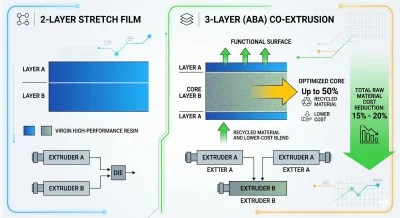
A 2-layer stretch film making machine produces film with a simple structure. Both layers share similar material functions, and performance depends on a uniform material composition. This limits flexibility in material selection, as high-performance resins are often required across the entire film to maintain strength and stability. As a result, raw material costs remain relatively fixed.
A 3-layer stretch film making machine, based on ABA co-extrusion technology, introduces a more advanced material distribution system. It uses three independent extruders feeding into a single die head. The outer A layers are designed for surface performance, including strength, puncture resistance, and cling. The inner B layer functions as the core.
This layered structure allows precise control over material placement. High-performance resins are used only in the outer layers where they are most effective. The core layer can incorporate up to 50% recycled materials or lower-cost polyolefin blends without affecting overall film performance.
This approach significantly improves material efficiency. By reducing the use of expensive raw materials, the 3-layer process typically lowers raw material costs by 15% to 20% per kilogram of film produced.
Beyond cost reduction, the core layer in a 3-layer structure can be engineered for specific functions. It can improve tear resistance, adjust elasticity, or enhance load retention. This enables the production of films with consistent performance while maintaining optimized material usage.
In comparison, the key difference between 2-layer and 3-layer systems lies in material flexibility and cost control. A 2-layer structure relies on uniform material distribution, while a 3-layer structure separates functions across layers. This separation allows more efficient use of raw materials without changing overall film thickness.
The co-extrusion design of a 3-layer stretch film making machine also supports stable production. Precise layer thickness control, consistent cooling, and uniform winding ensure reliable film quality during high-speed operation.
Overall, the difference in raw material cost between 2-layer and 3-layer stretch film production is driven by structural design and material allocation. A 3-layer stretch film making machine enables more efficient use of polymers through functional layering, resulting in reduced raw material consumption and improved production efficiency.