Top Tips for Using Stretch Film Extrusion Machine | Hualiang Machinery
2026-08-26
Stretch film is widely used for pallet wrapping, load stabilization, warehouse packaging, and transportation protection. As packaging operations become increasingly automated, manufacturers need stable and efficient film production rather than simply higher extrusion speed. The performance of a stretch film extrusion machine depends on extrusion stability, temperature control, cooling, winding accuracy, and daily maintenance.
Proper operation and preventive maintenance can help reduce production problems, maintain consistent film quality, and extend equipment service life. Understanding several key operating practices is therefore important for manufacturers producing stretch film for different packaging applications.
Understand the Importance of Multilayer Extrusion
Modern stretch film production increasingly uses multilayer co-extrusion technology because different layers can perform different functions. A five-layer stretch film extrusion machine, for example, can distribute different material formulations between individual layers to balance tensile strength, puncture resistance, cling, and material efficiency.
Multilayer structures can also support downgauging strategies. Instead of relying on a thicker film to achieve the required packaging performance, manufacturers can optimize the layer structure and resin distribution according to the application. This can help reduce material consumption while maintaining suitable film strength and load stability.
Two-layer and three-layer stretch film extrusion systems can also be suitable for specific applications where a simpler structure meets the required performance. The appropriate configuration should be determined according to film thickness, raw materials, production capacity, and final application rather than simply choosing the highest number of layers.
Maintain Stable Temperature Control
Temperature control is one of the most important factors in stretch film extrusion. The polymer needs to be processed within an appropriate temperature range to maintain stable melt flow and consistent film formation.
Operators should monitor individual heating and cooling zones instead of focusing only on the overall machine temperature. Excessive temperature fluctuations can affect melt viscosity and may contribute to surface defects, thickness variation, gels, or unstable film formation.
Processing temperatures should always be adjusted according to the characteristics of the selected resin. Common stretch film materials such as LLDPE, mLLDPE, and LDPE may require different processing conditions.
Raw material handling should also be controlled carefully. Materials should be stored properly and kept free from contamination, dust, and foreign particles. Following the resin supplier's recommended handling conditions provides a more stable foundation for extrusion.
Keep Rollers Clean and Properly Maintained
Cooling rollers and guide rollers have direct contact with the film, so their condition can affect film appearance and running stability. Additive deposits, dust, and accumulated material may gradually build up on roller surfaces and interfere with smooth film handling.
Regular inspection and cleaning should therefore be included in daily maintenance. Operators should check rollers for visible contamination, scratches, abnormal wear, or other conditions that could affect film tracking.
Mechanical components should also be inspected according to the machine maintenance schedule. Bearings, transmission components, and other moving parts require appropriate lubrication and inspection to reduce unnecessary friction and wear.
Cleaning and maintenance must always be carried out under safe shutdown conditions. Operators should never attempt to clean moving rollers or rotating components while the machine is running.
Control Winding Tension Carefully
Winding quality has a direct influence on the usability of finished stretch film rolls. Excessive tension may place unnecessary stress on the film, while insufficient tension can result in loose or unstable rolls.
The appropriate winding parameters depend on film thickness, width, material properties, roll diameter, and the specific winding system. Therefore, operators should establish suitable settings for different film specifications instead of applying one fixed tension value to every product.
A stable winding system helps maintain consistent roll formation, clean edges, and uniform roll hardness. This is particularly important when finished stretch film is supplied to automatic pallet wrapping equipment.
For high-output production, an automatic winding system can reduce manual intervention and support continuous operation between finished rolls.
Follow Preventive Maintenance Procedures
Preventive maintenance is essential for maintaining the long-term performance of a stretch film extrusion machine. Instead of waiting for mechanical problems to cause production interruptions, operators should establish routine inspection procedures.
Lubrication should follow the equipment manufacturer's recommended intervals and specifications. Bearings, transmission components, and other applicable parts should be checked for unusual noise, vibration, temperature, or wear.
The tension control system should also be inspected periodically. If the actual winding tension differs from the required setting, roll quality may become inconsistent even when extrusion conditions remain stable.
Temperature controllers, sensors, electrical components, and the control system should also be checked regularly. Early identification of abnormal conditions can help reduce unexpected downtime and make maintenance more manageable.
Follow Safe Operating Practices
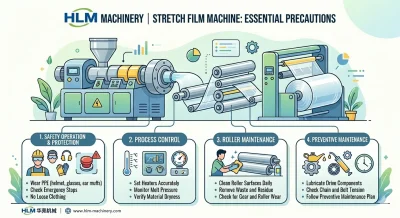
Safety should be part of every production procedure. Before starting the stretch film extrusion machine, operators should check emergency-stop devices, protective guards, and other safety components according to the machine's operating requirements.
Hot extrusion components, rotating rollers, shafts, and moving film paths require particular attention. Operators should wear appropriate personal protective equipment and avoid loose clothing near rotating machinery.
When cleaning or maintaining the machine, production should be stopped and the relevant safety isolation procedures followed. Extrusion components may remain hot after shutdown, so sufficient cooling time should be allowed before maintenance work begins.
| Key Area | Recommended Practice | Benefit |
|---|---|---|
| Temperature | Keep extrusion temperature stable | Consistent film quality |
| Rollers | Clean and inspect regularly | Stable film tracking |
| Winding | Maintain proper tension | Uniform roll formation |
| Maintenance | Check and lubricate key parts | Reduce downtime |
| Safety | Check safety devices before operation | Safer production |
Match Machine Settings to Film Specifications
Different stretch film products require different processing conditions. Film width, thickness, layer structure, resin formulation, output rate, cooling conditions, and winding requirements can all influence machine settings.
For manufacturers producing multiple specifications, recipe management can help maintain repeatable production parameters. Frequently used settings can be recorded and recalled when the same film specification is produced again, reducing unnecessary manual adjustments.
The goal should not simply be maximum production speed. Stable output, consistent film quality, reasonable material consumption, and reliable equipment operation are equally important for long-term production efficiency.
Achieving Stable Stretch Film Production
Stable stretch film production depends on the combined performance of extrusion, cooling, winding, and control systems. Proper temperature management, clean rollers, accurate winding tension, preventive maintenance, and safe operating practices all contribute to consistent film quality and reliable machine operation.
A properly configured stretch film extrusion machine can provide the production stability and flexibility required for different film structures, thicknesses, widths, and output levels. Our stretch film extrusion machines are available with different layer configurations and winding options to match specific production requirements.