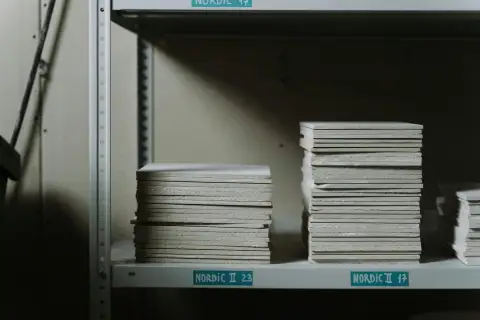
The ceramic tile industry requires packaging materials that can provide reliable load stability, strong puncture resistance, and consistent performance during storage and transportation. Large-format tiles, porcelain slabs, and heavy palletized products often experience significant stress during handling, long-distance shipping, and warehouse storage. Traditional single-layer stretch films may not provide sufficient strength and elasticity for these demanding applications.
Our 3-layer stretch film manufacturing machine is designed to help film producers manufacture high-performance stretch films specifically for ceramic tile packaging. Through advanced co-extrusion technology, the machine enables manufacturers to optimize film structures with improved strength, flexibility, and material efficiency, providing a reliable packaging solution for heavy-duty tile pallets, export transportation, and industrial logistics.
Key Factors Affecting Ceramic Tile Packaging Performance
Ceramic tile packaging presents unique challenges due to the high density, rigid structure, and sharp edges of tile products. During transportation, palletized tiles are exposed to continuous vibration, sudden impacts, and shifting forces caused by trucks, containers, and handling equipment. Without sufficient wrapping performance, these external forces may reduce pallet stability and increase the risk of product damage.
One of the main challenges in ceramic tile packaging is maintaining consistent holding force throughout the entire transportation process. Heavy tile pallets require stretch films with strong elastic recovery to keep the load compressed and prevent movement. Conventional films with limited stretch memory may gradually lose tension after wrapping, especially during long-distance transportation where pallets experience repeated mechanical stress.
Another common issue is film damage caused by sharp edges and concentrated pressure points. Ceramic tile cartons, especially large-format tiles and porcelain slabs, often create strong contact pressure against the wrapping material. Standard films with insufficient puncture and tear resistance can easily be damaged during handling, reducing the overall protection of the pallet.
The Role of 3-Layer Stretch Film in Ceramic Tile Packaging
Three-layer co-extrusion stretch film provides an effective solution for heavy-duty ceramic tile packaging by combining different material characteristics within a single film structure. Each layer can be designed with specific functions, allowing manufacturers to achieve a better balance between strength, elasticity, cling performance, and cost efficiency.
The core layer plays an important role in improving tensile strength and puncture resistance. By incorporating high-performance polyethylene materials into the middle layer, the film can better withstand sharp corners, rough surfaces, and external impacts commonly found in ceramic tile transportation.
The inner layer can be optimized for controlled cling performance, ensuring that the film maintains secure contact with itself during wrapping. This helps improve pallet stability and reduces the risk of film loosening during storage and transportation. The outer layer can be adjusted to provide smooth handling characteristics and surface protection, making the finished film suitable for automated packaging operations.
Compared with conventional single-layer stretch films, 3-layer structures provide manufacturers with greater flexibility in developing customized packaging films. By precisely distributing different polymers across multiple layers, producers can manufacture thinner films with improved mechanical properties while reducing unnecessary material consumption.
For ceramic tile applications, this means stronger pallet stabilization, improved resistance against transportation stress, and better compatibility with modern automatic wrapping systems.
Precision Manufacturing Process for 3-Layer Stretch Film Production
Producing high-quality ceramic tile packaging film requires a stretch film manufacturing machine with stable extrusion performance and accurate process control. The quality of the final film depends on several key factors, including polymer distribution, melt stability, thickness uniformity, and winding consistency.
Modern 3-layer extrusion systems use multiple extruders and precision-controlled feedblocks to combine different polymer materials into a uniform multi-layer structure. This allows manufacturers to adjust layer ratios according to specific application requirements, such as higher puncture resistance for heavy pallets or improved elasticity for automated wrapping applications.
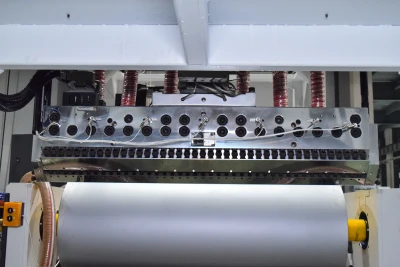
A precise T-die system is also essential for maintaining consistent film thickness across the entire film width. Uniform gauge control helps prevent weak areas within the film structure and improves production stability during continuous operation. For ceramic tile packaging, consistent film quality is particularly important because packaging lines often require reliable performance at high wrapping speeds.
Advanced stretch film manufacturing machines can also integrate automatic thickness monitoring systems and intelligent control interfaces. These technologies allow operators to monitor production parameters, optimize extrusion conditions, and maintain stable output quality. As a result, film manufacturers can produce consistent rolls that perform reliably in demanding industrial packaging environments.
Improving Packaging Efficiency Through Multi-Layer Film Technology
One of the major advantages of three-layer stretch film production is improved material utilization. By combining different polymers in specific layers, manufacturers can enhance overall film performance without relying on excessive thickness.
Optimized multi-layer structures help reduce polyethylene consumption while maintaining the strength required for heavy-duty pallet applications. This provides several advantages for film producers, including lower raw material usage, reduced production costs, improved sustainability performance, and stronger competitiveness in industrial packaging markets.
For ceramic tile packaging suppliers, lightweight yet high-performance films can also improve logistics efficiency. Reduced packaging weight helps lower transportation costs, while consistent film quality minimizes wrapping interruptions and improves overall production reliability.
As customers continue to demand more efficient and sustainable packaging solutions, multi-layer extrusion technology provides manufacturers with greater flexibility to develop customized stretch films for different ceramic tile products, pallet sizes, and transportation conditions.
Expanding Ceramic Packaging Capabilities with Stretch Film Manufacturing Machine
Investing in a reliable stretch film manufacturing machine allows film producers to expand their product range and enter higher-value industrial packaging markets. Ceramic tile manufacturers, building material suppliers, and export packaging companies increasingly require stretch films that can provide strong load containment while reducing material waste.
Our 3-layer stretch film manufacturing machines are engineered to support the production of industrial-grade films for ceramic tile packaging applications. With advanced co-extrusion technology, precise thickness control, and stable production performance, our equipment helps manufacturers develop customized stretch film solutions for heavy-duty pallets, large-format tiles, and demanding logistics environments.
By combining flexible film structure design with efficient manufacturing capabilities, our machines provide a dependable platform for producing high-performance stretch films. As global packaging requirements continue to evolve toward stronger, lighter, and more sustainable solutions, our stretch film manufacturing machines help producers improve product quality, optimize production efficiency, and strengthen their competitiveness in the industrial packaging market.