Differences in Application Scenarios for 2-Layer and 3-Layer Stretch Film Extrusion Machine
2026-04-27
In industrial packaging and logistics, the performance of stretch film directly affects load stability and transport safety. Different cargo types require different film structures. The stretch film extrusion machine plays a key role in determining film performance through its layer configuration and co-extrusion design.
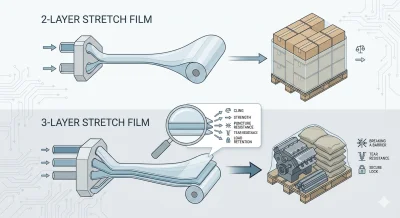
A 2-layer stretch film extrusion machine is designed for standard packaging applications. It uses two extruders to produce a film with a balanced structure. Typically, one layer provides basic strength, while the other ensures surface cling. This structure delivers stable performance for light to medium-weight goods with regular shapes.
In practical applications, 2-layer film is suitable for cartons, boxed products, and uniform pallet loads. It performs well in controlled environments such as warehouses and short-distance transportation. The structure is simple and efficient, making it effective for general-purpose packaging without complex performance requirements.
A 3-layer stretch film extrusion machine uses advanced co-extrusion technology to produce films with a more complex structure. It combines three extruders into a single die head, forming a multi-layer film with clearly defined functions. The typical structure includes two outer layers and one core layer.
Each layer in a 3-layer film serves a specific role. The outer layers are designed for cling, elasticity, and surface strength. The core layer is engineered to improve puncture resistance, tear resistance, and load retention. This layered design allows the film to perform under higher stress conditions.
In application scenarios, 3-layer film is used for heavy, irregular, or high-demand loads. It is suitable for industrial products with sharp edges, uneven surfaces, or high weight, such as construction materials, machinery components, and bulk goods. It also performs well in long-distance transport and dynamic handling environments.
The key difference between 2-layer and 3-layer stretch film extrusion machines lies in their application range. A 2-layer system supports efficient production for standard loads with consistent shapes. A 3-layer system provides enhanced structural performance for complex and demanding packaging conditions.
By adjusting layer structure and material distribution, stretch film extrusion machines can produce films tailored to different logistics requirements. This enables stable load containment across a wide range of industrial applications.