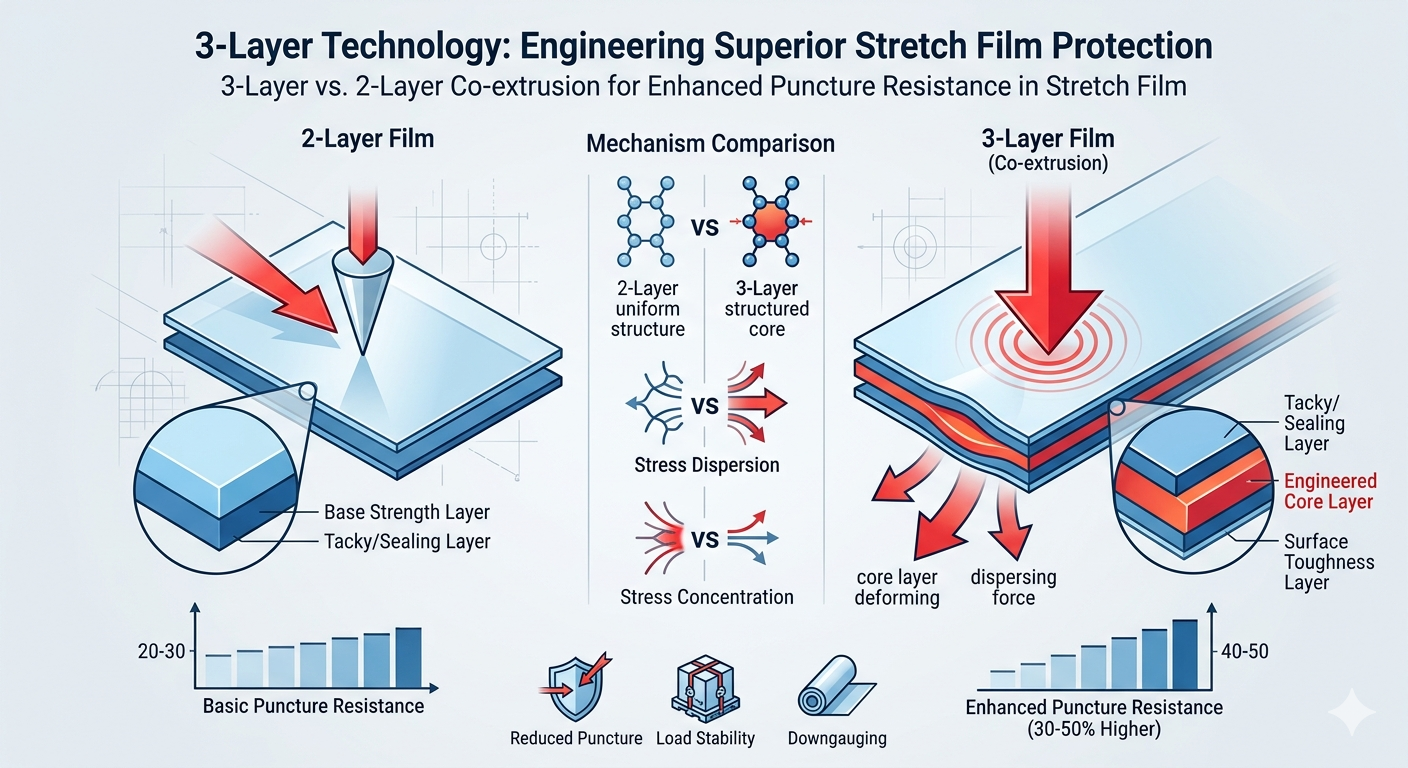
In the demanding environment of industrial logistics, the integrity of a stretch film is a critical factor in securing loads and preventing product damage. Modern stretch film making machine technology has evolved from basic 2-layer designs to advanced 3-layer co-extrusion systems. This transition significantly enhances film performance, specifically in puncture resistance.
The Technical Evolution: 2-Layer vs. 3-Layer Co-extrusion
The performance gap between these two structures is rooted in their molecular architecture and material distribution:
- 2-Layer Film Structure: Typically consists of a tacky sealing layer and a base strength layer. While functional, its uniform structure has a limited capacity to disperse concentrated stress from sharp objects.
- 3-Layer Film Structure: This advanced design introduces a dedicated, engineered core layer. This middle layer acts as a resilient shield, formulated from specialized resin blends like metallocene-catalyzed polyethylene (mLLDPE).
Why 3-Layer Film Offers 30-50% Higher Puncture Resistance
The superior puncture resistance of a 3-layer stretch film making machine is driven by a synergistic "sandwich" effect:
- Stress Dispersion: When a sharp edge strikes, the resilient core layer deforms to absorb the impact. It spreads the point force over a wider surface area, effectively blunting the attack.
- Material Optimization: Co-extrusion allows for the use of high-modulus polymers in the core, while keeping the outer layers optimized for cling and surface toughness.
- Enhanced Durability: This multi-layer architecture prevents small punctures from propagating into catastrophic tears, a common failure in monolayer or 2-layer films.
Performance Benefits for Industrial Applications
Films produced by a 3-layer stretch film making machine provide tangible advantages in high-stakes environments:
- Load Stability: High puncture resistance ensures film integrity when wrapping heavy or irregularly shaped cargo like bricks, machinery, and metal parts.
- Reduced Material Waste: The increased strength allows for downgauging—using a thinner film to achieve the same or better protection than a thicker 2-layer film, reducing overall plastic consumption.
- Environmental Protection: High-integrity wrap prevents moisture ingress and dust contamination during long-distance export and multi-modal transit.
Conclusion
As global logistics standards become more rigorous, the demand for high-performance protective packaging continues to rise. Investing in a 3-layer stretch film making machine is a strategic move to optimize material usage and ensure superior load security. By leveraging engineered puncture resistance, manufacturers can produce premium film that meets the toughest industrial requirements.