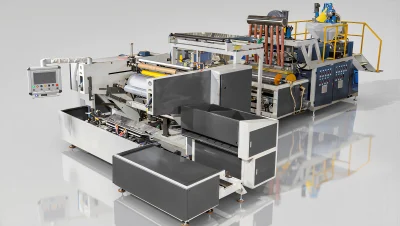
Precautions for Using a 3-Layer Stretch Film Machine
2026-09-01
Running a 3-layer stretch film extrusion machine efficiently is not simply a matter of pressing start and letting the line run. Film clarity, cling performance, tensile strength, and puncture resistance are all determined by how tightly an operation controls temperature, raw material quality, maintenance timing, and process discipline. Many production issues that get blamed on "bad film" actually trace back to how the machine was operated the day the roll was made.
Why Traditional Operating Habits Fall Short
Older stretch film lines, and even newer lines run on outdated habits, tend to share the same weak points. Startup decisions are made by feel rather than by data — an operator checks the extruder temperature gauge, decides it "looks close enough," and starts production before true thermal equilibrium has been reached. For a 3-layer co-extrusion structure combining LLDPE with metallocene-based cling materials, that shortcut is costly: even a small imbalance between layers shows up downstream as uneven thickness, weak cling, or poor optical clarity.
Raw material handling is another recurring gap. Moisture content is frequently checked only occasionally, if at all, rather than verified before every batch. Resin that has absorbed even a small amount of ambient humidity can introduce microscopic bubbles and surface defects that are invisible on the roll but become obvious the moment the film is stretched around a pallet. Thickness gauges, similarly, are often calibrated on a loose schedule rather than tied to actual production conditions, which allows small measurement drift to go unnoticed until an entire batch shows inconsistent layer distribution.
Maintenance on many lines still follows a fixed calendar instead of the actual condition of the equipment. Die heads are cleaned "when someone gets around to it," gear pumps and filters are replaced on a generic timetable, and sealing systems are inspected reactively, after a pressure problem has already affected film quality. This calendar-based approach either wastes maintenance hours on parts that didn't need attention yet or, worse, misses early warning signs of wear that lead to unplanned downtime.
Material and formulation changeovers add another layer of risk. Without a strict per-extruder purging procedure, residual material from a previous run can cross into a new formulation, contaminating one or more layers and creating inconsistency between batches that were supposed to be identical. Finally, process knowledge on many lines still lives in the heads of a few experienced operators rather than in documented, repeatable parameters, which makes training slow and shift-to-shift consistency difficult to guarantee.

Where Stretch Film Performance Really Matters
These operating gaps are not abstract — they show up differently depending on what the film is protecting.
In beverage and bottled water palletizing, stretch film is often stored and applied in humid warehouse environments, and it needs to hold consistent tensile strength and cling regardless of ambient moisture. Film produced on a line without proper environmental and thermal control can perform well on a dry day and fail to hold pallet loads securely during a humid production run, leading to shifted or collapsed loads in transit.
In building material and profile packaging, heavy, often irregularly shaped loads demand high puncture resistance from the outer layer and strong cling from the inner layer. When thickness monitoring is inconsistent, the film develops thin spots that are invisible until the load is in transit, at which point a single weak point can tear and compromise the entire wrap.
In e-commerce and logistics packaging, the demands are different again: high-frequency changeovers between film types, tight batch-to-batch consistency, and minimal downtime. A line that struggles with slow, manual purging between formulations or that suffers frequent unplanned stops simply cannot keep pace with modern fulfillment volumes.
Built for Consistent, Controlled Stretch Film Production
Our 3-layer stretch film extrusion machine is engineered specifically to close these operational gaps rather than leave them to operator judgment.
Thermal stability is built into the startup sequence rather than left to visual estimation. The extrusion system is monitored through to genuine thermal equilibrium before production begins, which matters most for multi-layer structures combining LLDPE with metallocene-based cling layers — the exact combination where temperature imbalance does the most damage to thickness uniformity and optical clarity. For pallet packaging in humid environments such as beverage and bottled water logistics, that stability translates directly into film that holds its tensile strength and cling performance regardless of the weather the day it was produced.
Layer consistency is supported by inline thickness monitoring and gauge calibration built into routine operation rather than treated as a periodic afterthought. This keeps layer distribution uniform across a run, which is exactly what heavy-load applications like building material and profile packaging depend on — a puncture-resistant outer layer and a high-cling inner layer that stay within tight thickness tolerances instead of drifting into weak points partway through a roll.
Maintenance on our line is guided by actual operating condition rather than a rigid calendar. Gear pumps, filters, and sealing systems are checked against real melt pressure behavior, so components are serviced when the equipment actually needs it — reducing both wasted maintenance time and the risk of the unplanned stoppages that hurt high-throughput operations like e-commerce and logistics packaging the most.
Formulation changeovers follow a strict per-extruder purging procedure, so switching between film types — for example, moving between a high-cling formulation and a standard packaging film — does not risk cross-contaminating layers or compromising the next batch. Combined with fully documented process parameters captured during commissioning, including temperature settings, screw speed, and tension levels, every run has a clear, repeatable benchmark to follow. That documentation also shortens the learning curve for new operators and keeps output consistent across shifts, which matters as much on a slow day as it does during peak-volume production.
The result is a 3-layer stretch film extrusion machine designed to bring greater control and consistency to the key stages of film production, from startup and raw material handling to maintenance, changeovers, and continuous operation. For manufacturers and procurement teams evaluating a stretch film production line, the long-term value of the equipment goes beyond nominal output speed. Stable processing, consistent film properties, efficient material utilization, and dependable operation can have a more direct impact on production costs and product quality over time. By combining precise process control with a practical production configuration, a well-designed 3-layer extrusion line can provide a reliable foundation for producing stretch film consistently across different packaging requirements and operating conditions.