Why Online Thickness Control Matters in Stretch Film Production
As high-speed automated pallet wrapping systems advance, stretch film manufacturers face increasingly stringent tolerances regarding thickness uniformity, mechanical performance, cling, and winding quality. For three-layer cast stretch film, maintaining a stable transverse direction (TD) and machine direction (MD) thickness profile is essential because the final stretch film properties depend on the coordinated performance of multiple extrusion layers.
Traditional offline quality control methods fail to provide real-time process visibility at elevated line speeds. When thickness deviation occurs across the stretch film width or in the machine direction, the deviation may not be identified until a sample is removed and tested. By that time, a considerable amount of stretch film may already have been produced.
Consequently, continuous online thickness measurement is critical for modern cast extrusion lines. Continuous measurement allows production teams to see actual stretch film thickness during operation and respond to process variation more efficiently.
Thickness Uniformity Supports Stable Stretch Film Performance
The objective of thickness control is not simply to produce thinner stretch film. A well-designed production process should maintain the required thickness specification while keeping thickness variation within a controlled range.
Uniform thickness distribution supports isotropic stress distribution during high-speed pre-stretch applications. If some areas are significantly thinner than others, these sections may experience higher stress during stretching, while excessively thick sections increase material consumption. Tight gauge control optimizes the balance between pre-stretch capability, ultimate tensile strength, puncture propagation resistance, and resin yield.
Roll geometry is another important consideration. Localized high spots cause localized build-up during winding, generating non-uniform tension distribution, soft edges, and roll telescoping. For customers using automatic wrapping equipment, consistent roll formation helps the stretch film unwind more smoothly during continuous operation.
Three-layer stretch film also requires stable layer distribution. Depending on the product specification, the outer slip layer, core structural layer, and inner cling layer can be designed with different material formulations and functional requirements. Accurate extrusion and co-extrusion control help maintain the intended structure, while online thickness measurement provides additional information about the finished web.
How an Online Thickness Measurement System Works
An online thickness measurement system continuously monitors the web in real time during continuous extrusion. Depending on the stretch film specification and machine configuration, an appropriate non-contact measurement technology can be integrated into the cast stretch film production line.
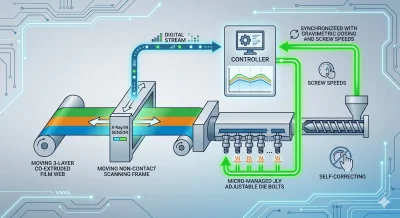
The measurement system collects thickness data across the stretch film width and sends the information to the control interface. Instead of depending only on periodic manual inspection, operators can view the thickness profile and identify changes while the stretch film is being produced.
Interfaced with the primary Human-Machine Interface (HMI), the system maps cross-web thickness distributions, enabling operators to identify thermal band failures, die lip buildup, or melt pump delivery fluctuations.
For configurations equipped with automatic die adjustment, the measurement system can also participate in closed-loop thickness control. When the measured profile deviates from the target range, the control system can adjust the corresponding die actuators to correct the distribution.
The exact control method depends on the die structure, actuator configuration, stretch film specification, and automation system. This is why online thickness measurement should be considered as part of the complete stretch film production system rather than simply an independent measuring device.
Closed-Loop Thickness Control on Our 3-Layer Stretch Film Manufacturing Machines
Our three-layer stretch film manufacturing machines are designed with the complete cast stretch film production process in mind. The extrusion system, multi-layer co-extrusion structure, T-die, cooling section, thickness monitoring, and winding system work together to provide stable stretch film production.
For applications requiring tighter thickness control, an online thickness measurement system can be integrated with the machine's PLC and HMI control architecture. The measured stretch film profile provides real-time production information, while the automatic control system can use this information to support die adjustment and process correction.
This closed-loop approach reduces the need for operators to repeatedly measure samples and manually adjust the die based only on intermittent inspection results. Instead, the production line can continuously compare the actual stretch film profile with the target setting and respond to detected deviations according to the configured control strategy.
For manufacturers producing thin or high-performance stretch film, this capability is particularly useful. As production speed increases, the time available for manual intervention becomes shorter. Continuous measurement and automatic correction provide a more responsive method for maintaining a stable production process.
Our stretch film manufacturing machines can therefore be configured not only for the required production capacity and stretch film width, but also for the level of thickness monitoring and automation required by the customer's application.
Better Thickness Control Helps Improve Material Utilization
Polyethylene materials such as LLDPE constitute up to 80% of total operational expenditure in stretch film extrusion. When thickness variation is difficult to control, manufacturers may intentionally produce film slightly above the target thickness to maintain a safety margin. This safety margin consumes excessive resin and inflates unit production costs.
With online thickness measurement, manufacturers can obtain more accurate information about the actual film profile. This allows the production process to be optimized around the required specification rather than relying solely on conservative thickness settings.
The potential material benefit depends on film thickness, production width, resin formulation, machine speed, process stability, and operating conditions. Therefore, there is no universal percentage of material savings that applies to every production line. The practical objective is to reduce unnecessary thickness variation and avoid excessive material use while maintaining the required film performance.
Our three-layer stretch film manufacturing machines are developed to support this approach by combining stable extrusion control with accurate die adjustment and optional online thickness monitoring. This provides manufacturers with a more practical foundation for improving both product consistency and material utilization.
| Key Aspect | Traditional Control | Online Thickness Control |
|---|---|---|
| Thickness Monitoring | Manual sampling and offline inspection | Continuous real-time thickness measurement |
| Thickness Consistency | More dependent on operator experience | More stable and consistent film thickness |
| Thickness Adjustment | Manual die adjustment | Supports automatic die adjustment |
| Production Stability | Deviations may be detected later | Faster response to thickness variation |
| Data Management | Limited production records | Real-time monitoring and trend data |
| Automation Level | Manual or semi-automatic | PLC and HMI-based control |
Online Thickness Data for More Consistent Production Management
The value of an online measurement system extends beyond immediate thickness correction. Production data can also support process optimization, quality analysis, and production management.
When integrated with PLC and HMI systems, thickness information can be monitored together with key extrusion parameters. Operators can review thickness trends during production and use recorded data to investigate process changes or quality deviations.
For manufacturers producing multiple film specifications, digital production data can also support recipe management and repeatable setup. Once appropriate process parameters have been established for a specific film structure and thickness, the production team can use the stored settings as a reference for future production.
Our stretch film manufacturing machines can be configured with different levels of automation according to production requirements. From basic process monitoring to more advanced closed-loop control, the machine configuration can be selected according to the required film quality, production capacity, material structure, and investment plan.
Build a More Controlled 3-Layer Stretch Film Production Line
Choosing a stretch film production line requires a holistic evaluation of machine subsystems. For consistent three-layer film production, the relationship between extrusion output, melt temperature, coextrusion layer ratios, T-die performance, cooling conditions, thickness control, and winding stability must be engineered as an integrated mechanical unit.
Our three-layer stretch film manufacturing machines integrate these production stages into a coordinated cast film solution. Depending on customer requirements, the line can be equipped with online thickness measurement and automatic control functions to provide more precise monitoring of the finished film.
We focus on matching the machine configuration to the actual production application. Film thickness, web width, target output, LLDPE formulation, multilayer structure, automation requirements, and factory conditions can all be considered when developing the equipment configuration.
For manufacturers aiming to improve film consistency, reduce unnecessary over-thickness, and achieve more stable high-speed production, our three-layer stretch film manufacturing machines provide a reliable platform for modern stretch film manufacturing. With integrated extrusion, multilayer coextrusion, T-die, cooling, online thickness measurement, and winding technologies, the production line can be configured around practical quality and efficiency requirements rather than relying on a one-size-fits-all solution.