Operation Process of 3-Layer Stretch Film Extrusion Machine
2026-04-27
The 3-Layer Stretch Film Extrusion Machine is designed for stable and continuous production of multi-layer stretch film. Proper operation ensures consistent film quality, efficient production, and reliable machine performance. The following outlines the standard operating process from system start-up to finished roll winding.
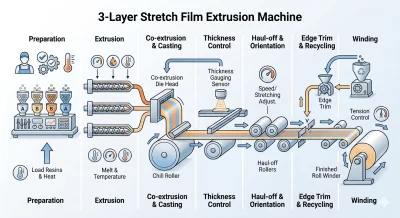
The operation begins with system preparation. Operators first check raw materials and ensure that each layer’s resin is correctly loaded into the corresponding extruder. Typically, LLDPE is used for the core layer, while functional materials such as metallocene or cling additives are used for the outer layers. At the same time, electrical systems, heaters, and cooling units must be inspected to confirm normal operation. Temperature settings for each heating zone are then configured according to material requirements, generally within the range of 180°C to 240°C.
After reaching the target temperatures, the extruders are started one by one. Screw speed is increased gradually to achieve stable melting and continuous material flow. During this stage, operators need to monitor melt pressure and temperature closely to ensure each extruder is running smoothly and consistently.
Once extrusion becomes stable, the co-extrusion process begins. The three melt streams are combined in the die head to form a uniform A-B-A layer structure. Operators adjust the output of each extruder to maintain the correct layer ratio and ensure balanced flow. The molten film is then cast onto chilled rollers, where rapid cooling stabilizes the film structure and improves clarity and strength.
During production, the thickness control system should remain active. Operators monitor the film gauge through the control system and ensure automatic adjustments are working properly. Consistent thickness across the film width is critical for product performance and material efficiency.
The film then enters the haul-off section, where it is stretched under controlled tension. By adjusting roller speed ratios, operators can control the degree of stretching and ensure stable film properties. Proper tension control helps prevent defects such as film breakage or uneven stretching.
At the final stage, the film edges are trimmed and the material is wound into rolls. Operators must ensure stable winding tension, proper alignment, and smooth roll formation. Edge trim can be recycled back into the production process to improve material utilization.
Throughout the entire operation, continuous monitoring is essential. Key parameters such as temperature, pressure, screw speed, and line speed should remain stable. Avoiding sudden changes and maintaining consistent operating conditions will ensure steady production and uniform film quality.
The 3-Layer Stretch Film Extrusion Machine enables efficient production of high-quality stretch film through controlled operation and stable processing conditions. A well-managed workflow ensures reliable performance, consistent output, and optimized production efficiency.