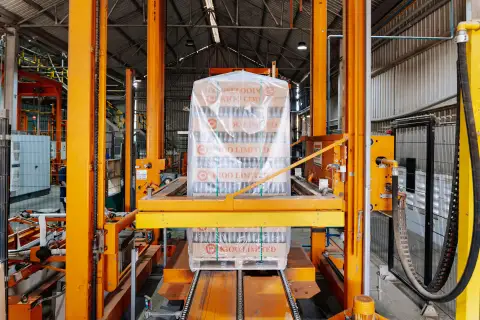
Packaging Challenges in Glass Bottle Transportation and Logistics
The glass bottle packaging industry requires highly reliable protection solutions to maintain product safety throughout manufacturing, storage, and transportation. Glass containers used in beverage, pharmaceutical, cosmetic, and chemical industries are widely recognized for their excellent barrier properties and product compatibility, but their fragile structure and relatively high weight create significant challenges during logistics operations.
During pallet transportation, glass bottles are exposed to multiple external forces, including vibration, sudden acceleration, stacking pressure, and handling impacts. Without sufficient load stabilization, bottle layers may shift during transportation, causing friction between containers, pallet instability, and potential product damage. These risks become more noticeable in long-distance shipping, where repeated vibration and environmental changes can affect packaging performance.
Traditional packaging materials may not always provide the required balance between strength, elasticity, and holding force for heavy glass bottle loads. Films with inconsistent thickness distribution, insufficient puncture resistance, or poor stretching performance may break during high-tension wrapping processes. For automated pallet wrapping systems, unstable film quality can also lead to production interruptions, increased material consumption, and reduced packaging efficiency. As a result, glass bottle manufacturers and logistics providers increasingly require advanced stretch film solutions with stable mechanical properties and consistent application performance.
How 3-Layer Stretch Film Manufacturing Machine Improves Film Performance
A three-layer stretch film manufacturing machine enables packaging material producers to manufacture customized stretch films with optimized structures for demanding industrial applications. Unlike conventional single-layer films, three-layer co-extrusion technology allows different materials and functional properties to be distributed across separate layers, improving overall film performance.
The production process typically combines linear low-density polyethylene (LLDPE) with advanced polyethylene materials such as metallocene polyethylene (mLLDPE) to achieve better tensile strength, puncture resistance, and elastic recovery. Through precise layer distribution, manufacturers can design films that provide strong load retention while maintaining efficient material usage.
The inner layer of the film can be formulated with suitable cling properties to ensure stable bonding between wrapped layers. The middle layer provides the main mechanical strength and stretching capability, helping the film maintain consistent holding force after application. The outer layer can be adjusted to achieve appropriate slip characteristics, improving pallet handling and reducing difficulties during transportation and storage.
This multi-layer structure allows glass bottle packaging producers to achieve a more balanced combination of protection, flexibility, and cost efficiency compared with traditional film structures.
| Item | Traditional Stretch Film | 3-Layer Stretch Film |
|---|---|---|
| Film Structure | Simple structure with limited performance adjustment | Multi-layer structure with optimized strength and flexibility |
| Load Stability | Suitable for general pallet wrapping | Better load retention for heavy glass bottle pallets |
| Puncture Resistance | More likely to tear under concentrated stress | Improved resistance against impact and sharp edges |
| Film Thickness Control | Thickness consistency may vary | More uniform thickness through precision extrusion control |
| Application Efficiency | Higher risk of film breakage during automated wrapping | Stable performance for high-speed packaging lines |
| Material Efficiency | May require thicker film for protection | Optimized structure reduces material consumption |
Importance of Film Thickness Control and Extrusion Precision
The performance of stretch film is closely related to the stability and precision of the production equipment. A high-quality stretch film manufacturing machine uses advanced extrusion control technology to maintain consistent film thickness, stable temperature distribution, and uniform material flow throughout the production process.
For glass bottle packaging applications, thickness uniformity is especially important because heavy pallet loads generate significant mechanical stress during wrapping and transportation. Weak areas caused by uneven film thickness may reduce puncture resistance and affect overall packaging reliability.
Modern production lines are commonly equipped with automatic thickness control systems, precision T-die technology, and intelligent temperature management systems to improve film consistency. These technologies help manufacturers produce stretch films with reliable quality across different roll widths and production speeds.
Stable extrusion performance also supports continuous operation in industrial environments, allowing packaging material producers to maintain consistent output quality while reducing production fluctuations.
Enhancing Glass Bottle Load Stability with Multi-Layer Stretch Film
One of the most important functions of stretch film in glass bottle packaging is maintaining pallet stability during transportation. After wrapping, the film creates a controlled compression force around the pallet, helping secure bottle layers and reduce unnecessary movement.
During truck transportation, rail shipping, or ocean freight, pallets may experience continuous vibration and external impact. High-performance three-layer stretch films provide controlled elasticity and recovery characteristics, allowing the film to absorb these forces while maintaining load integrity.
For beverage bottles, chemical containers, and pharmaceutical glass packaging, stable load retention helps reduce the possibility of product shifting and improves transportation reliability. The combination of tensile strength and elastic recovery enables the film to adapt to different pallet structures while maintaining consistent wrapping performance.
In addition, high-quality stretch films produced by advanced equipment can maintain good transparency, allowing barcode labels and product information to remain visible during warehouse operations, inventory management, and distribution processes.
Supporting Automated Pallet Wrapping Operations
Modern glass bottle production facilities increasingly rely on automated palletizing and wrapping systems to improve efficiency. In these environments, packaging materials must meet strict requirements for consistent feeding, stable tension control, and reliable machine operation.
A stretch film manufacturing machine designed for industrial production helps create films with predictable stretching characteristics and stable roll quality. This allows the film to perform smoothly on automatic pallet wrappers, including rotary-arm and turntable wrapping systems.
Consistent film performance reduces the frequency of film breakage and minimizes operator intervention during packaging operations. For large-scale manufacturing plants, this improvement contributes to higher production efficiency and more stable packaging processes.
The flexibility of three-layer film structures also allows manufacturers to develop different film specifications for various glass bottle applications, from lightweight beverage containers to heavier industrial glass products.
Improving Material Efficiency and Sustainable Packaging Performance
Sustainability has become an important consideration for modern packaging manufacturers. Advanced stretch film technology helps companies reduce material consumption by producing thinner films with improved mechanical performance.
With precise extrusion control and optimized layer design, manufacturers can maintain required load stability while reducing unnecessary resin usage. This not only lowers packaging material costs but also supports environmental objectives by reducing plastic consumption.
Modern stretch film manufacturing machines can also integrate accurate material dosing systems and recycling solutions for production waste. These features improve raw material utilization and help manufacturers create more efficient production processes.
For companies producing packaging materials internally, this technology provides greater flexibility to adjust film formulations according to customer requirements and market trends.
Stretch Film Manufacturing Machine for Efficient Glass Bottle Packaging Production
The application of a three-layer stretch film manufacturing machine in glass bottle packaging demonstrates the importance of advanced extrusion technology in modern industrial logistics. Through multi-layer co-extrusion design, precise thickness control, and stable production performance, these machines enable manufacturers to produce reliable stretch films for fragile and heavy products.
As a professional manufacturer of stretch film production equipment, we provide advanced stretch film manufacturing machine solutions designed for industrial packaging applications. Our equipment integrates efficient extrusion systems, precision T-die technology, automatic thickness control, and reliable winding systems to support the production of high-quality three-layer stretch films.
With flexible machine configurations and professional technical support, our solutions help packaging producers improve production efficiency, maintain stable film quality, and develop customized packaging materials for glass bottle transportation and other demanding industries. By investing in reliable stretch film production technology, customers can strengthen their packaging capabilities and build long-term competitiveness in the global market.