Key Advantages of a Fully Automatic Stretch Film Extrusion Machine
2026-08-26
High-volume packaging operations are under constant pressure to run faster, waste less material, and keep production lines moving around the clock. For years, semi-automatic stretch film extrusion machines were the industry standard, but their reliance on manual intervention has become one of the biggest bottlenecks in modern manufacturing. As demand for consistent, high-performance LLDPE film continues to grow, more producers are turning to a fully automatic stretch film extrusion machine to eliminate downtime, reduce labor dependency, and deliver film quality that manual processes simply cannot match.
The Limits of Traditional Semi-Automatic Equipment
Semi-automatic lines depend heavily on operators for core loading, roll changeovers, and tension adjustments. Every one of these manual steps introduces variability and, more importantly, downtime. When a machine has to stop or slow down for an operator to load a new paper core or doff a finished roll, overall equipment utilization drops sharply.
Manual tension control is another persistent challenge. Even experienced operators cannot replicate the consistency of a closed-loop control system, which means roll geometry, end-face flatness, and film gauge can vary from one roll to the next. In a single-layer extrusion process, this inconsistency is compounded by limited material engineering options, resulting in film that is more prone to puncture and tearing when wrapping heavy or irregularly shaped pallet loads.
These limitations do not just affect the machine itself. They ripple downstream, creating inconsistent rolls that cause tension fluctuations, film breaks, and stoppages on automated pallet-wrapping lines. As packaging facilities move toward continuous, high-speed operations, the gap between what semi-automatic equipment can deliver and what the industry actually needs continues to widen.
Why Stretch Film Quality Defines Packaging Performance
Stretch film is far more than a commodity material. It is the last line of defense protecting palletized goods through transportation, warehousing, and handling. The performance of the film directly determines whether a load arrives intact or shifts, tears, and becomes a safety hazard in transit.
Because stretch film is consumed at such high volume, even small variations in thickness, tension, or strength translate into significant cost and reliability differences at scale. Facilities running high-speed automated wrapping equipment depend on film that behaves identically roll after roll. Any inconsistency forces operators to slow down wrapping speed, increase wrap cycles, or accept a higher risk of load failure. In short, the quality of the film entering a wrapping line is only as good as the extrusion process that produced it, which is why the machine behind the film matters just as much as the film itself.

How a Fully Automatic Stretch Film Extrusion Machine Solves These Problems
A fully automatic stretch film extrusion machine is engineered specifically to remove the variability and downtime that limit semi-automatic lines, while giving manufacturers precise control over film structure and performance.
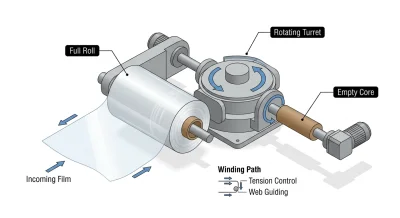
Continuous production through automated core handling and turret winding replaces manual roll changeovers with a dual-station turret winder and a robotic core-loading system that feeds paper cores directly from a magazine. Roll changeovers happen at full line speed without stopping production, which allows facilities to move toward true lights-out, 24/7 manufacturing while maximizing asset utilization.
Multi-layer co-extrusion technology gives manufacturers the ability to engineer film structure layer by layer, with 2-layer, 3-layer, and 5-layer configurations available depending on application needs. A 3-layer A/B/A or 5-layer A/B/C/B/A structure allows different polymer grades to be combined within a single film, producing a high-cling inner layer for load stability, a puncture-resistant core for strength, and a durable outer layer for abrasion resistance. This layered approach makes the film far more capable of securing heavy machinery components, building materials, metal products, and other irregular or high-mass pallet loads compared to single-layer film.
A 350 percent pre-stretch capability allows the extrusion process to produce thinner film without sacrificing strength, delivering more linear coverage per pound of resin. For packaging operations wrapping large volumes of pallets daily, this directly reduces material consumption and cost per load while maintaining holding force, making it a practical way to lower packaging expenses without compromising load security.
Precision winding tension control keeps tension constant throughout the entire roll, producing flat end-faces and consistent roll geometry from the first wrap to the last. This consistency matters most once the film reaches a customer's own high-speed wrapping line, where uneven rolls cause tension spikes, film breaks, and unplanned stops.
Closed-loop gauge control continuously scans the film web in real time and automatically adjusts the die lips to maintain micrometer-level thickness uniformity across the entire roll. This eliminates the thick and thin spots common in manually monitored extrusion, ensuring the finished film performs predictably whether it is wrapping a single pallet or running through thousands of wrap cycles a day.
Together, these systems produce standardized rolls that are identical in weight, length, and performance, which is exactly what high-speed automated wrapping lines require to run efficiently and without interruption.
Built for Manufacturers Who Cannot Afford Downtime
Every feature of a fully automatic stretch film extrusion machine is designed around one goal: removing the variability that manual processes introduce, so producers can deliver film that performs the same way every single time. From automated core handling and non-stop turret winding to multi-layer co-extrusion, high-ratio pre-stretch, and closed-loop gauge control, this equipment gives manufacturers the tools to compete in a packaging market that increasingly demands speed, consistency, and reliability.
Our fully automatic stretch film extrusion machine is built to meet exactly these demands. With dual-station turret winding for uninterrupted production, configurable 2, 3, and 5-layer co-extrusion systems for tailored film performance, precision tension and gauge control for roll-to-roll consistency, and a 350 percent pre-stretch capability that maximizes yield per kilogram of resin, our stretch film extrusion machine gives producers the reliability and output quality that modern packaging lines depend on. Whether you are upgrading from a semi-automatic setup or specifying a new production line from the ground up, our engineering team can help configure a machine that matches your film specifications, output targets, and automation goals. Contact us today to discuss your project and see how our stretch film extrusion machine can improve your production efficiency and film quality.