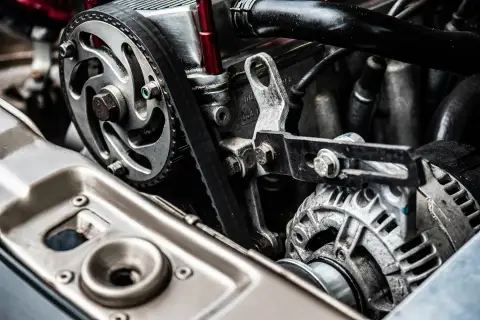
Fuel tanks, brake calipers, alloy wheels, and engine blocks share one packaging challenge that most other industries never have to solve: irregular geometry combined with sharp, protruding metal. A single pallet of automotive or motorcycle components can carry dozens of exposed bolt heads, casting flashes, and machined edges, all moving against the wrap during forklift handling, rail transfer, and ocean transit. Standard packaging film, designed around flat cartons and soft-sided loads, simply was not built for this. This is why parts exporters and Tier 1 suppliers increasingly specify film produced on a purpose-built stretch film manufacturing machine rather than relying on generic wrap sourced for general warehousing use.
Why Standard Packaging Struggles With Auto and Motorcycle Parts
The core difficulty starts with product geometry. Fuel tanks, brake components, cast aluminum wheels, and engine parts rarely stack into clean, uniform shapes, and their surfaces are dense with the kind of sharp edges and hardware protrusions that concentrate stress on a wrapped film at a single point rather than distributing it across a flat panel. Under handling and transport vibration, a conventional film that punctures at one bolt head does not stay a small hole — the tear propagates along the wrap, and once the barrier is broken the entire pallet loses containment force, allowing parts to shift or separate in transit. Metal components add a second layer of risk: most automotive parts are sensitive to humidity, and a film without a genuine moisture barrier allows condensation to reach bare or lightly coated metal surfaces during long-distance shipping or extended warehouse dwell time, leading to surface oxidation and corrosion claims on arrival. On top of the damage risk, heavy or irregular loads have traditionally pushed packaging teams toward extra corner boards, edge protectors, and secondary strapping just to compensate for a film that cannot do the job on its own, which adds labor, material cost, and time to every pallet that leaves the plant.
The Protective Role of Co-Extruded Stretch Film in Parts Packaging
A well-engineered multi-layer stretch film addresses these failure points by assigning a specific mechanical function to each layer rather than asking a single resin to do everything. The outer layers are formulated for abrasion and puncture resistance, giving the film the toughness to absorb contact with bolt heads, casting edges, and machined corners without the point of contact turning into a propagating tear — this is the layer most directly responsible for surviving sharp automotive hardware, and it is typically validated against recognized puncture and impact benchmarks such as ASTM D1709. The inner layer is formulated for high cling and tack, so the film grips itself tightly on each wrap pass and forms a continuous, low-permeability seal around irregular contours rather than leaving gaps at the geometry changes common on wheels and tanks. Between these functional skins, the core layers carry an elastic, high-prestretch resin system — commonly capable of 200 to 250% stretch depending on formulation — that gives the film its memory and sustained clamping force, allowing it to hold heavy, unevenly shaped loads firmly in place and recover tension as parts settle or shift during transport rather than loosening over time. Working together, this layered structure lets the finished film deliver strong, stable containment force across a pallet of alloy wheels or engine components while also forming a tight moisture barrier that measurably reduces the surface corrosion risk that plagues metal parts in transit.
Engineering the Film: What a 5-Layer Stretch Film Manufacturing Machine Contributes
None of these combined properties are achievable by improvising with a single-layer or basic three-layer line — they require true five-layer co-extrusion, most commonly built around a symmetric A-B-C-B-A structure in which the outer skins (A), the intermediate tie or transition layers (B), and the elastic core (C) are extruded simultaneously through independently controlled dies. On a 5-layer stretch film manufacturing machine, precise control over melt temperature, extruder screw speed, and die-lip gap across all five material streams is what allows tough outer resins, cling-optimized inner resins, and an elastic core to be fused into a single film only 15 to 23 microns thick without one layer's processing requirements compromising another's. This level of process control also governs film consistency roll to roll: automotive and motorcycle parts exporters typically run high volumes on automated pallet wrapping equipment, and any variation in gauge, tack, or prestretch response from batch to batch shows up immediately as inconsistent containment force on the packing line. Equipment capable of tight, repeatable co-extrusion is therefore not just a production efficiency question but a direct input into the finished film's field performance on demanding, irregular loads.
| Layer Structure | Function | Packaging Benefit |
|---|---|---|
| A Layer (Outer Skin) | High strength and wear resistance | Protects against puncture and external impact |
| B Layer (Tie Layer) | Enhances layer bonding | Improves film stability and prevents delamination |
| C Layer (Elastic Core) | Provides stretch and recovery force | Maintains strong load holding during transportation |
| B Layer (Tie Layer) | Supports layer integration | Ensures consistent film performance |
| A Layer (Outer Skin) | Durable protective surface | Improves handling and shipping reliability |
Commercial and Operational Value for Packaging Producers
For film manufacturers supplying the automotive and motorcycle parts sector, the business case for investing in this level of co-extrusion technology is straightforward. Film with a genuinely elastic, high-prestretch core allows downstream customers to achieve strong containment force while applying less material per pallet, directly reducing their film consumption and per-unit packaging cost without sacrificing load security. Because the film's outer and inner layers are engineered for puncture resistance and self-cling respectively, customers packaging sharp-edged or irregular parts can also reduce or eliminate the corner boards, edge protectors, and extra strapping that generic film requires, simplifying their packing process and cutting secondary material spend. And because these functional properties are built into the film during production rather than compensated for afterward on the customer's line, a producer running a well-controlled five-layer line is positioned to compete directly for higher-margin, technical-grade orders from Tier 1 and Tier 2 automotive suppliers rather than competing only on price for commodity wrap.
Partnering With the Right Equipment Supplier
Specifying film for auto and motorcycle parts packaging is ultimately a question of what production equipment stands behind the roll. Our five-layer co-extrusion stretch film manufacturing machine is engineered specifically to give producers this level of control — precise A-B-C-B-A layer distribution, stable multi-stream melt management, and repeatable prestretch calibration — so that the film coming off the line is genuinely capable of protecting fuel tanks, brake parts, alloy wheels, and engine components through the full handling and shipping cycle. Whether you are upgrading an existing line to serve automotive-grade specifications or building new capacity to enter this market, our engineering team can work with you on machine configuration, resin structure, and target film gauge for your production goals. Contact us today to request equipment specifications, arrange a film performance test, or discuss a production line proposal tailored to your customers' packaging requirements.