How Stretch Film Extrusion Machine Improve Product Competitiveness
2026-09-01
The stretch film wrapped around a pallet load rarely gets a second thought until it fails — until a load shifts in transit, a corner gets crushed, or a customer opens a shipment to find damage that packaging should have prevented. In modern manufacturing, the performance of a stretch film extrusion machine sits directly upstream of all of that, and it has become one of the clearest levers a producer has for improving product competitiveness rather than just meeting a minimum packaging spec.
Structural Limitations of Conventional Stretch Film Extrusion
Simple, single-layer or basic two-layer extrusion lines face a structural limitation that's hard to engineer around: without the ability to combine different polymers like LLDPE, mLLDPE, and EVA in precise, separated layers, these machines are forced into a trade-off between puncture strength and cling performance rather than delivering both. A film built to resist tearing often sacrifices the tack needed to hold a load securely, and a film optimized for cling often can't withstand the abrasion and impact a pallet load experiences in transit.
Gauge control is a second recurring weakness. Machines without automatic T-die systems tend to produce film with inconsistent thickness across the web width, and that unevenness limits how far the film can be safely pre-stretched before it breaks. Since higher pre-stretch ratios are what allow a roll to cover more pallets with less material, a machine stuck at lower, less consistent stretch ratios quietly drives up material cost per load — a cost that compounds across thousands of pallets a year.
These two limitations feed into a third, more strategic problem: film that can't hold higher pre-stretch ratios also can't deliver the holding force needed for genuinely reliable load stability. Producers stuck with lower-performing film either accept a higher risk of load shift and product damage, or compensate by using more material per pallet — and either choice quietly erodes the competitiveness a well-engineered stretch film production line should be delivering in the first place.

Why These Weaknesses Matter Across Different Applications
The consequences of underperforming stretch film look different depending on what's being wrapped, but in every case, film performance ends up shaping the customer's experience with the product inside it.
In furniture export packaging, irregularly shaped items and uneven weight distribution place real demands on puncture resistance and holding force. Film without adequate strength or tension consistency is more likely to loosen or tear during long ocean transit, leaving corners exposed to abrasion and impact by the time the shipment reaches its destination.
In cold chain and frozen food pallet packaging, cling stability and gauge consistency have to hold up under low-temperature conditions that make film naturally more brittle and less forgiving of thickness variation. A film with uneven gauge is more likely to develop a weak point that fails exactly where the cold chain environment is least tolerant of any lapse in seal integrity.
In glass and ceramic tableware packaging, load stability is the difference between a shipment arriving intact and one that doesn't. Fragile, tightly packed items depend on consistent wrapping tension to stay immobilized throughout transit, and any inconsistency in the film's holding force translates directly into a higher risk of breakage from the vibration and shifting that happen in ordinary transport.
From Furniture to Cold Chain: How Our Multi-Layer Film Redefines Cargo Transit Safety
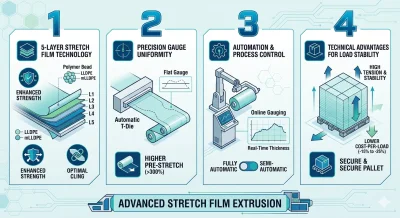
Our multi-layer co-extrusion stretch film extrusion lines are available in 2-layer, 3-layer, and 5-layer configurations, allowing the film structure to be matched to the required balance of strength, cling, and material efficiency. By assigning different polymers to specific functional layers, a properly designed multi-layer structure can combine mechanical strength with a dedicated cling layer more effectively than a basic single-material structure. Materials such as LLDPE, mLLDPE, and EVA can be incorporated where appropriate to the target formulation and application. For furniture export packaging, this layered approach can provide a useful balance of puncture resistance, tear strength, and cling for securing irregular or unevenly distributed loads during transit.
Gauge uniformity is supported by automatic T-die systems integrated into the production line, helping reduce cross-web thickness variation and maintain more consistent film properties. More uniform gauge provides a stable basis for achieving higher pre-stretch ratios when the film formulation, thickness, and wrapping equipment are designed for this purpose. Using an appropriate pre-stretch level can reduce material consumption per load while maintaining the required film integrity. For cold-chain and frozen-food packaging, consistent film thickness also helps provide more predictable mechanical and handling performance, while the resin formulation should be selected and tested according to the intended low-temperature conditions.
Pre-stretch capability is particularly important in load-stabilization applications because the right combination of film formulation, thickness, and stretch ratio can generate sufficient holding force while reducing the amount of film required per pallet. The actual holding force depends on the film's tensile properties, stretch level, application method, and load characteristics rather than stretch ratio alone. For glass and ceramic tableware packaging, a properly selected film structure and wrapping process can help keep products securely positioned during normal transportation and handling. At the same time, optimizing film strength and stretch performance can reduce unnecessary material use without simply relying on a thinner film.
Investing in a multi-layer co-extrusion stretch film extrusion line is a strategic decision that reaches beyond the packaging department. Whether a producer needs the balanced performance of a 3-layer system or the high-speed output of a 5-layer line, the precision and efficiency these machines deliver directly shape how reliably products arrive, how much material a company spends achieving that reliability, and ultimately how competitive that company's packaging performance looks next to everyone else shipping into the same supply chain.