Uneven film edges are one of those problems that look minor on paper and turn into real losses on the production floor. A few millimeters of width variation at the edge of the roll can throw off winding tension, distort roll geometry, and quietly eat into material yield shift after shift. On a modern stretch film making machine, we treat edge control as a core design requirement rather than an afterthought, because the edge is where waste starts and where roll quality is decided.
Why Uneven Edges Still Cause Trouble on Older Lines
Most of the edge problems we see trace back to production lines that were never built with trimming and recycling in mind. When edge control depends on manual adjustment, operators are checking width by eye or with hand tools, and any drift in extrusion pressure or line speed shows up as ragged, inconsistent edges before anyone catches it. That inconsistency then travels straight into the winding station, where it shows up as loose or telescoping rolls, uneven roll faces, and film that unwinds unevenly on the customer's own equipment.
The waste side of the problem is just as costly. Without an inline trimming and recycling path, edge trim gets cut away, cooled, collected by hand, and either discarded or set aside for a separate reprocessing run later. That cooling-and-reheating cycle adds energy cost, adds labor, and often degrades the material enough that it can't be fed back into a multi-layer structure without affecting film clarity or strength. On a high-speed line, every one of those manual steps is also a potential stoppage — a jammed trim strand, a full waste bin, an operator pulled away to sort scrap instead of watching the extruder. None of this is unique to one factory; it's simply what happens when a stretch film making machine wasn't designed to handle its own edge trim as part of the process.
Where Edge Quality Actually Determines Packaging Performance
Edge quality isn't just a cosmetic detail — it shows up directly in how the film performs once it leaves the factory. In beverage pallet wrapping, film is applied at high wrap speed with fairly aggressive tension, and any inconsistency in edge width creates uneven force distribution around the load. Loads that looked secure on the wrapping line can shift in transit because one section of the film stretched more than another. Older stretch film machines without inline edge control tend to produce exactly this kind of inconsistency, especially as the line speeds up.
E-commerce and logistics packaging puts a different kind of pressure on edge quality. Automatic wrapping equipment at fulfillment centers reads the film edge to control tension and feed, so a wandering or fuzzy edge can cause misfeeds, tearing, or inconsistent wrap patterns on irregularly shaped parcels. And in industrial and heavy-goods packaging, film is asked to do the most physical work — resisting punctures from sharp corners, holding heavy loads through multiple handling stages — which means any weak point at the edge, even a small one, becomes the point where a wrap is most likely to fail. Traditional trimming methods, done offline or by hand, simply don't hold the tolerance these applications need at production speed.

How Edge Trimming and Online Recycling Work Together on Our Machine
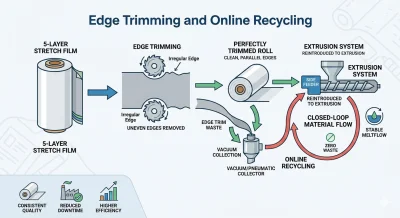
We built precision edge trimming directly into the stretch film making machine rather than treating it as a separate finishing step. Adjustable rotary blades sit ahead of the nip rollers and trim the film edge continuously as it moves through the line, holding width tolerance tight enough that the roll edges stay clean and parallel from the first meter to the last. That consistency is what keeps winding stable at high speed — rolls build evenly, tension stays where it should, and the telescoping and edge deformation issues that plague older lines simply don't have a chance to start. For beverage pallet applications, this translates into wrap tension that stays even around the whole load; for e-commerce wrapping lines, it means an edge clean enough for automatic equipment to track without hesitation.
The trim doesn't just disappear once it's cut, either. A vacuum-driven pneumatic system pulls the hot edge trim away the instant it's cut and feeds it back into the extrusion system, either through the main extruder or a dedicated side feeder, while the material is still molten or semi-molten. Because the trim never fully cools down, it can be reintroduced into the melt stream without the quality loss that comes from reheating cold scrap, and the multi-layer structure stays consistent layer by layer. That matters most in industrial packaging, where puncture and tensile performance can't afford to dip just because part of the film is made from recycled edge material — with this closed-loop approach, the recycled content performs the same as virgin resin in the finished roll.
The Practical Payoff of a Closed-Loop Edge System
Put trimming and recycling together and the effect on the production floor is cumulative. Edge trim waste drops close to zero because material that used to go into a scrap bin now goes straight back into the product. Operators spend less time on manual cleanup and edge adjustment, which means fewer unplanned stops and a line that can run longer between interventions. Roll quality becomes far more predictable, too — when every roll comes off the winder with the same clean, parallel edges, downstream customers see fewer complaints about telescoping, misfeeds, or torn film during application.
For us, that reliability is really the point of building edge trimming and online recycling into the stretch film making machine in the first place. It's not just about cutting a straighter edge or saving a percentage of raw material, though both of those matter to the bottom line. It's about giving customers in beverage, logistics, and industrial packaging a film that behaves the same way roll after roll, on their equipment, at their line speed. A stretch film making machine that handles its own edge trim and feeds it straight back into production isn't just more efficient to run — it's a more dependable partner on the packaging line, which is ultimately what high-speed operations are looking for when they choose their equipment.