Solving Gel and "Fish Eye" Issues in Stretch Film Extrusion Machine Production
2026-08-18
In high-performance stretch film production, gel particles and fish eye defects are among the most common and challenging surface quality problems faced by manufacturers. These microscopic imperfections may appear as small transparent spots, cloudy areas, or irregular formations on the film surface, but their impact on product performance can be significant. For industrial packaging applications that require high transparency, stable stretching performance, and reliable load protection, controlling gel and fish eye defects has become a key priority in modern film manufacturing.
During the extrusion process, these defects are usually caused by multiple factors, including incomplete resin melting, polymer degradation, contamination from raw materials or equipment, and poor dispersion of additives. Traditional extrusion systems with unstable temperature control or insufficient filtration capability may struggle to maintain consistent melt quality, resulting in defects that reduce film appearance, mechanical strength, and customer acceptance.
As global demand continues to increase for high-performance packaging materials, manufacturers require more advanced production technology to achieve cleaner melt processing and higher film consistency. A modern stretch film extrusion machine is designed not only to increase production capacity but also to solve complex material processing challenges through precise thermal control, optimized screw design, advanced filtration, and intelligent process management.
The Importance of Defect-Free Stretch Film in Industrial Applications
Stretch film is widely used in logistics, warehouse operations, export packaging, food packaging, agricultural applications, and automated wrapping systems. Industrial users expect stretch film to provide excellent tensile strength, reliable puncture resistance, stable cling performance, and outstanding optical clarity.
For automatic packaging lines, surface quality is especially important. Even small gel particles or fish eyes can create weak points within the film structure. These areas may become stress concentration points during stretching, increasing the possibility of film tearing or inconsistent wrapping performance.
In addition to affecting mechanical properties, visible defects can reduce product value in markets where transparency and appearance are critical. For example, manufacturers producing high-clarity stretch film for food packaging or premium industrial applications require a smooth and uniform film surface without noticeable imperfections.
Therefore, producing high-quality stretch film requires precise control of the entire extrusion process. From resin feeding and melting to filtration and winding, every stage must maintain stable conditions. Advanced stretch film extrusion machine technology provides manufacturers with the necessary control capabilities to reduce defects and improve production efficiency.
Precise Thermal Management to Prevent Polymer Degradation
One of the major causes of gel formation is polymer degradation caused by excessive heat exposure or unstable temperature conditions. When resin remains at high temperatures for too long, molecular chains may begin to break down, creating degraded materials that appear as gel particles in the finished film.
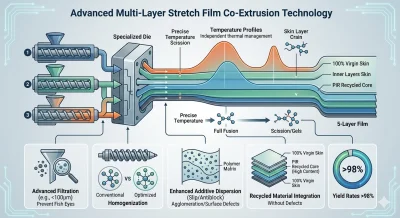
A professional stretch film extrusion machine uses advanced thermal management systems to maintain accurate temperature control throughout the extrusion process. Independent heating zones in the barrel allow operators to precisely regulate each processing section, ensuring that resin is melted efficiently without unnecessary thermal stress.
The screw and barrel design also play an important role in maintaining stable melt conditions. Optimized melting zones provide sufficient energy for complete resin fusion while avoiding excessive shear heating. This balanced approach helps protect polymer properties and reduces the possibility of degradation-related defects.
For multi-layer stretch film production, independent layer control provides additional advantages. Different materials, including virgin resin, metallocene polyethylene, and recycled materials, may have different processing requirements. A well-designed extrusion system allows each layer to be processed under suitable conditions, ensuring proper bonding and uniform film quality.
Advanced Filtration and Homogeneous Melting Technology
Incomplete melting and foreign particles are common sources of fish eye defects. During resin processing, small unmelted particles or contaminants may remain inside the melt and become visible after film formation. To prevent these problems, advanced filtration technology is an essential component of modern stretch film production.
High-performance stretch film extrusion machine systems are equipped with efficient melt filtration devices designed to remove impurities before the polymer reaches the die. Fine filtration systems using appropriate filter screens can effectively capture small contaminants while maintaining stable melt pressure during continuous production.
Automatic screen changers further improve production reliability by allowing filter replacement without significant production interruption. This reduces downtime and ensures consistent melt cleanliness throughout long production runs.
In addition to filtration, screw geometry has a direct influence on melt quality. Barrier screw designs improve resin melting efficiency by separating solid and molten materials during processing. This creates more uniform melting behavior and enhances additive dispersion throughout the polymer.
A well-designed screw system helps achieve complete resin melting and stable material mixing, reducing the risk of unmelted particles becoming visible defects in the final film. This is especially important when processing high-performance resins with specific flow characteristics.
Improving Material Dispersion and Supporting Sustainable Film Production
Modern stretch film manufacturers are increasingly focusing on sustainable production by incorporating recycled materials into film structures. However, recycled resin often contains more variations compared with virgin materials, making dispersion control more challenging.
Advanced stretch film extrusion machine technology provides better mixing capability to support the use of recycled materials while maintaining film quality. Multi-layer extrusion designs allow manufacturers to place recycled materials in inner layers while maintaining high-quality virgin resin on the outer surfaces.
This structure provides a balance between environmental responsibility and premium product performance. Proper material distribution prevents excessive concentration of additives or recycled particles, reducing the possibility of surface defects.
Additive dispersion is another important factor affecting film appearance. Slip agents and antiblock additives are commonly used to improve film handling and reduce blocking during storage. However, poor dispersion may cause additive aggregation, leading to visible defects or inconsistent surface properties.
Precise mixing technology ensures these additives are distributed evenly throughout the polymer matrix, improving film performance while maintaining a clean and uniform appearance.
Intelligent Control Systems for Stable Production Quality
Modern film production depends increasingly on automation and real-time monitoring. Advanced stretch film extrusion machine systems integrate intelligent control technologies to help operators maintain stable production conditions and quickly identify potential quality issues.
Automatic pressure monitoring, temperature feedback systems, and PLC-based control platforms allow manufacturers to monitor critical processing parameters throughout operation. When abnormal conditions occur, operators can adjust production settings before defects affect large quantities of finished film.
Remote diagnostic functions also improve equipment maintenance efficiency by helping technical teams analyze operating conditions and provide support. This reduces unexpected downtime and improves overall production reliability.
Through the combination of precision mechanical design, advanced material processing, and intelligent automation, manufacturers can achieve higher production consistency and reduce waste caused by quality defects.
Achieving Higher Yield with Reliable Stretch Film Production Technology
Reducing gel and fish eye defects is not achieved through a single component improvement. It requires a complete production strategy that combines accurate temperature management, efficient filtration, optimized screw design, stable material dispersion, and intelligent process control.
With advanced extrusion technology, manufacturers can significantly improve film consistency and production efficiency. Optimized melt flow design and precise processing control allow modern production lines to achieve excellent product quality with stable output rates. Under proper operating conditions, well-designed systems can help manufacturers maintain high production yields while minimizing material waste.
For companies competing in international packaging markets, producing defect-free stretch film provides a strong advantage. Higher transparency, better mechanical performance, and consistent roll quality help manufacturers meet increasingly strict customer requirements.
Upgrade Your Production with Advanced Stretch Film Extrusion Machine Solutions
Solving gel and fish eye problems requires equipment that understands the complexity of polymer processing. Our stretch film extrusion machine solutions integrate advanced filtration systems, precision melting technology, multi-layer extrusion capabilities, and intelligent control systems to help manufacturers produce cleaner, stronger, and more reliable stretch film.
Whether producing two-layer, three-layer, or five-layer stretch film, our equipment is designed to provide stable operation and consistent film quality for different market applications. By combining engineering expertise with practical production experience, we help customers reduce defects, improve efficiency, and achieve long-term manufacturing value.
Contact our technical team to explore customized solutions for your stretch film production requirements and build a more competitive packaging film manufacturing system with advanced extrusion technology.