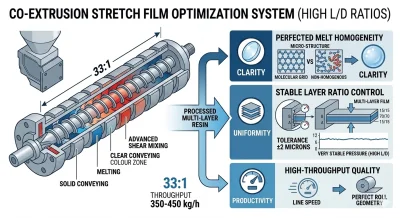
Stretch film clarity is an important quality characteristic for packaging applications where product visibility, label recognition, and overall film appearance matter. As manufacturers increasingly produce thinner and multi-layer stretch films, maintaining consistent optical quality requires careful control of the entire extrusion process.
The screw length-to-diameter ratio, commonly expressed as L/D ratio, is one of the important design parameters of a stretch film making machine. It influences the available processing length for melting, conveying, and mixing polymer materials. However, L/D ratio does not determine film clarity on its own. Resin selection, screw geometry, processing temperature, melt pressure, feedblock design, T-die performance, cooling conditions, and film thickness can all affect the final optical properties of stretch film.
Why Stretch Film Clarity Matters in Modern Packaging
Stretch film is widely used for pallet stabilization, warehouse packaging, transportation protection, and load consolidation. In many of these applications, transparent film allows operators to see the packaged goods without removing the wrapping. This can be useful for identifying products, checking packaging condition, and locating labels or other visible information.
For retail and logistics packaging, consistent transparency also contributes to a cleaner package appearance. In industrial packaging, film clarity can make it easier to inspect the wrapped load during storage and transportation.
However, optical clarity must be considered together with mechanical performance. A stretch film used for pallet wrapping may also need sufficient tensile strength, puncture resistance, elongation, and cling. This is one reason why multi-layer extrusion has become an important production approach: different layers can be designed to contribute different properties rather than requiring one material to provide every function.
What Can Happen When Extrusion Conditions Are Not Properly Matched?
A stretch film extrusion process requires sufficient melting and mixing of the polymer before the material reaches the feedblock and die. If the screw configuration or operating conditions are not well matched to the resin and output requirements, melt quality may become less consistent.
Insufficient plasticization or mixing can contribute to visible film defects and variations in appearance. Poor additive dispersion may also affect surface properties or create localized differences in the film. In addition, gels, unmelted particles, contamination, and thermal degradation can influence film appearance and should not be attributed to screw L/D ratio alone.
For multi-layer stretch film, the situation can be more complex because different resins may be processed simultaneously. Each material has its own melting behavior and processing characteristics, so independent extrusion control and appropriate screw design become important for maintaining stable melt conditions.
How Screw L/D Ratio Influences the Extrusion Process
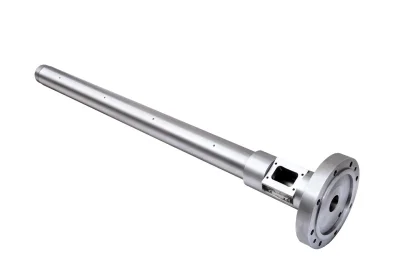
The L/D ratio describes the relationship between screw length and screw diameter. A longer screw provides a greater processing path within the extruder, giving the polymer more opportunity to pass through different sections designed for conveying, melting, and mixing.
For stretch film production, an appropriate L/D ratio can support stable plasticization and melt conveying when combined with suitable screw geometry and operating conditions. The actual result depends on the material being processed and the design of the screw, including its compression and mixing sections.
A longer screw should not automatically be considered better. Excessive residence time or unsuitable processing conditions can create other challenges, particularly for temperature-sensitive materials. The objective is to establish an extrusion system in which the screw geometry, L/D ratio, temperature profile, screw speed, and output are properly matched. The L/D ratio should be evaluated as part of the overall extrusion design rather than as an isolated indicator of machine quality.
Melt Homogeneity and Its Relationship with Film Clarity
Before stretch film reaches the T-die, the polymer should be converted into a stable and sufficiently homogeneous melt. Consistent melting and mixing help provide more uniform material distribution across the film structure.
For a multi-layer stretch film making machine, this process begins with the individual extrusion units. Different materials can be processed under their respective conditions before being combined through the co-extrusion feedblock. This approach provides greater control over the characteristics of each layer.
A well-designed screw system can therefore contribute to more stable melt conditions, while the feedblock and T-die determine how that melt is distributed and formed into the final film. The connection is important: good screw performance alone cannot compensate for an unsuitable feedblock or die design.
Screw Design and Multi-Layer Stretch Film Production
Three-layer, five-layer, and other multi-layer stretch films are designed to combine different functional properties within one film structure. Depending on the formulation, outer layers may contribute to cling and surface characteristics, while core layers can contribute significantly to tensile and puncture performance.
Our stretch film making machine can be configured with independent extrusion systems so that different resin formulations can be processed according to their respective requirements. Independent temperature and speed adjustment provides greater flexibility when developing film structures with different layer ratios and material combinations.
The screw L/D ratio works together with these controls. A suitable processing length provides the conditions required for melting and mixing, while independent extrusion control allows operators to manage each material according to its processing window. This coordinated approach is more meaningful than simply increasing screw length without considering the material formulation.
T-Die and Cooling Conditions Also Affect Film Clarity
After the polymer melts have been combined, the T-die becomes critical to film formation. The die must distribute the melt consistently across the film width so that the finished film maintains a stable thickness profile.
Thickness variation can affect both mechanical performance and visual appearance. Localized differences in film thickness may become more noticeable when producing thin-gauge stretch film, making die precision and process stability particularly important.
Cooling conditions are another part of the optical-quality equation. The rate and uniformity of cooling influence how the polymer solidifies and, depending on the resin system, can affect the final optical characteristics of the film. For this reason, our stretch film making machine integrates extrusion, film forming, and cooling considerations rather than treating clarity as a function of screw design alone.
Applications Where Film Clarity Provides Practical Value
In pallet and logistics packaging, transparent stretch film allows operators to identify the contents and inspect the condition of wrapped loads. Stable film quality is particularly useful when rolls are used on automatic or semi-automatic wrapping equipment.
For food and beverage distribution, clear film can make packaged products and external labels easier to identify during storage and handling. The film must still provide sufficient mechanical strength and load stability for transportation.
In electronics and industrial component packaging, transparency can help operators identify products, labels, and packaging conditions without removing the protective film. For these applications, optical quality is one part of a broader requirement that may also include protection from dust and moisture and reliable load stabilization.
Designing a Stretch Film Making Machine for Consistent Film Quality
A properly engineered stretch film making machine needs to balance several interconnected systems. The screw and L/D ratio influence melting and mixing, while temperature control determines whether the polymer is processed within a suitable thermal range. The feedblock controls the multi-layer melt arrangement, and the T-die determines the final film profile. Cooling and winding then influence the stability and usability of the finished film roll.
Our machine is designed around this integrated approach. Rather than relying on a single specification to define film quality, the extrusion system combines controlled plasticization, multi-layer melt distribution, precision film forming, and process monitoring. This provides manufacturers with a more practical foundation for producing stretch film with consistent thickness and appearance.