How Stretch Film Extrusion Machine Improve Film Transparency
2026-09-04
Transparency is one of the fastest ways to judge the quality of a stretch film without ever touching it. A hazy, cloudy roll signals uneven melting, poor cooling control, or a worn die lip long before it fails a puncture test. For pallet wrapping, food-grade packaging, and e-commerce logistics, optical clarity is not a cosmetic detail — it is a direct indicator of polymer purity, process stability, and the precision of the stretch film extrusion machine that produced the roll.
Buyers rarely think about extrusion mechanics when they unroll a pallet wrap, but the difference between a glass-clear film and a dull, milky one is decided entirely inside the machine — long before the roll ever reaches a warehouse. Melt temperature control, cooling rate, and die geometry all leave a visible fingerprint on the finished film, which is why two rolls made from the same resin formulation can still look completely different depending on the equipment that produced them.
Why Ordinary Equipment Struggles to Produce Clear Film
Most haze problems trace back to a handful of mechanical weaknesses that are common in older or lower-cost production lines. When a screw cannot generate consistent shear across the barrel, small pockets of unmelted resin — often called "unmelts" — pass straight through into the film, scattering light and creating visible specks or cloudy patches. Temperature fluctuations along the barrel make this worse, since uneven heating produces gels and inconsistent melt viscosity that never fully disappear downstream.
Cooling speed is just as critical. When a chill roll cannot pull heat away from the molten web fast enough, the polymer has more time to crystallize before it solidifies. Slower cooling allows spherulites — the crystalline structures that scatter light and cause visible cloudiness — to grow larger, which is one of the most common reasons stretch film looks dull instead of glossy.
Surface haze adds a third layer of difficulty. A die lip that cannot maintain a perfectly uniform gap across the web width will produce gauge variation, edge-bead buildup, or resin accumulation at the lip itself. Any of these defects roughens the film surface and undermines the smooth, glass-like finish that high-clarity applications demand. Add an unstable melt flow — turbulence in the melt bank, uneven distribution across the die — and even a well-formulated resin can come out looking inconsistent from one meter of film to the next.
On older lines, these three problems tend to compound rather than stay isolated. A screw that generates uneven shear also makes it harder for the downstream cooling system to work with a predictable melt temperature, and a die that is already struggling with gauge variation will show that inconsistency even more clearly once the film has extra haze layered on top of it from poor quenching. This is why operators on legacy equipment often describe clarity as unpredictable from batch to batch, even when the resin, additive package, and line settings stay the same — the root cause usually sits in the mechanical precision of the extruder itself, not the formulation.
Where Clarity Actually Matters on the Production Floor
These issues are not abstract. In food and pharmaceutical pallet packaging, warehouse staff need to read labels, lot numbers, and expiry dates straight through the wrap without unwrapping a single layer — a hazy film means slower inspection and more manual double-checking, and in regulated environments it can even slow down compliance audits where batch traceability has to be confirmed visually. In high-volume e-commerce fulfillment, sorting teams rely on being able to see the contents of a pallet at a glance, so cloudy or streaky film directly slows down quality checks and increases the chance of a picking error during peak-season volume spikes when speed matters most.
Retail and FMCG distribution have their own version of the same problem: stretch film wrapped around a display pallet is supposed to be nearly invisible, and any haze or dullness can affect how the product looks to a buyer before it ever reaches the shelf. In each of these cases, the film itself is doing double duty — protecting the load mechanically while staying optically out of the way — and that second requirement is exactly where a poorly engineered extrusion process starts to show its limitations.
Engineering Clarity Into Every Layer
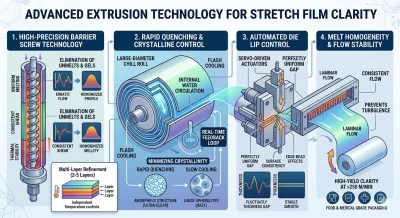
A stretch film extrusion machine built for optical performance addresses each of these failure points directly, starting with the screw. High-precision barrier screw geometry generates uniform shear across the full length of the barrel, which keeps the melt homogeneous and eliminates the unmelted particles that cause internal haze. On two-layer, three-layer, and high-speed multi-layer configurations, each layer can be temperature-controlled independently, so the outer clarity layer and the inner cling or strength layer are both processed at their optimal melt profile rather than a single compromise setting.
Cooling comes next, and this is where line speed and clarity intersect most directly. Large-diameter chill rolls with optimized internal water circulation pull heat out of the web fast enough to limit spherulite growth before it can scatter light, which is the mechanism behind a true flash-cooling effect. On multi-layer lines, precise cooling temperature management also prevents stress marks from forming as the film solidifies, and on fully automatic winding systems, real-time feedback loops continuously adjust coolant flow so clarity stays consistent even as production speed increases.
Surface quality is finished at the die. Servo-driven die lip actuators hold a uniform gap across the entire web width, which prevents the edge-bead effects and lip buildup that roughen the film surface over a production run. Combined with a die and flow-channel design engineered to keep the melt bank moving without turbulence, this keeps thickness and clarity stable from the first meter of a roll to the last — a difference that becomes obvious once line speeds climb past 250 meters per minute, where any inconsistency in melting, cooling, or die control shows up immediately in the finished film.
None of these systems works in isolation, which is part of why clarity is such a reliable indicator of overall machine quality. A screw that produces a homogeneous melt still needs a cooling system capable of locking that clarity in before crystallization can undo it, and a chill roll running at the correct temperature still needs a die that delivers a uniform, turbulence-free melt stream across the full web width. When barrier screw extrusion, rapid chill roll quenching, and automated die lip control are engineered together as a single system rather than as separate components bolted onto a line, the result is a stretch film extrusion machine that can hold high-clarity output consistently, roll after roll, rather than only under ideal conditions.
Built for the Clarity Modern Packaging Demands
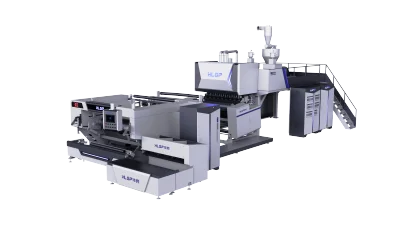
Every one of these systems — barrier screw extrusion, rapid chill roll quenching, and servo-controlled die lip adjustment — is engineered to work together rather than in isolation, because clarity is never the product of a single component. Our stretch film extrusion machines are designed around this principle from the ground up, with nitrided alloy steel screw and barrel components, closed-loop water cooling, and precision die control built into two-layer, three-layer, and high-speed multi-layer configurations alike.
Each configuration is sized for the output a specific application actually needs, from compact two-layer lines suited to smaller or mid-volume operations up through high-speed multi-layer systems capable of running well above 200 meters per minute without sacrificing optical quality. Independent temperature zoning across each layer, real-time coolant feedback on fully automatic models, and servo-adjusted die lips work together to keep thickness tolerance and clarity consistent across an entire production run, not just in the first few rolls off the line.
Whether the application calls for food-grade pallet wrapping, high-speed e-commerce packaging lines, or retail-ready display loads, our machines are built to deliver the melt stability, cooling precision, and die accuracy that turn ordinary stretch film into a consistently clear, glass-like finish — production run after production run.