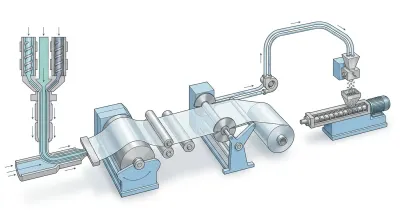
In high-capacity stretch film extrusion, managing edge trim waste is critical to production efficiency. Integrating an inline trim recycling system directly into a stretch film making machine creates a continuous, closed-loop process. This system captures edge scrap as it is produced and re-feeds it into the extruder in real time, significantly changing the dynamics of film production.
Understanding the precise impact of this process on machine performance and final film quality is essential for optimizing multi-layer extrusion lines, including 2-layer stretch film machines, 3-layer stretch film machines, and 5-layer stretch film machines.
Technical Mechanics of Inline Trim Extrusion
The integration of direct edge trim recycling modifies the thermal and mechanical behavior inside the extruder. When edge trims are re-fed into a fully automatic stretch film machine or semi-automatic stretch film machine, the recycled polymer undergoes a secondary heat history.
- Melt Viscosity Control: Introducing recycled content alters the overall melt flow index (MFI). Advanced extrusion control systems stabilize this by monitoring real-time pressure and adjusting barrel temperatures.
- Layer Uniformity: In complex multi-layer configurations, such as a 5-layer stretch film machine, the recycled material is typically directed to the core layers. This localized feeding prevents surface defects and maintains consistent gauge control across the entire film width.
- Continuous Feed Stabilization: The automated edge trim system ensures a steady volumetric feed rate, eliminating the pressure fluctuations often caused by manual scrap re-feeding.
Impact on Physical Film Properties
A primary engineering concern with inline recycling is its effect on the physical performance of the finished stretch wrap. When properly calibrated, a modern stretch film making machine maintains the structural integrity of the film with negligible loss in performance.
- Tensile Strength and Elongation: Precise formulation protocols balance the ratio of recycled trim with virgin resin. This ensures the film retains its high stretchability and load-retention capabilities without premature tearing.
- Tear and Puncture Resistance: By optimizing screw design and melt homogenization, the recycled blend distributes evenly, keeping the impact on tear properties under 5%.
- Optical Clarity: Advanced filtration and melt blending prevent degradation, ensuring that even with recycled content, the film preserves excellent transparency and gloss.
Maximizing Extrusion Line Efficiency
Implementing inline trim recycling directly enhances the operational parameters of both fully automatic and semi-automatic systems.
- Raw Material Yield: Reclaiming edge scrap immediately increases the material yield rate to over 98%, drastically reducing unrecoverable industrial waste.
- Thermal Efficiency: Re-feeding warm edge trim utilizes residual heat, reducing the total energy required to melt the polymer blend compared to processing cold, pelletized scrap.
- Reduced Downtime: Eliminating external roll winding and offline pelletizing processes simplifies the production floor, resulting in seamless, 24/7 continuous extrusion operation.