How Stretch Film Extrusion Machine Affect Stretch Ratio: Key Technical Factors
2026-09-02
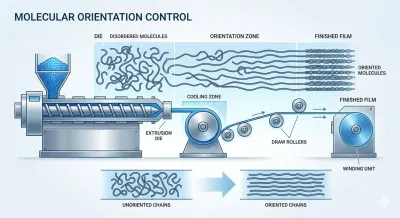
Stretch ratio is one of the most decisive performance indicators in industrial wrapping film, yet it is also one of the most frequently mismanaged. A film that stretches too little cannot deliver adequate load retention, while a film that stretches unevenly leaves pallets vulnerable to shifting, puncture, and collapse during transit. The root cause of these problems almost always traces back to the extrusion process itself — and specifically, to how a stretch film extrusion machine manages molecular orientation from melt to finished roll.
Why Traditional Extrusion Setups Struggle With Stretch Ratio Consistency
Older or lower-precision production lines tend to treat screw speed and line speed as loosely coordinated settings rather than a tightly synchronized system. When these two speeds drift out of alignment, the draw-down ratio becomes unstable, and the film comes off the line with inconsistent gauge and unpredictable elongation behavior. Operators are often left manually nudging parameters to compensate, which is slow, imprecise, and difficult to repeat run after run.
Temperature control presents a similar challenge. On machines without independently regulated heating zones, melt viscosity fluctuates as the polymer moves through the barrel and die. Small variations in viscosity translate directly into uneven molecular alignment, producing localized weak spots that fail under tension long before the rest of the film reaches its stretch limit. Cooling adds another layer of risk: if the chill roll cannot pull heat away from the film quickly and evenly, the molecular orientation set during stretching never fully locks in place, leaving the finished roll brittle in some areas and overly soft in others.
The cumulative effect of these shortcomings is a film that behaves inconsistently on the pallet — sometimes overstretching and tearing, sometimes failing to stretch enough to hold a load securely.
Where Stretch Ratio Performance Actually Matters on the Ground
These technical shortcomings are not abstract. They show up directly in day-to-day packaging operations across very different industries.
In metal profile and pipe bundling, loads often have sharp edges and irregular cross-sections. A film with an unstable stretch ratio applies uneven tension around these shapes, leading to loose sections that allow bundles to shift or, in tighter spots, localized overstretching that tears the film against a sharp edge. Either failure mode compromises load security during transport.
Carton and paper roll pallet packaging depends on the film applying steady, moderate tension across a relatively soft and crushable surface. When stretch ratio varies from wrap to wrap, some layers apply too much pressure and deform the product underneath, while others apply too little and fail to keep the stack stable. The result is either product damage or load looseness — both costly outcomes for high-volume shippers.
High-speed automatic wrapping lines are perhaps the most sensitive to stretch ratio instability. These systems are calibrated to a specific film elongation and tension profile, and any inconsistency coming out of the extrusion process forces frequent manual recalibration on the wrapping line itself. That downtime adds up quickly in operations running continuous shifts, cutting directly into throughput.
Engineering Precise Molecular Orientation Into the Extrusion Process
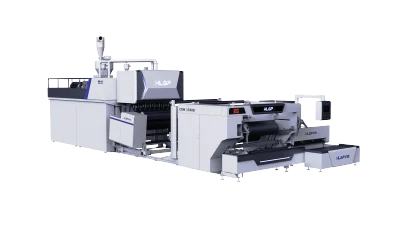
A well-engineered stretch film extrusion machine addresses stretch ratio instability at its source, starting with synchronized control of screw speed and line speed. By coordinating these two variables in real time, the draw-down ratio stays within a tight, predictable range throughout the run. On production lines capable of line speeds up to 250 meters per minute, this synchronization is what keeps molecular orientation consistent even as output scales up — the film stretches the same way at the beginning of a roll as it does near the end.
Temperature management plays an equally central role. Independent control across each heating zone keeps melt viscosity stable from the hopper through the die, which allows polymer chains to align uniformly rather than in the uneven patches that show up when temperature drifts. This stability is what prevents the weak spots and inconsistent elongation behavior that plague less controlled systems.
Cooling performance is the final piece of the puzzle. A circulating water chill roll system removes heat from the film immediately after extrusion, locking in molecular orientation before it has a chance to relax or distort. Fast, even cooling improves surface quality, supports dimensional stability, and preserves the elasticity that was built into the film during stretching — properties that are especially important when the film needs to recover and cling tightly around irregular loads.
Underpinning all of this is the mechanical integrity of the extrusion system itself. Screws and barrels constructed from nitrided 38CrMoAlA alloy steel maintain dimensional accuracy and wear resistance over long production runs, which keeps output steady and prevents the gradual drift in melt flow that can quietly undermine draw-down control over time. Combined with a precision die assembly, cross-web thickness variation can be held within roughly three percent of target — a tolerance tight enough to keep stretch ratio uniform across the full width of the film, not just down its length.
Turning Precise Stretch Ratio Control Into Real Packaging Performance
When screw speed, line speed, temperature, and cooling are all working in coordination rather than independently, the practical benefits show up immediately in the field. On metal profile and pipe bundling lines, this level of control produces film that applies even tension around irregular shapes, reducing both loosening and edge tears. For carton and paper roll pallet packaging, consistent stretch ratio means the film applies steady, predictable pressure across every layer, protecting product integrity while still keeping the load tightly secured. On high-speed automatic wrapping lines, film with stable, repeatable elongation behavior reduces the need for constant tension recalibration, helping keep throughput high and unplanned stops to a minimum.
This is the deeper value behind our stretch film extrusion machines — it is not simply about producing film faster, but about producing film whose stretch behavior can be trusted, wrap after wrap, roll after roll. We build synchronized speed control, zone-specific temperature regulation, rapid chill roll cooling, and durable alloy screw and barrel construction into every line, so stretch ratio stays consistent under real production conditions. For operations where load security, material efficiency, and line uptime are all on the line, that consistency is what our stretch film extrusion machines are engineered to deliver, run after run.